
EDITORIAL RESEARCH / PRACTICAL GUIDE · ECOM RATINGS
A practical guide to Sellvia Mall’s 7-day trial, five included downloads, purchase-only exclusions, AI tokens, billing timing, and cancellation rules.
Editorial research · Sources checked October 28, 2026 · Documentation-based guide
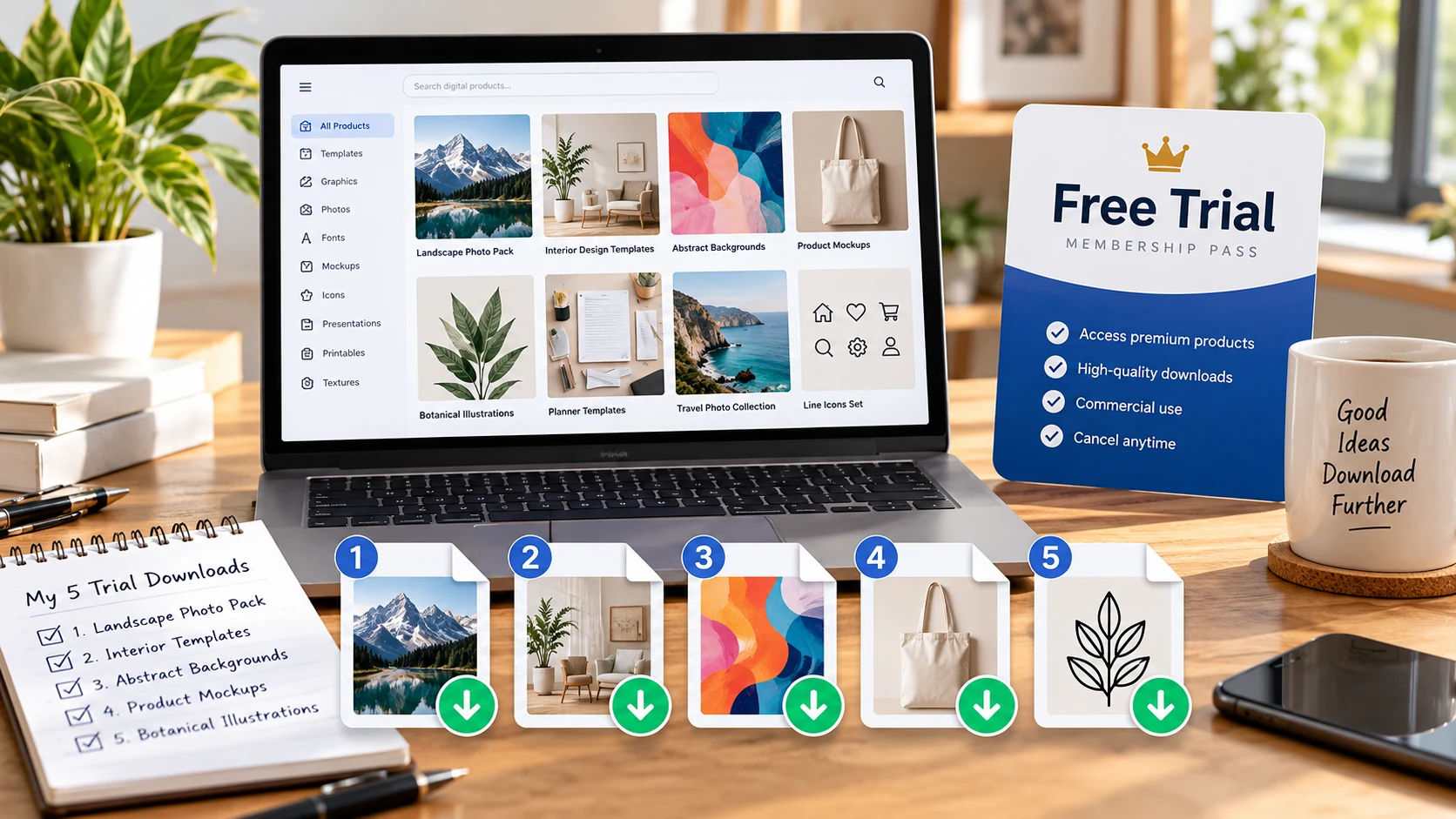
The core issue: The Sellvia Mall trial is simple only if you separate four different things: access to the catalog, the five downloadable items included during the free week, the 100 welcome AI tokens added to the account, and purchase-only products that sit outside the trial entirely.
The trial is a membership preview, not unlimited free shopping
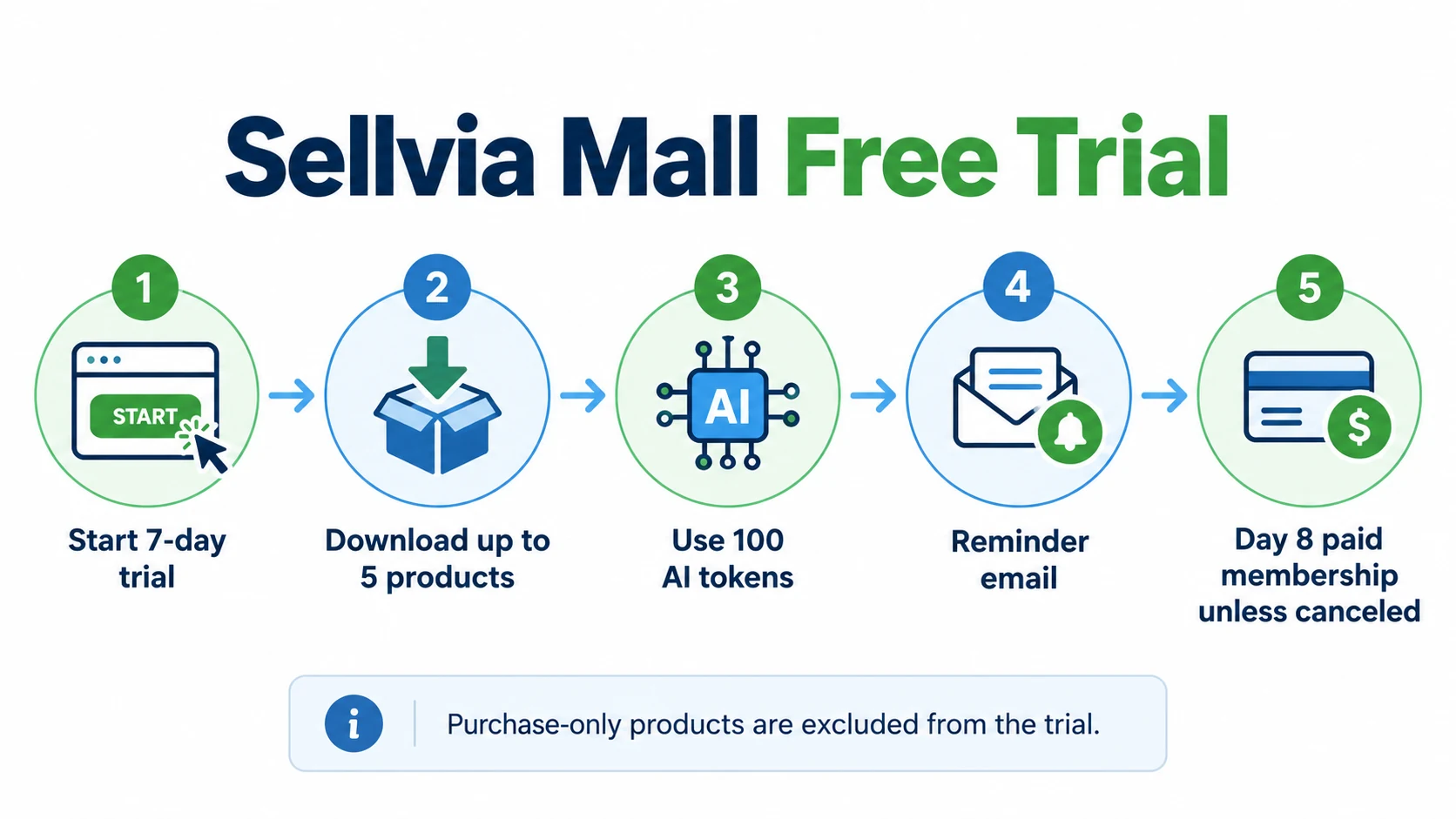
Sellvia Mall’s Infinity Pass begins with a 7-day free trial. During that period, a valid payment method is required, but no charge is taken if the customer cancels before the trial ends. The trial is designed as a meaningful preview rather than as an unrestricted free-access window. According to the current terms, trial users can browse the full catalog, download up to five included products free of charge, and receive a welcome bonus of 100 AI tokens.
That combination is important because it means the trial is not only about static downloads. It also lets the user test the part of the service that uses tokens for generated outputs. At the same time, the trial is not the same as a paid Infinity Pass. The terms draw a clear line between included catalog items and a separate class of purchase-only products that are excluded from the trial.
This structure solves a commercial problem for the platform: it allows real testing without turning the free week into a way to collect unlimited files. For users, the practical question becomes: what exactly counts against the five-product limit, what does not, and what remains available after cancellation? Those answers are straightforward once the different product types are separated.
The best way to think about the trial is as a controlled sample of the membership. You are not simply opening an account; you are testing how the catalog, downloads, account area, token system, and membership renewal work together.
What the five-product limit actually applies to
The five-product limit applies to downloads from the included catalog during the seven-day trial period. In practical terms, each trial user can choose up to five qualifying products and keep them. The product may be a template, checklist, guide, course, or other downloadable asset that belongs to the included catalog. The key is that the item must be one of the products made available under the membership itself.
What the five-product limit does not mean is five clicks of any type across the entire platform. Browsing does not consume the allowance. Reading product pages does not consume the allowance. Having a token balance does not reduce the count. The limitation is specifically about included product downloads during the trial phase.
Users should therefore make intentional choices. The trial works best when someone selects products that represent different kinds of value: perhaps one downloadable guide, one practical template, one AI-assisted tool, and one or two assets from the areas they are most likely to use later. That approach gives a more accurate sense of whether the paid membership is worth continuing.
From an editorial perspective, the platform’s rule is clear enough to avoid surprise, but customers still benefit from reading product-page labels carefully. The difference between ‘included in the pass’ and ‘purchase-only’ is operationally more important than the product category itself.
What usually counts as one download slot
In practice, users often want to know whether a ‘download’ means the product itself or every file inside a product. The public terms explain the overall allowance rather than every product-by-product edge case, so the safest interpretation is to treat the product access event as the thing that matters. If a product is offered as one included item and you claim it during the trial, that should be treated as one of the five trial selections.
That means users should not assume they can repeatedly claim many product pages because the files are small or because the product later opens into multiple assets. What matters is whether the product page itself is part of the included catalog and is counted as one selected product during the free week. If anything is unclear, the account area or support response should be treated as more authoritative than guesswork.
This is also why planning matters. Choose products that genuinely represent what you may continue using later, rather than burning a slot on something you opened only because it looked interesting in the moment. The trial is generous enough to test several categories, but not so wide that accidental clicks should be treated casually.
Why purchase-only products are excluded
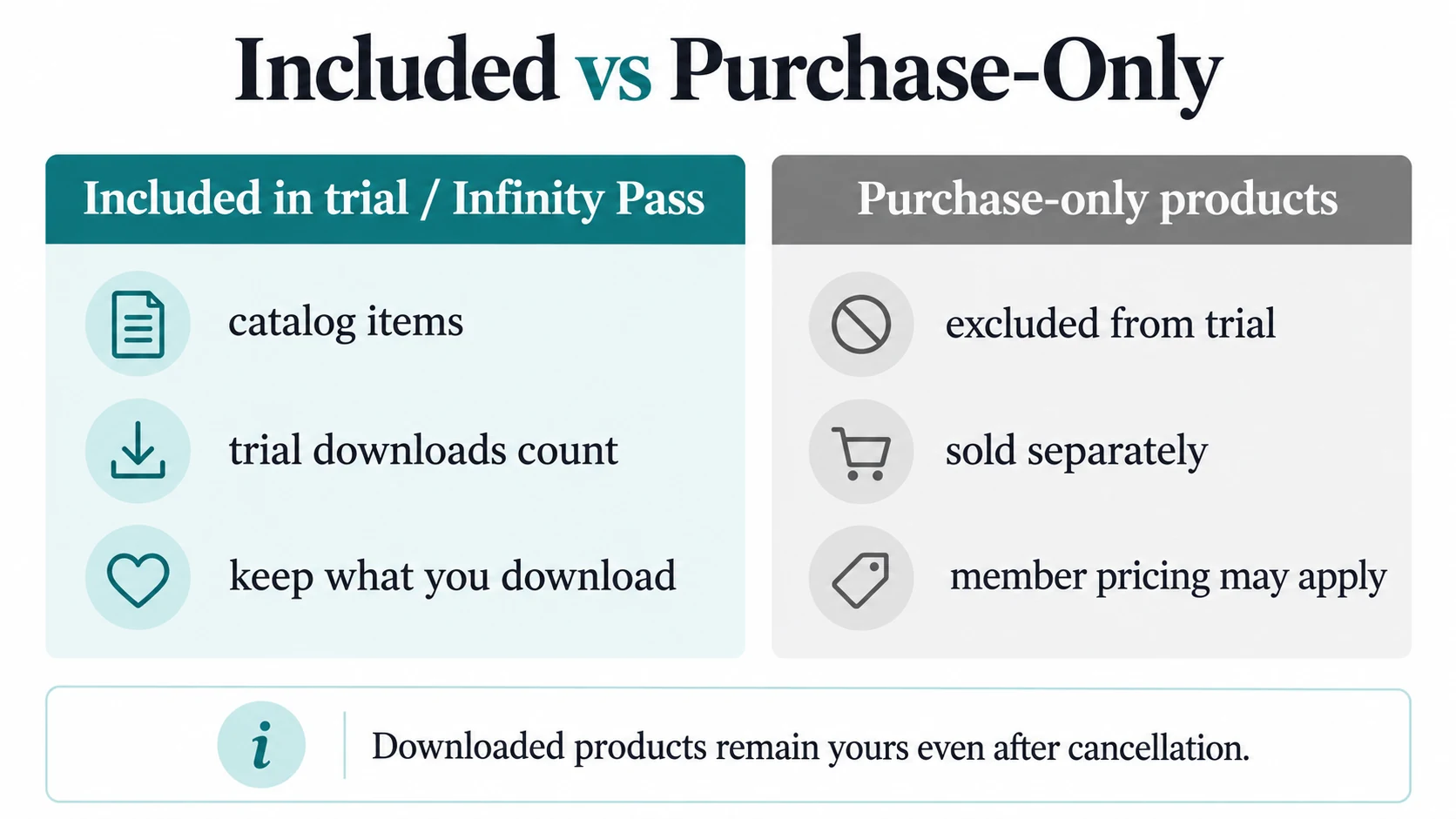
Sellvia Mall’s terms carve out a separate set of purchase-only products. These are positioned as larger or more premium releases that are not part of the trial and not part of the general included catalog. In other words, the five free trial downloads are not a coupon that can be applied to everything on the site. If a product page identifies an item as purchase-only, the trial does not unlock it.
This exclusion matters because it shapes user expectations. Someone may see a high-value product and assume that having started the trial gives them access to it. The current terms say otherwise. Purchase-only products are sold separately. Active members may sometimes receive member pricing on such products, but separate sale status still means the item is not one of the five free trial downloads.
Operationally, this is a useful distinction for users as well. It tells them to evaluate membership value and premium purchase decisions separately. The trial answers the question ‘Do I find the included catalog and token-based features useful?’ It does not answer the question ‘Should I buy a larger standalone release?’ unless the member continues into paid status and considers member pricing later.
A careful trial user should therefore treat product labeling as the decisive signal. The site says it tells users on the product page whether a product is included or purchase-only. That single label determines whether the five-download logic applies.
How the 100 AI tokens fit into the free week
The welcome bonus of 100 AI tokens is separate from the five-download limit. The terms explain that certain digital products generate personalized outputs and that each generation consumes tokens, starting at two tokens per generation, with the cost displayed before use. Downloading a product does not itself consume tokens. That separation is crucial because otherwise users could easily confuse a downloadable item with the dynamic feature that sits inside it.
Think of the trial as containing two allowances. The first allowance is product access: up to five included downloads. The second is interactive usage: a token balance that lets the user run AI-assisted generations. A person could download fewer than five products and still use many tokens. Another user could download five products but use almost none of the tokens. The two meters run independently.
This is a sensible design choice because it gives realistic product testing. Some users care mainly about static resources and may use very few tokens. Others are evaluating the personalized tools, so their real question is whether the AI-generated output is useful enough to justify keeping the membership or buying more tokens later.
Importantly, the current terms say unused tokens remain in the account until used and do not expire at the end of a billing cycle. They also remain in the account after cancellation. That makes the token system materially different from the five-download trial allowance, which is tied to the trial period itself.
What happens on day 8 if you do nothing
If the user does nothing, the trial converts automatically into a paid Infinity Pass on day 8. Sellvia Mall states that it sends a reminder email before the first charge. The card on file is then billed at the current membership price unless the user has cancelled during the trial. This is not an unusual subscription structure, but it is still one of the most important practical points for new users.
The customer should therefore use the free week for two decisions at once. First, decide whether the included catalog and AI features are useful. Second, decide whether the membership is worth continuing on a recurring basis. The trial is not only a chance to collect a few files; it is the evaluation period before the recurring charge begins.
A common misunderstanding in subscription trials is to focus only on what can be downloaded and ignore the renewal decision. Sellvia Mall’s own materials reduce that risk by stating the timeline clearly, but customers still benefit from checking account settings, billing information, and cancellation controls before the end of the seventh day.
For cautious users, a simple habit helps: note the start date immediately, review the reminder email when it arrives, and decide before the final day whether the membership has delivered enough value.
What you keep if you cancel before or after billing
The current terms are user-friendly on one central point: downloads already obtained from the included catalog remain yours to keep even after cancellation. The site says this both for trial conversions and for later membership cancellation. In other words, cancellation stops future catalog access once the active period ends, but it does not erase the products previously downloaded.
That rule applies both to files obtained during the free trial and to files obtained while the membership is active and paid. The member keeps those downloaded products. What stops after cancellation is the ability to continue taking new downloads from the included catalog once access has expired.
The terms also state that unused AI tokens remain in the account after cancellation. That does not mean the user regains catalog membership; it simply means the token balance is not automatically wiped out at the moment of cancellation. Separate refund rules still apply, and tokens are explicitly non-refundable whether they were bonus tokens or purchased top-ups.
Practically, this means users should think in three separate post-cancellation buckets: files already downloaded stay, unused tokens stay in the account, and future included downloads stop once the active membership period is over. That three-part distinction prevents most confusion.
Payment method and cancellation details still matter
Because a valid payment method is required to start the trial, users should also understand the supporting billing mechanics. Sellvia Mall’s payment page says the service accepts major cards, certain digital wallets, and PayPal for one-time secure checkout, while the membership renews using the payment method on file. The site also states that users can change their card in account settings for future renewals.
Why does this matter in an article about five downloads? Because trial clarity depends on billing clarity. A customer should know where the payment method is stored, where cancellation is handled, and what happens if the stored card has changed or expired. The terms and payment page indicate that the company sends a reminder email before the first paid renewal and also communicates if there is a problem with renewal payment. That reduces friction, but it does not remove the user’s responsibility to monitor the account.
The safest routine is simple: confirm the card on file, locate the cancellation controls on day one, and rely on the reminder email as a backup rather than as the only safeguard. That way the five-download trial remains a product-evaluation exercise rather than becoming a billing surprise.
A smart way to use the free week
Because the trial has both a download cap and a token allowance, the smartest approach is to plan it instead of clicking impulsively. Begin by listing the problem types you actually want the service to solve. Do you want practical templates? Research-style guides? Personalized AI tools? A balanced sample is more informative than spending the entire trial on one narrow content type.
Next, check which products are included and which are purchase-only before using any of the five download slots. If the account owner is comparing trial value against a possible paid month, it makes sense to pick products that represent the recurring benefit of the catalog rather than products that are one-off curiosities. Use the 100 tokens on one or two scenarios that matter to you, not just on test prompts with no real decision value.
Finally, document the experience. Keep a quick note of which products were downloaded, which token-based tools were tested, how useful the outputs were, and whether the reminder email and account settings were easy to understand. This turns the trial into a decision file rather than a vague impression.
That matters because the right post-trial choice is not the same for everyone. Some users will see enough value to continue immediately. Others may conclude the five samples were sufficient and cancel before billing. A good trial is one that makes that decision easier.
Questions users should answer before the trial ends
Before the seventh day ends, a user should be able to answer a few concrete questions. Did I understand which products were included and which were excluded? Did I use the five downloads on items I genuinely wanted? Did the token-based products provide useful output? Were there any products I expected to be included but discovered were purchase-only?
The next set of questions is about operational trust. Was billing timing clear? Did I see where to cancel? Did the platform label products and pricing transparently? Did I understand what I would keep if I cancelled? The reason these questions matter is that the platform is selling not only files, but a repeatable membership experience.
If the answers are positive, the trial has done its job. If the user still feels uncertain about what was included, how tokens worked, or what would happen after day 7, the problem is not necessarily the value of the products; it may be a mismatch between the user’s needs and the membership structure.
In short, the free week is successful when the customer ends it with clarity, whether the final decision is to continue or cancel.
Bottom line
The five-product trial limit on Sellvia Mall is easier to manage once the platform is divided into its moving parts. During the seven-day trial, users can browse the full catalog, download up to five included products, and use a welcome bonus of 100 AI tokens. Purchase-only products sit outside that free allowance. If the trial is not cancelled, it becomes a paid Infinity Pass on day 8.
The most useful practical takeaway is that the trial is not one single bucket of value. It is a combined test of catalog access, product labeling, token-based functionality, and billing transparency. Users who understand those layers can make better use of the five downloads and avoid confusion about what stays available after cancellation.
Primary sources and methodology
- Sellvia Mall Terms and Conditions
- Sellvia Mall Infinity Pass
- Sellvia Mall Business Pass FAQ
- Sellvia Mall Payment Methods
- Sellvia Mall Refund Policy
Editorial method: this article uses Sellvia Mall’s published membership, payment, and refund information. The worked interpretations here explain how the free-trial mechanics interact in practice, but users should rely on the current product-page labels and account settings for their own purchases.