
EDITORIAL RESEARCH / PRACTICAL GUIDE · ECOM RATINGS
A practical verification guide for traders who want to understand whether negative balance protection depends on their ActivTrades entity, documents, and client classification.
Editorial research · Sources checked October 28, 2026 · Documentation-based guide

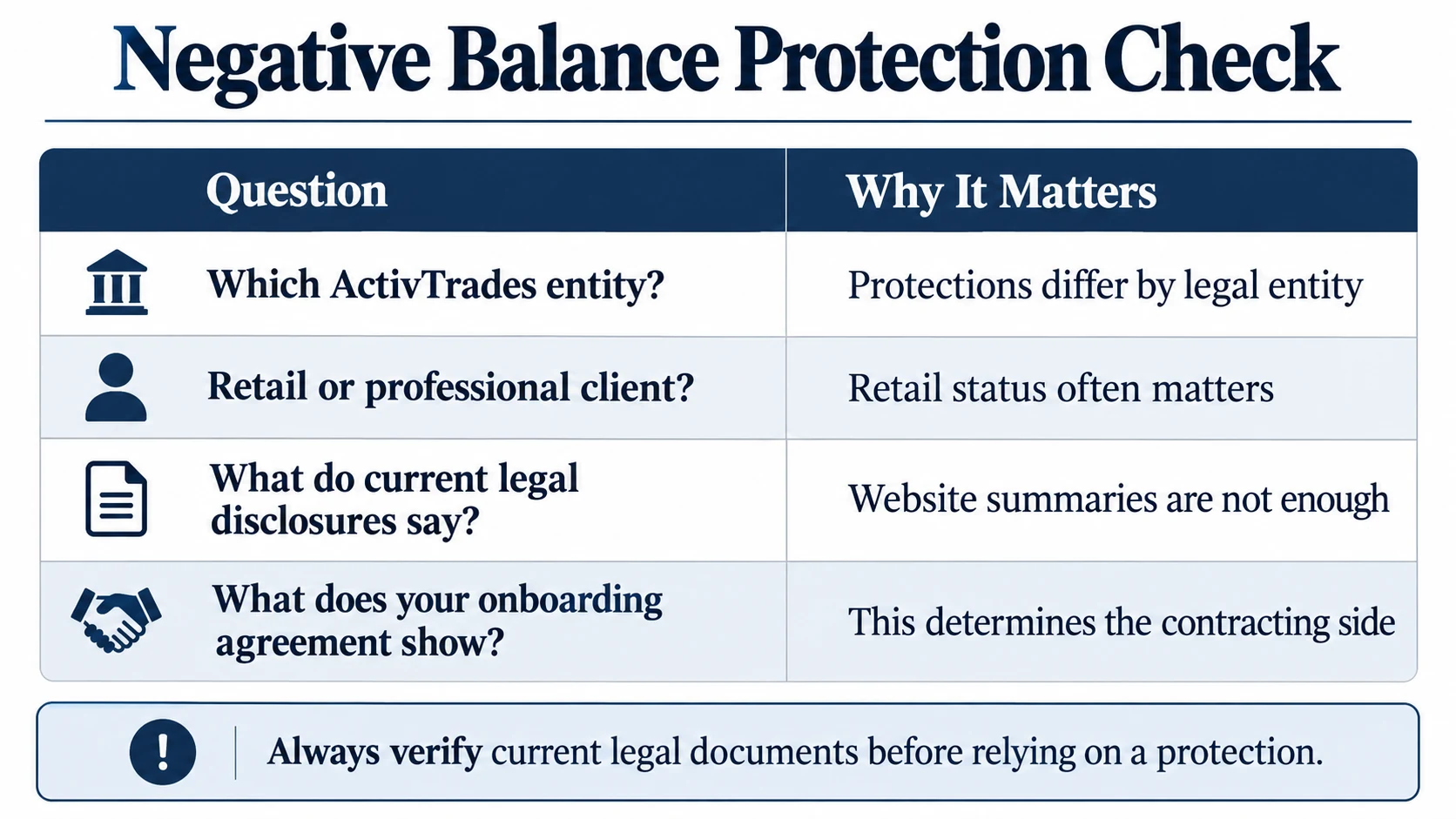
The core issue: ActivTrades uses strong safety language on its website, but the protection a trader can rely on still depends on three things that should be checked together: the legal entity serving the account, the client classification attached to the account, and the current legal documents that govern that specific relationship.
Start with the phrase itself: what negative balance protection means
Negative balance protection is often summarized too casually. In practical terms, it means a client should not be left owing money to the broker after extreme market movement pushes account equity below zero. That sounds simple, but the legal scope can vary. Protection may be framed as a retail-client safeguard, as a contractual commitment on particular account types, or as part of a regulated-entity framework. Those differences matter because website marketing language is never the whole answer.
For ActivTrades, the public site makes two important claims that shape this article. First, marketing pages state that all retail client accounts are protected from negative balances. Second, ActivTrades also promotes a professional account page that references negative balance protection. On the surface this sounds broad, but it still leaves critical follow-up questions. Which ActivTrades company is contracting with the client? Is the trader onboarded as retail or professional? And which current agreement actually governs the account?
Those are not lawyerly technicalities. They determine what evidence a trader can rely on if a dispute arises after an exceptional market event. A user who opens an account through one regional pathway may not be governed by the same disclosures as a user onboarded elsewhere. Client status can also affect the overall bundle of regulatory safeguards even when the platform experience looks identical.
So the right mindset is verification, not assumption. Negative balance protection is most useful when the trader knows exactly where it comes from: a regulator-backed retail framework, a company-specific contractual promise, or a combination of both.
Why the legal entity matters before client status does
ActivTrades operates through multiple legal entities across jurisdictions. Public company information identifies regulated operations connected with the United Kingdom, Portugal, the Bahamas, Mauritius, Brazil, and promotional activity in the UAE. That corporate footprint is common for international brokers, but it means the brand name alone does not tell you which company is on the other side of your account.
The first practical step, then, is not to ask ‘Does ActivTrades offer protection?’ in a generic sense. It is to ask ‘Which ActivTrades entity opened my account and which jurisdiction’s disclosures apply to me?’ A trader in one region may be served by a company subject to one regulatory framework, while another trader sees the same front-end website yet enters a relationship with a different legal entity.
This matters because investor-protection language can be summarized differently across websites, legal notices, and onboarding flows. A short marketing line may say retail clients are protected, but the actual documentation may define terms, exclusions, procedures, or classification consequences more precisely. If a trader does not identify the contracting company, any attempt to verify protection will be incomplete.
A good rule is to capture the legal entity from multiple places: the footer or regulation page, the account-opening process, and the client agreement or legal notice. If those sources do not align, that discrepancy itself becomes a reason to pause and ask support for clarification before assuming coverage.
Retail and professional status can change the protection picture
Client classification is the second major variable. ActivTrades publicly highlights that all retail client accounts are protected from negative balances. That statement is consistent with the broader pattern in many regulated CFD environments, where retail status is tied to stronger default protections. Retail clients generally receive a more protective framework around risk disclosures, leverage limits, and appropriateness assessments.
Professional status is different. A trader may seek professional classification for reasons such as leverage or experience-based eligibility, but the regulatory trade-off can involve fewer protections overall. ActivTrades’ professional account materials still refer to negative balance protection, which means a professional client should not simply assume protection disappears. However, the trader still needs to verify whether the promise applies across all entities the same way and whether any conditions or distinctions are spelled out in the documents governing that account.
The practical error to avoid is treating ‘professional’ as a uniform global label with uniform outcomes. A professional client under one entity may see one set of terms, while a client onboarded elsewhere may be subject to a different disclosure package. The website summary is helpful, but the classification outcome displayed in your onboarding and account records is what anchors the real analysis.
This is why screenshots or saved copies matter. If a client is relying on retail status for protection, that classification should not live only in memory. It should be documented from the account area, onboarding emails, or legal records.
What the public ActivTrades website says today
At the time of review, ActivTrades’ public ‘About’ and ‘Why choose us’ materials state that all retail client accounts are protected from negative balances. The individual trading-account page also repeats that retail clients are protected. Meanwhile, ActivTrades’ professional-account page presents negative balance protection as part of the professional proposition as well. These statements are valuable because they identify the protection as an intentional part of the broker’s positioning.
But public pages serve a marketing and educational role. They are not a substitute for the governing text in a client agreement or legal disclosure. Website summaries can simplify. They may not describe how a given entity defines the scope of the protection, how client categorisation interacts with it, or which document prevails if website copy and contractual language diverge.
That does not make the website unreliable. It simply means the website is the starting layer. A trader should use it to identify the claim being made, then trace that claim into the documents linked from the regulation or legal-documents area. If the site says retail clients are protected, the verification task is to find the exact documentation that supports that statement for the entity behind your account.
This article therefore treats the public website as an evidence source, but not as the only evidence source.
Negative balance protection is not the same as margin close-out
Another source of confusion is the difference between negative balance protection and margin-close-out mechanics. Margin close-out rules describe when positions may be reduced or closed because the account no longer supports the open exposure. Negative balance protection addresses a different question: what happens if, despite those controls, the account still falls below zero after fast or exceptional market movement.
A trader can misunderstand the relationship between those concepts in two directions. One trader may think a broker with strong margin controls does not need a separate protection promise. Another may think a protection promise eliminates the need to understand stop-out, close-out, slippage, or gap risk. Both views are incomplete. Margin controls and negative balance protection work at different points in the risk chain.
This distinction matters especially during volatile events. Even a broker that closes positions according to margin rules may still face situations where prices gap or liquidity disappears so quickly that a deficit appears before orders are executed. That is exactly why clients should look for both operational risk controls and clear statements about whether any resulting negative balance remains their responsibility.
When reading legal documents, therefore, search not only for the protection phrase itself but also for terms such as margin, deficit, early close-out, liquidation, and account balance. These sections often explain how the protection interacts with real trading mechanics.
Which documents deserve the most attention
Three document categories matter most. The first is the entity identification material: regulation pages, legal notices, and any company details shown during onboarding. These documents help the client confirm the exact ActivTrades company involved. The second is the client agreement or legal terms. This is where the most binding operational relationship is usually described. The third is the risk disclosure or client-classification material that explains how the account is categorized and what that means.
When reading these documents, the client should look for more than the exact phrase ‘negative balance protection.’ Related sections may discuss margin close-out, account deficits, early close-outs, or actions taken when an account risks going negative. Sometimes the practical mechanics of the protection are explained around those operational sections rather than in a standalone marketing phrase.
It is also sensible to review date stamps or version references. A PDF copied from a forum or a third-party document site is weaker evidence than the current legal document linked directly from the broker’s own site. If a trader uses archived or third-party copies only, the article should be treated as a clue, not as final proof.
A strong verification file therefore contains the current website statement, the current legal notice, the current client agreement, and a record of account classification. That bundle is far more reliable than one screenshot alone.
A five-step verification workflow before you trade size
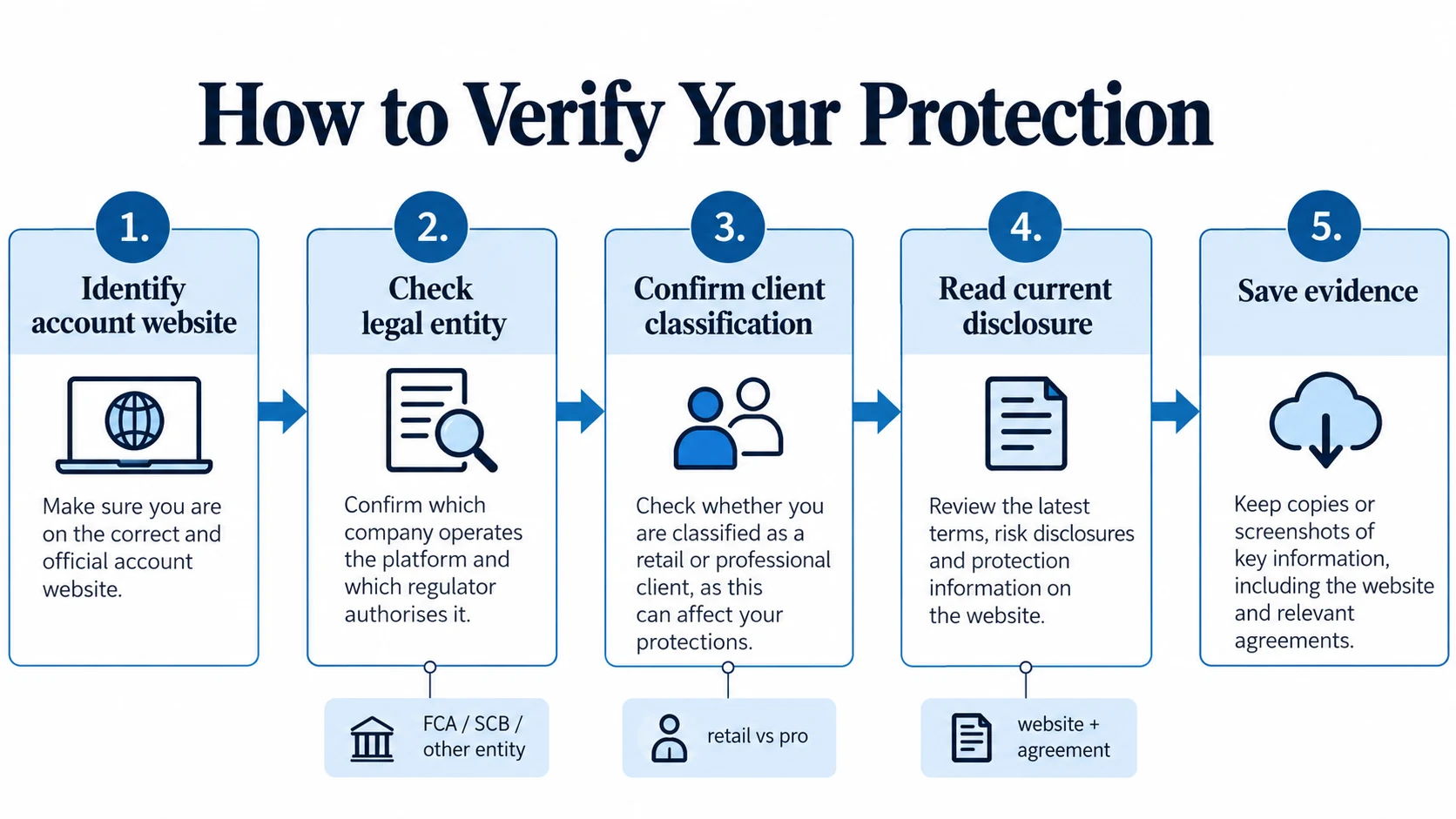
A practical workflow helps reduce ambiguity. Step one: confirm the official website and login environment you are using. This sounds basic, but many misunderstandings begin when a trader reads one regional page and opens an account under another path. Step two: identify the legal entity named in the regulation page, legal notice, and onboarding materials. If the names or jurisdictions do not match, stop and resolve that gap.
Step three: confirm client classification. Are you retail or professional? This should be visible in account documentation or through support confirmation. Step four: read the current disclosure materials and search them for protection, deficit, margin, and close-out language. Step five: save evidence. Download or screenshot the documents and the relevant website statements so that the verification survives later site changes.
This workflow does two things. First, it protects the trader from relying on generalized internet commentary. Second, it forces the trader to turn a marketing promise into a document-backed understanding. The difference becomes important only when something goes wrong, which is exactly why the evidence should be gathered before the fact.
For active traders, the best time to do this is before increasing position size or using higher-risk strategies. Verification after a market shock is always harder and often less credible.
How to interpret retail versus professional messaging without overreading it
The coexistence of retail-protection messaging and professional-account messaging can confuse traders. Some assume that if a professional-account page mentions negative balance protection, then nothing material changes between classifications. Others assume the opposite and believe professional status automatically removes protection. Both shortcuts are risky.
The correct interpretation is narrower. The website may show that ActivTrades wants to communicate some level of protection across different audiences. But whether the protection applies, and in what form, still needs to be traced through the entity and document structure relevant to the individual account. A professional client may still benefit from negative balance protection but lose other retail-specific safeguards. A retail client may have broad protection but still need to understand how margin close-out rules operate before a deficit appears.
In other words, negative balance protection is only one part of the client-protection picture. It does not replace risk management, nor does it erase all differences between retail and professional accounts. Traders should avoid turning it into a marketing halo that substitutes for careful reading of the documents.
This balanced interpretation also helps when comparing brokers. A claim that sounds generous on a home page may be weaker in practical detail than a plainer but more clearly documented protection elsewhere.
Recordkeeping is part of the protection workflow
Many traders verify a broker feature once and then forget to preserve the evidence. That is a mistake. Protection-related records should be treated like part of the trading file itself. Save PDFs of current legal documents, screenshots of the relevant website statements, copies of onboarding emails, and any written answers from support. If your classification changes from retail to professional, preserve proof of the change and the date on which it took effect.
This does not mean preparing for litigation every day. It means keeping a coherent record so that you do not have to reconstruct the relationship later from memory or from broken website links. The exercise is especially useful when brokers operate through several entities and update documentation over time.
A small amount of discipline creates a large practical advantage. When a trader can point to the exact entity, the exact account classification, and the exact document version relied upon, the discussion moves from vague expectations to evidence-backed understanding. That is the point of this whole article.
What support should be asked if the documents are unclear
If public documents do not answer the question decisively, contact support with precise requests rather than a general question like ‘Am I protected?’ Ask which legal entity services your account, whether your account is classified as retail or professional, and which current document sets out the negative-balance-protection terms for your specific account. If the answer references a web page, ask for the exact document or section number as well.
Written responses are preferable to phone summaries. An email or ticket response can be saved alongside the legal documents and website captures. Even then, a support answer should be treated as supplementary evidence, not as stronger than the governing agreement. If support says one thing and the legal text seems to say another, the discrepancy needs clarification rather than interpretation by the trader.
Clients should also ask about account migration or entity changes if they have been long-term users. Broker groups sometimes update structures, domain routes, or documentation. A protection statement saved years earlier may not describe the current relationship if the account has been re-papered or moved to another entity.
This is less dramatic than it sounds. It is simply part of maintaining a serious compliance file for a leveraged trading account.
Bottom line
ActivTrades publicly presents negative balance protection as a real safety feature, especially for retail clients, and it also references the protection in professional-account marketing. That is meaningful. But the answer to ‘Who qualifies under which entity?’ is not fully resolved by the brand name alone. It depends on the legal entity serving the account, the classification assigned to the client, and the current documents governing that relationship.
A trader who verifies those three layers before relying on the protection is in a much stronger position than one who relies on a headline statement or forum summary. The safest practical conclusion is therefore conditional but useful: start with the website claims, then verify them through the current legal documents and your specific account classification. That is how a broker-safety feature becomes something you can actually evidence.
Primary sources and methodology
- ActivTrades About page
- ActivTrades Why choose us
- ActivTrades Individual Trading Account
- ActivTrades Professional Account
- ActivTrades regulation information
- ActivTrades legal notice / legal documents
Editorial method: this guide relies on ActivTrades public website statements and legal-information pages available at the time of review. Because legal protections are entity-specific and documents can change, the article does not assume that one marketing statement alone resolves eligibility for every client in every jurisdiction.