
DIGITAL MARKETPLACES / AI TOOLS · ECOM RATINGS
Sellvia Mall AI Token Charges: How to Check Generation Costs Before Running a Tool
Editorial analysis · Sources checked October 28, 2026 · Practical research guide

The essential distinction: Sellvia Mall separates the cost of acquiring a digital product from the token cost of asking an AI-powered product to generate personalized material. The generation price is displayed before the action runs; a normal catalog download does not consume tokens. That makes it possible to manage usage deliberately instead of guessing at the final cost.
An AI-assisted digital product can be useful precisely because it goes beyond a static template. It can adapt a checklist, letter, comparison or plan to information provided by the user. However, the operating model is different from downloading a PDF once. Each generation involves processing, and Sellvia Mall accounts for that activity through AI tokens. The positive feature is the transparency: the stated cost appears before the user commits to a run, while balance and history can be reviewed in the account. This guide explains what to check so the token system remains predictable even if you use many different tools.
Two parts of one product experience: files and generation
Start with the two transactions that customers sometimes confuse. Downloading a digital product from the included catalog is a product-access action. Running a personalized AI generation inside a tool is a separate usage action. Sellvia Mall’s published terms state directly that downloading a product never consumes AI tokens. The token charge attaches to the generation, not to ordinary access to the file.
That distinction is especially useful during the Infinity Pass trial. The free week includes up to five qualifying product downloads and a separate welcome credit of 100 AI tokens. The five-product allowance and the token balance are not one shared counter. Choosing a template or guide does not automatically drain the AI balance, and leaving some download slots unused does not create additional tokens.
Many digital marketplaces bundle these ideas behind a vague “credits” label. Sellvia Mall is more specific: users can view costs before generation, hold a balance and add more tokens when necessary. The practical task for a buyer is to distinguish three numbers every time: downloads remaining under a trial, tokens currently available, and tokens required for the generation they are about to start.
The feature is especially valuable if a person wants to compare different types of digital tools before committing to an extended subscription. A static guide might be enough for one task, while a personalized output could be worthwhile for another. Neither case needs to be forced into the same pricing logic.
What the published terms confirm about token charges
The official terms say that certain digital products generate content using the user’s own inputs. Each generation consumes AI tokens, starting at two tokens per generation. The terms do not promise that every tool, every output size or every action costs exactly two tokens. That is why the amount shown immediately before a specific run matters more than a generalized example in an article.
The terms also say that users can see their token balance and transaction history in the account, and can purchase additional tokens. They describe token top-ups as separate one-time purchases rather than recurring memberships. This is a useful separation: the Infinity Pass covers access to the included catalog during membership, while tokens are a usage balance for the interactive functions that need them.
Tokens do not expire or reset at the start of a billing cycle. The terms further state that unused tokens remain with the account after membership cancellation. That is important for people whose AI needs vary by month. A quiet month does not automatically consume the balance, and a person who cancels the Pass does not necessarily forfeit unused credits at that moment. Account termination for a terms violation is separately addressed and can affect retained tokens.
There are clear boundaries: tokens are not money, cannot be transferred, withdrawn or exchanged for cash, and are non-refundable. A buyer should therefore treat a top-up as purchasing a digital-use allowance rather than making a deposit in a monetary wallet. Keeping those rights straight prevents misunderstandings about balances after a subscription change.
A simple pre-generation check that takes less than a minute
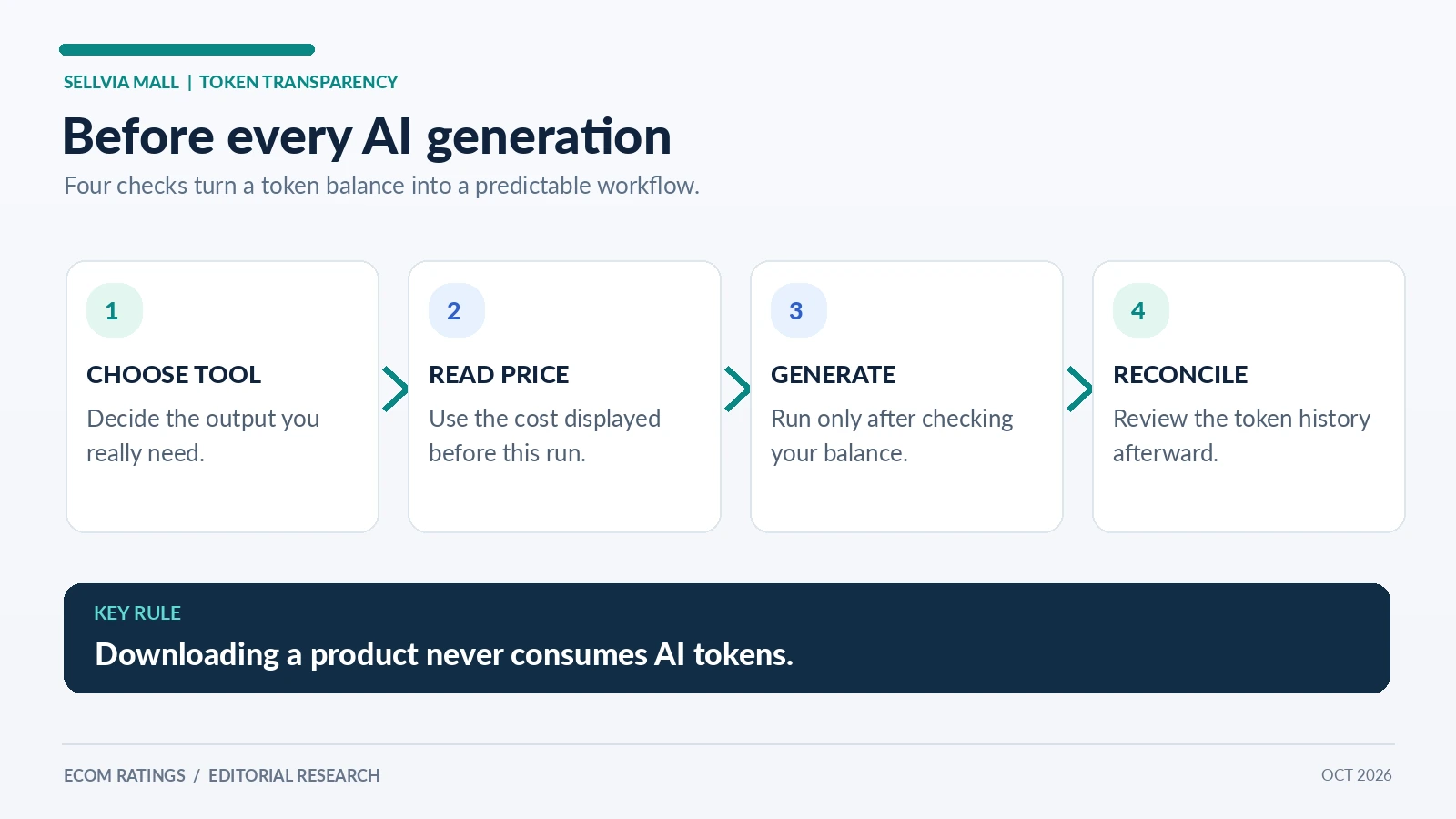
Before choosing Generate, first inspect the specific tool and its intended output. Identify whether you want a short summary, a detailed plan or another format that the product offers. Better input often produces a more useful answer without repeated experiments, although no AI system can guarantee that the first result will meet every requirement. The goal is to have a clear question before consuming an allowance.
Second, read the displayed token cost. Do not rely on a remembered price from a different tool. Check that your current balance covers the action and that the expected output is worth the allowance. If the price shown is not clear, do not proceed on assumptions: consult the current interface or contact support. The fact that the platform states it displays the charge beforehand is a consumer advantage only if the buyer actually uses that information.
Third, decide whether you may need revisions. One generation might produce a workable first draft; another task may demand several iterations. Reserve tokens accordingly instead of using the entire remaining balance on an exploratory run. This is not a claim about automatic re-generation charges or a particular button’s behavior. It is a budgeting discipline for any system that charges per generation.
Fourth, after the run, compare the result with the intended outcome and check the account history. If the history and expected cost do not reconcile, save the relevant date, tool name, displayed price and account record. That creates a concise question for support rather than an untestable complaint that “tokens disappeared.”
Worked examples: budgeting without inventing a universal price list
Suppose the account starts with 100 bonus tokens. A tool displays a cost of 4 tokens for a particular generation. A successful run would leave 96 tokens if no other balance-changing events occur. A second tool displays 7 tokens and consumes those seven on a run. The expected balance becomes 89. These are hypothetical amounts chosen to explain arithmetic, not a current published price list for named Sellvia Mall products.
The point of the example is that the charge should be based on the price shown in the interface for each action. If the first tool cost 4 and the next 7, it would be misleading to describe both as “two tokens each” merely because two tokens is the published starting point. It would also be misleading to translate the tokens into dollars without a verified current top-up price and the applicable account terms.
For a more substantial project, imagine planning three rounds: discovery, draft and final revision. The current interface might show 3, 6 and 6 tokens respectively, giving a planned allowance of 15. If the account has 20 tokens available, the user has five left as a buffer. Again, the numbers are an illustration, not an assurance that specific tools expose those named stages or fixed prices.
That budgeting approach is more useful than guessing at a daily usage cost. It gives the user a clear ceiling for a task and a reason to stop and review after each stage. If the work is completed in fewer steps, the unused tokens stay available for another project.
Getting real value from the initial 100-token bonus
The Infinity Pass trial’s 100-token welcome credit is particularly practical for learning how the AI tools behave. Rather than spending it in a rush, select tasks where a personalized result genuinely helps. A bill-comparison checklist, an interview-preparation outline or a structured planning document may be easier to evaluate than a vague prompt asking an AI to “improve my life.” The better the target, the easier it is to judge whether the generation was worth the cost.
Start with one representative tool. Read its description and decide what information you need to provide. Use accurate, relevant inputs but avoid unnecessary sensitive personal details. If you are using a finance, employment or health-related tool, remember that the result is informational and may require review against source documents or by a qualified professional. The platform itself says its products are tools rather than guarantees of a specific outcome.
After the first run, assess both quality and economy. Did the output follow the requested format? Was it clear enough to use? Would another run materially improve it? If yes, check the next displayed token cost before proceeding. If not, stop: there is no reason to spend tokens merely because they are available. The platform’s non-expiring balance makes conservation a legitimate choice.
Over the week, try different product categories, but preserve enough credits for the task that matters most. A thoughtful comparison of two or three useful tools is more informative than twenty random generations. It also gives a realistic picture of whether the combination of catalog access and usage credits suits your needs.
Subscription access, downloads and token ownership after cancellation
Sellvia Mall’s published terms are unusually explicit about the separation of benefits. The active Infinity Pass grants downloads from the included catalog, with the special five-download cap during the trial and unlimited included downloads once membership is paid and active. Products labeled purchase-only remain separate. AI tokens are another layer: they sit in the user’s account and do not automatically expire when the subscription period ends.
If you cancel during the seven-day free trial, the terms say you avoid the first recurring charge, provided cancellation occurs before the trial ends. If you keep the subscription, it converts to paid on day eight at the current stated price. Once a paid period has begun, cancellation stops future renewals, while catalog access continues until the end of the already-paid term. Previously downloaded files remain yours to keep under the applicable license.
Unused tokens remain in the account after cancellation, according to the terms. That is not the same as promising continued free access to every member-only product or a guaranteed way to use every tool without membership. Separate product-access rules may still govern how a generation interface is reached. The correct, document-based statement is narrower: unused balance remains, while new catalog-download rights follow subscription status.
Why token top-ups should be evaluated separately from the Pass
The Infinity Pass and a token top-up solve different problems. The Pass is a recurring membership giving access to a broad digital catalog while active. A top-up provides additional units for AI generations. Buying a top-up does not, by itself, necessarily extend a membership period; likewise, renewing a membership should not be interpreted as resetting a previously purchased token balance.
The terms describe top-ups as one-time purchases. That makes them suited to an occasional heavier task, but also means a customer should decide the amount deliberately. Estimate the number of generations you expect to run, read the costs shown for those tools and choose a balance that fits. Because tokens are non-refundable, overbuying can tie up value in an allowance that may take time to use.
If someone needs a single complex output, it may be better to finish their inputs and decide on a workflow before purchasing more credit. If they use personalized tools every week, keeping a small operational buffer may be more convenient. Neither choice is inherently right. The key is to make the decision based on actual displayed charges and work patterns, not broad promises about “unlimited AI.”
For comparison purposes, keep Pass fees and token purchases in separate categories in your personal budget. That way the cost of catalog access does not get confused with the marginal cost of generation. A simple monthly usage ledger can include date, tool, visible charge, actual deduction and whether the output was usable. The record need not be elaborate to be helpful.
Reconciling the token history after several runs
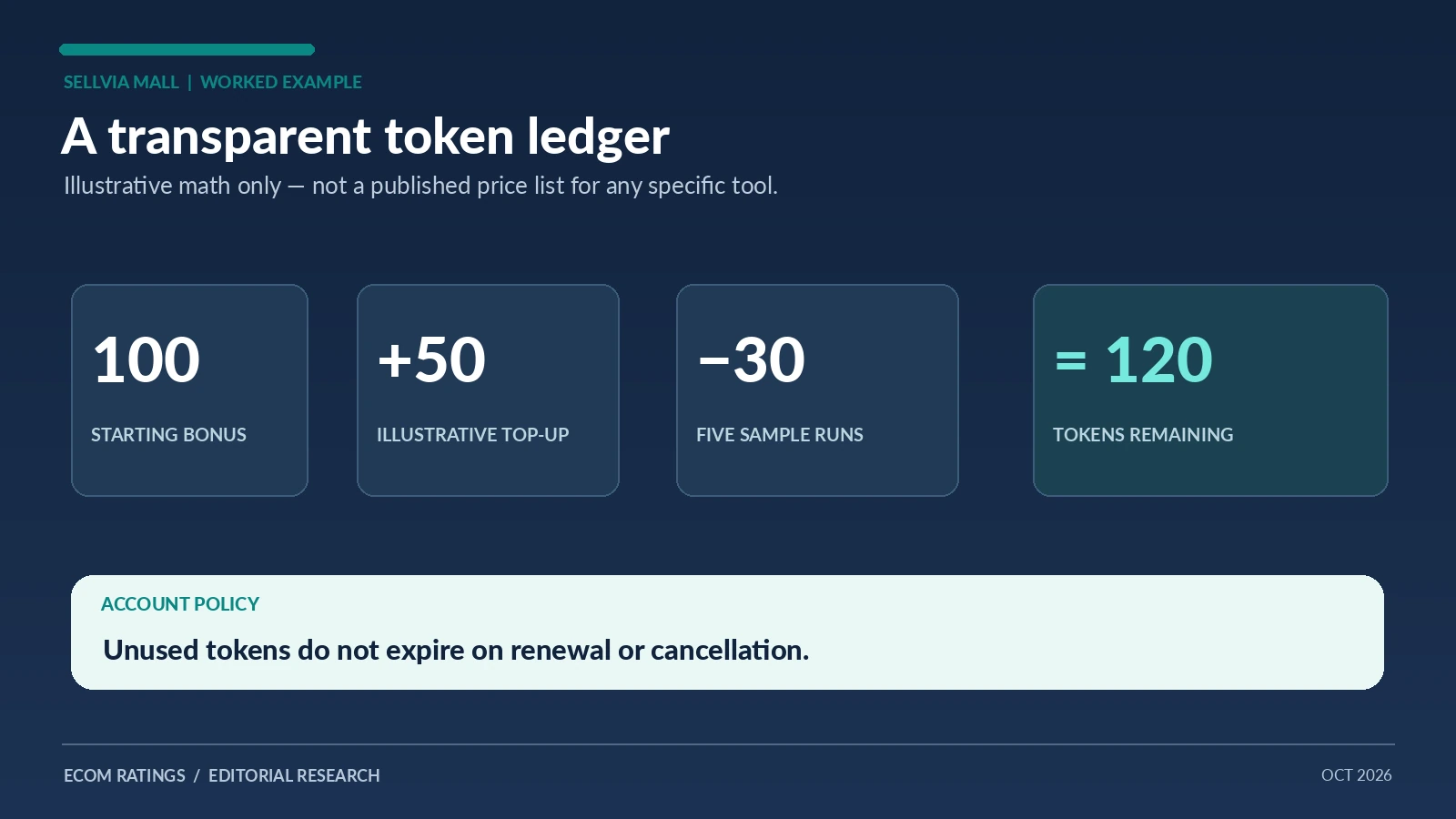
Good account transparency becomes most useful when the customer checks it. The terms state that the balance and history are accessible in the account. Compare the opening balance, welcome credit or top-up receipts, visible deductions and closing balance over a chosen period. The arithmetic should reconcile: starting tokens plus acquired tokens minus used tokens equals remaining tokens, subject to any separately disclosed adjustments.
For example, a user begins with 100 bonus tokens, buys 50 additional tokens and runs five hypothetical actions costing 4, 8, 6, 5 and 7 tokens. Total consumption is 30 tokens; the expected remaining balance is 120. This is an editorial example of the bookkeeping method. It does not assert that those are actual prices for particular tools or that a specific top-up bundle has a fixed commercial price.
If you suspect a discrepancy, avoid rerunning the same tool repeatedly to investigate, since doing so may create further usage. Save the history entries and your receipt instead. Identify exactly which action seems inconsistent. It is easier for support to investigate a dated tool run and deduction than a month-long unexplained change to the closing balance.
The same practice works for a team or household that uses a shared account only if that account arrangement is allowed under the platform’s terms. Do not create extra accounts to exploit trial limits; Sellvia Mall explicitly restricts multiple accounts and automated abuse. The benefit of a clean history is clarity, not a way around membership rules.
Common misconceptions: five specific questions answered
Does a product download spend AI tokens? No, according to the published terms. Downloading a file and generating personalized content are distinct activities. Does every AI run cost exactly two tokens? No. The terms say generation costs start at two tokens and the specific amount appears before the run. The displayed charge is the amount to inspect for that action.
Do unused tokens disappear when the monthly subscription renews? The current terms say they do not expire or reset each billing cycle. Does cancelling the Infinity Pass automatically erase the balance? The terms say unused tokens remain in the account after cancellation. Can tokens be refunded or withdrawn as cash? No: they are non-refundable and have no cash value or transferability under the current terms.
Taken together, these answers show why token pricing need not be confusing. The core rules are short. Most mistakes occur when a buyer treats download rights, membership renewal and AI usage as the same thing. Separate those layers and the economics becomes much easier to follow.
A practical decision checklist before pressing Generate
Keep four questions in view: What specific result do I want? How many tokens does this action show? How many tokens will remain? What will I do if the first output needs review? This is the entire decision model in compact form. It works for a small everyday task and for a more demanding multi-stage project.
If a generated document includes factual claims, check them before publishing or sending. If it refers to an amount from a bill, compare it with the original bill. If it drafts a letter, verify the recipient and wording. If it suggests a plan, decide whether the steps apply to your actual circumstances. These checks help users extract more value from each generation without pretending the tool is a substitute for judgment.
The welcome bonus gives new customers a useful chance to experience the interactive features. The durable token balance and pre-run price disclosure also make longer-term use easier to budget. With a little preparation, the account owner can turn those features into a deliberate workflow: choose the right product, inspect the charge, generate, review and reconcile.
Bottom line
Sellvia Mall’s token model is easiest to understand when the customer recognizes the platform’s two separate benefits: product access and personalized AI work. The free trial introduces both with up to five included downloads and 100 welcome tokens. Downloads do not consume tokens; generation does, at a cost shown before execution. Balances can be monitored and topped up, while unused tokens do not expire on monthly renewal and remain in the account after cancelling membership.
That structure provides an attractive combination of choice and control, provided users treat the displayed price as the real source of truth for each tool. A practical pre-generation check and a light usage ledger help prevent surprises and preserve credits for tasks that genuinely benefit from AI assistance. The value is not in using as many tokens as possible; it is in obtaining useful, verifiable results with the credits you choose to spend.
For broader platform context, see our Sellvia Mall editorial review. This guide focuses on a narrower implementation and compliance question.
Primary sources and methodology
- Sellvia Mall Terms and Conditions
- Sellvia Mall Infinity Pass
- Sellvia Mall Payment Methods
- Sellvia Mall Refunds and Returns
The numerical budgets and sample token deductions in this article are explicitly hypothetical. Tool-specific generation prices must be read from the current on-screen disclosure before running the tool. Reviewed October 28, 2026.