
BROKER RESEARCH / LEGAL ENTITY DOCUMENTS · ECOM RATINGS
INFINOX Client Money Protections: What Its Entity Documents Actually Say
Independent editorial research · Source check: November 2, 2026
INFINOX presents client-fund security as an important part of its global offering. Its public materials describe segregation of customer money, banking arrangements, regulatory entities, negative balance protection for retail clients, and excess-of-loss insurance for certain clients. These are meaningful subjects to investigate. The difficulty is that they are not identical safeguards, do not necessarily apply to every legal entity in the group, and cannot be evaluated by reading a home-page claim alone.
The most useful approach is document-led: identify the contracting company, locate its current agreement, read the client-money clause, and then test any insurance or compensation claim against the exact document for that legal relationship. This guide makes those distinctions without assuming that the INFINOX brand itself is a single regulated entity. The facts described below reflect public materials available in early November 2026; a specific customer should still confirm the document version accepted during onboarding.
Start with the company named on your client agreement
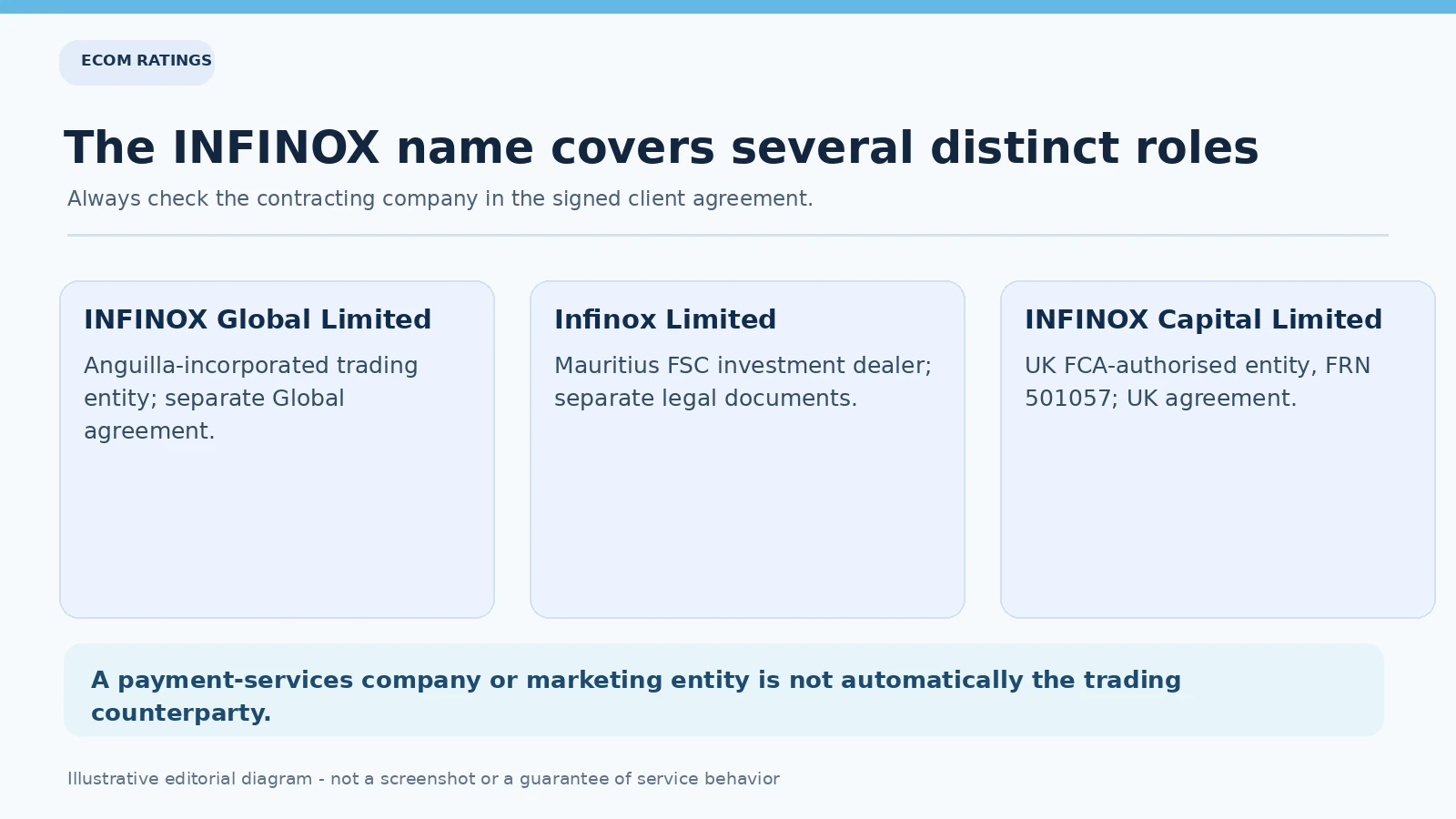
INFINOX operates through several companies with distinct roles. The public regulation page identifies Infinox Limited in Mauritius, authorised by the Financial Services Commission under licence GB20025832. It identifies Infinox Global Limited as incorporated in Anguilla, company number A000001246. It also identifies a United Arab Emirates entity used for marketing and introducing activities and a Cyprus company facilitating payment processing. The separate UK website identifies INFINOX Capital Limited as authorised by the Financial Conduct Authority under FRN 501057.
Those facts cannot be flattened into a single sentence such as 'INFINOX is FCA regulated, so every client is protected by UK rules.' That would be misleading. A licence is issued to a particular company for particular activities. The regulated entity named on a group page may not be the entity receiving an individual customer's order. A payment-services company can appear on statements without becoming the trading counterparty.
Before comparing protections, download your signed onboarding documents, inspect the contract introduction, and note the full legal name, company number, and governing jurisdiction. Check the account confirmation email as well. If those records name a different company than the website page you read, investigate the discrepancy rather than assuming the most attractive protection applies.
Segregation: what it protects and what it does not
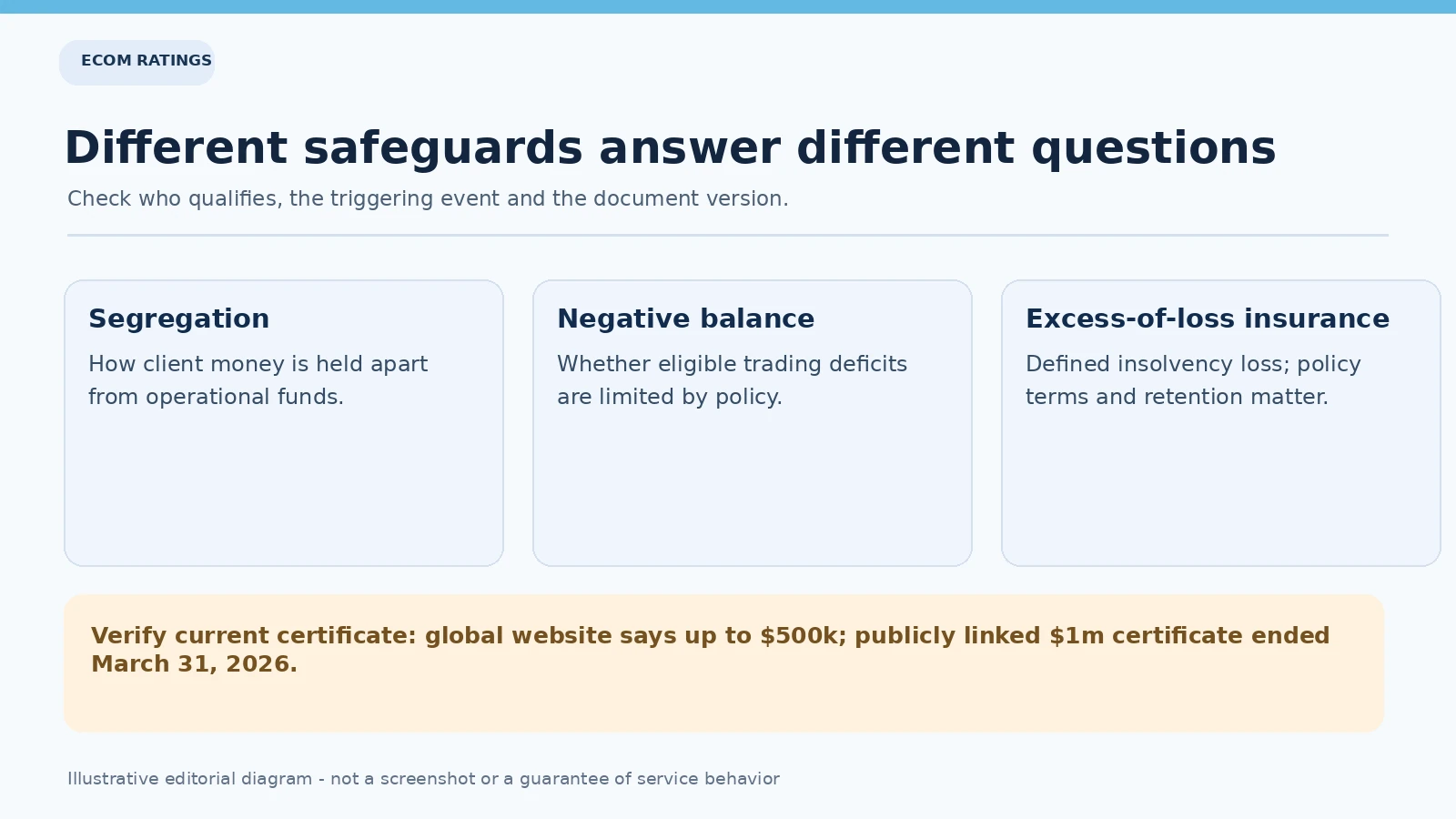
Client-money segregation is an accounting and custody safeguard. The general principle is to keep client money apart from a firm's operational funds in designated arrangements, reducing the risk that a trading firm's own cash needs or insolvency process absorbs client balances indiscriminately. INFINOX's global marketing materials emphasize segregation of customer funds from corporate funds. Its agreements, however, are the place to look for operative terms and exceptions.
Segregation is not the same as a government guarantee of all deposits. It is also not a promise that a customer can never lose money from an open trading position. CFD trading losses, negative balance rules, bank failure, broker failure, and client-money shortfalls are separate questions. A correctly segregated account can still involve a failed intermediary or other legal complication; conversely, an insurance claim can be limited by exclusions and a retention even if segregation was practiced correctly.
For an individual trader, the practical evidence is the clause describing how client money is held, which third parties may receive it, what reconciliations are performed, and whether the agreement permits special collateral arrangements. These details are more useful than the word 'segregated' in isolation because they identify where the remaining risks might reside.
The UK entity and FCA client-money rules
The UK legal-document page identifies INFINOX Capital Limited, company number 06854853, as authorised by the FCA under reference 501057. A client agreement available from that site states in its client-money section that funds received or credited as client money are treated under FCA client-money rules, with segregation from the firm's own money at approved banks. The FCA's CASS rules are a broader regulatory source governing the treatment of client assets by applicable firms.
That is a concrete form of protection, but the agreement must be read in full. The same accessible UK agreement includes a provision under which professional clients or eligible counterparties who enter a title-transfer collateral arrangement may transfer ownership of relevant collateral to the firm. The document explains that such amounts might then cease to qualify as client money and may not be segregated in the same way. The classification of a client and any separately signed collateral agreement therefore matter.
Another important nuance: the accessible UK agreement dated September 2024 states that the company does not provide services to retail clients under that agreement. This is a statement about that document's scope, not proof of every present or past onboarding configuration. A current applicant should check the latest contract rather than applying a generalized retail-protection description to a professional-only arrangement. Treat the specific signed agreement as the primary reference.
The Anguilla entity and its client-money clauses
Infinox Global Limited is identified on the global site as an Anguilla-incorporated company. Its global client agreement is presented separately from the documents for the Mauritius entity. The available Global agreement describes circumstances in which client money can be held in segregated accounts or passed to an intermediate broker, settlement agent, or over-the-counter counterparty at another approved institution. It also states that legal and regulatory treatment can depend on the jurisdiction of that third party.
This is a meaningful disclosure. It helps a customer distinguish a pledge to segregate funds from the question of who ultimately holds them and under what law. A client should record whether the agreement permits transferring funds to outside institutions and what due diligence or liability language applies if those institutions fail. The existence of such clauses does not mean a loss is inevitable; it means the contractual risk allocation deserves scrutiny.
Do not import UK CASS or UK investor-compensation rights into the Anguilla company merely because both use the INFINOX trading name. The client's protections must be established from the governing agreement and any independently applicable local law. A group affiliation by itself is not a substitute for an explicit legal basis.
The Mauritius entity has its own regulatory identity
Infinox Limited's published legal materials describe a Mauritius-incorporated company regulated by the Financial Services Commission under Global Business licence GB20025832. The global legal-documents page makes a separate set of contracts available for that company. This distinction is important because an FSC-regulated agreement is not automatically the same document as one governed by a UK FCA entity or an Anguilla company.
The correct audit should identify the Mauritius entity's own rules for holding client money, permitted third-party arrangements, reconciliation, margin treatment, and dispute resolution. The documents may use familiar phrases such as segregation and safeguarding, but a trader should confirm the exact clauses rather than infer that all group agreements were copied word for word. Comparing legal language line by line is more reliable than comparing badges or country flags on a marketing page.
A customer should also check the date and version of the agreement linked during account opening. The public site may display multiple historic or current PDF paths. A file downloaded years earlier may be useful background, but it cannot settle today's position if the contract has been amended or the account moved between entities.
Insurance is separate from segregation
INFINOX's global regulation page currently promotes an excess-of-loss insurance arrangement for Infinox Global Limited. It describes eligible-client cover of up to USD 500,000 per claimant, subject to a USD 20,000 retention and policy limits. This is a specific claim and should not be rewritten as blanket insurance for every INFINOX account. It identifies the insured entity and expressly limits eligibility and coverage.
A separate publicly accessible evidence-of-cover PDF raises an important verification question. That document names Infinox Global Limited and the insurer Arch 2012, specifies a period running from 1 April 2025 to 31 March 2026, states an upper figure of USD 1 million per claimant, and includes a USD 20,000 retention. By November 2026, that stated period has ended. The older document therefore cannot establish current insurance on its own, and the amount in it differs from the figure currently stated on the global website.
The correct conclusion is not that the advertised protection is false or that the old policy necessarily vanished without replacement. It is that the currently accessible evidence and the current marketing statement require reconciliation. A prospective client should request the renewed certificate and underlying policy terms for the current period, confirm the applicable limit, and check whether their exact account and loss type qualify. This is a high-value information gap that a generic broker review usually misses.
What a retention and policy limit mean in practice
An excess-of-loss policy is not equivalent to ordinary deposit insurance. The advertised USD 20,000 retention means a claim may have an initial portion of loss that is not covered by the insurer, subject to the policy's definitions and structure. The precise application depends on the full wording. A limit such as USD 500,000 per claimant also does not automatically mean that every customer with a balance below that figure can recover the balance in full.
Consider a hypothetical client with a net eligible loss of USD 70,000 after a qualifying insolvency event. Someone might be tempted to subtract the retention and assume insurance automatically pays USD 50,000. That calculation is only an arithmetic illustration and is not a statement of the policy's payout rules. Coverage can depend on who qualifies as a claimant, the definition of net loss, total policy limits, exclusions, deductible operation, and required claims procedure.
It is also essential to distinguish insolvency losses from ordinary trading losses. An insurance document written for an insolvency event does not compensate an unsuccessful market position. Similarly, negative balance protection governs account deficits under defined conditions; it is not general insurance against losing deposits through trading. Each layer should be labeled with the event it addresses.
Negative balance protection and account loss
INFINOX's global regulation materials state that negative balance protection applies to retail clients. This is relevant to leveraged trading because fast market movements can produce losses greater than the cash in an account if positions cannot be closed at expected prices. Protection of this type is designed to restrict how much the eligible trader may owe after such a deficit arises.
The statement does not resolve which retail classification or jurisdiction applies to a particular user. A professional client may have a different set of protections, and the UK agreement noted above has its own categorisation language. The trader should verify classification and the exact contractual treatment of deficits rather than assuming the site's general retail messaging extends to all entities or account classes.
The distinction from client-money segregation remains important. Segregation addresses how client funds are treated and held. Negative balance protection addresses whether a leveraged loss can leave the client indebted beyond deposited funds. A client may care about both, but proof of one does not prove the other. A thorough review needs independent evidence for each.
Third-party banks, intermediaries and payment providers
The global site refers to banking relationships and segregated client accounts. The client agreements may also allow transfers through banks, intermediate brokers, settlement agents and OTC counterparties. This creates a chain of custody that should be understood conceptually: the trading company owes duties under the client agreement, while one or more third parties may hold or process relevant funds.
The payment entity named on a card charge or transfer instruction can add another layer of confusion. INFINOX's published group structure lists INFINOX Services EU Limited in Cyprus as a payment-services provider. That role does not by itself establish that the Cyprus company is the broker, the guarantor of a trading account, or the entity granting the client's contractual protections. Trading counterparty, payment processor and fund custodian are different functions.
For an audit, preserve the deposit receipt, card or bank descriptor, legal name in the account agreement, withdrawal instructions, and any support correspondence identifying who holds client money. If a payment route changes, ask whether the contracting broker changes too. A simple reconciliation can prevent a customer from relying on the regulatory status of an entity whose role was limited to processing funds.
A practical entity-by-entity document matrix
Start with four columns. Column one is the legal contracting name and jurisdiction. Column two is the licensing authority or corporate registration claimed in official disclosures. Column three lists the actual client-money and title-transfer clauses. Column four lists any insurance or compensation arrangement shown to apply specifically to that entity. Do not fill a blank cell with information from a sister company just to make the table look complete.
For the UK company, note the FCA identity and look up the latest UK agreement and relevant CASS treatment. For the Mauritius company, use the FSC-regulated agreement and its own disclosures. For Infinox Global Limited, record the Anguilla identity, its client-money terms, and the current insurance evidence requested from the firm. List the UAE marketing entity and Cyprus payment-services company as separate roles, not as substitutes for a trading counterparty.
This matrix should have a fifth operational column: evidence date. Regulations, account classifications, client agreements and insurance certificates can change. If the insured amount or document expiry date differs from the current marketing statement, that row should say 'requires confirmation' rather than presenting an unsupported current guarantee.
Questions worth sending to INFINOX in writing
Ask which exact legal entity holds your trading account, including its company number and regulator where applicable. Ask which version of the client agreement you accepted and whether any later entity migration changed it. Ask whether your funds are treated as client money, and whether any collateral title-transfer arrangement applies to your account classification. If client money may be held abroad or passed to an intermediary, ask which legal protections apply in those circumstances.
For any advertised insurance, request a currently dated insurance certificate, the named insured company, the full policy limit, the retention, claimant eligibility, exclusions, and a description of the claims process. Specifically ask INFINOX to reconcile the current global website's USD 500,000 figure with the publicly accessible expired certificate showing USD 1 million for a prior period. A written answer anchored to a current document is stronger evidence than a sales-page summary.
Finally, ask how complaints are handled and whether the entity is within any applicable compensation scheme. Do not presume coverage merely because a regulator is mentioned. If a third party gives an answer inconsistent with the signed agreement, seek clarification before depositing additional funds. These questions are routine due diligence for leveraged financial accounts, not accusations of wrongdoing.
Do not confuse a high standard of disclosure with a guarantee
INFINOX provides multiple useful primary-source materials: group regulation pages, entity-specific agreement links, and descriptions of segregation and insurance. That documentation makes it possible to investigate protections more rigorously than a simple promotional badge would allow. But good disclosure should encourage precise interpretation. An advertised safeguard is valuable only to the extent that a particular client's circumstances satisfy its terms.
A simple practical test is to imagine a stressful scenario: a bank fails, a broker becomes insolvent, a third-party intermediary experiences difficulties, or a trading position gaps beyond available funds. Would the same protection respond to all four? No. Different rules and documents govern each event. Once those scenarios are separated, the group structure becomes easier to evaluate without either overstating the safeguards or dismissing them.
The most useful evidence file is modest: the signed account agreement, legal-entity verification, dated segregation or title-transfer clauses, any current insurance certificate and policy, client categorisation, and the relevant payment records. That file can be refreshed whenever the contract or provider's documentation changes.
Bottom line
INFINOX's client-money story contains several distinct safeguards and legal structures. Segregation addresses custody of customer funds; FCA rules apply to relevant UK arrangements, while Mauritius and Anguilla documents require separate consideration. Negative balance protection concerns qualifying trading deficits. The global excess-of-loss insurance claim concerns defined insolvency scenarios for eligible clients of a named company, not every kind of account loss.
The most important unresolved public-document question is the difference between the global website's advertised USD 500,000 coverage and the older certificate showing a USD 1 million limit for a period ending on 31 March 2026. Neither should be presented as a current, universal guarantee without renewed policy evidence. A trader who checks the named legal entity, accepted agreement, and currently effective insurance terms has a much stronger basis for understanding what protection actually applies.
Primary sources and verification
- INFINOX global regulation and entity disclosures
- INFINOX global legal documents
- INFINOX UK legal documents
- FCA client money and assets guide
- INFINOX public evidence of insurance – expired period
- INFINOX UK client agreement – September 2024
Related editorial research: INFINOX company listing.
Editorial disclosure: Source documentation and worked examples are distinguished throughout. Policies, API features, regulatory records, legal agreements and insurance evidence can change. This article is informational research, not legal, financial or investment advice, and it does not claim testing of a private account or unverified Ecomzy interface.