
DIGITAL TOOLS / PURCHASE CLARITY · ECOM RATINGS
Ecomzy Mall One-Time Purchases vs Subscriptions: How to Verify Renewal Terms
Independent editorial guide · Source review: November 2, 2026
The practical answer: check the item, not the marketplace name
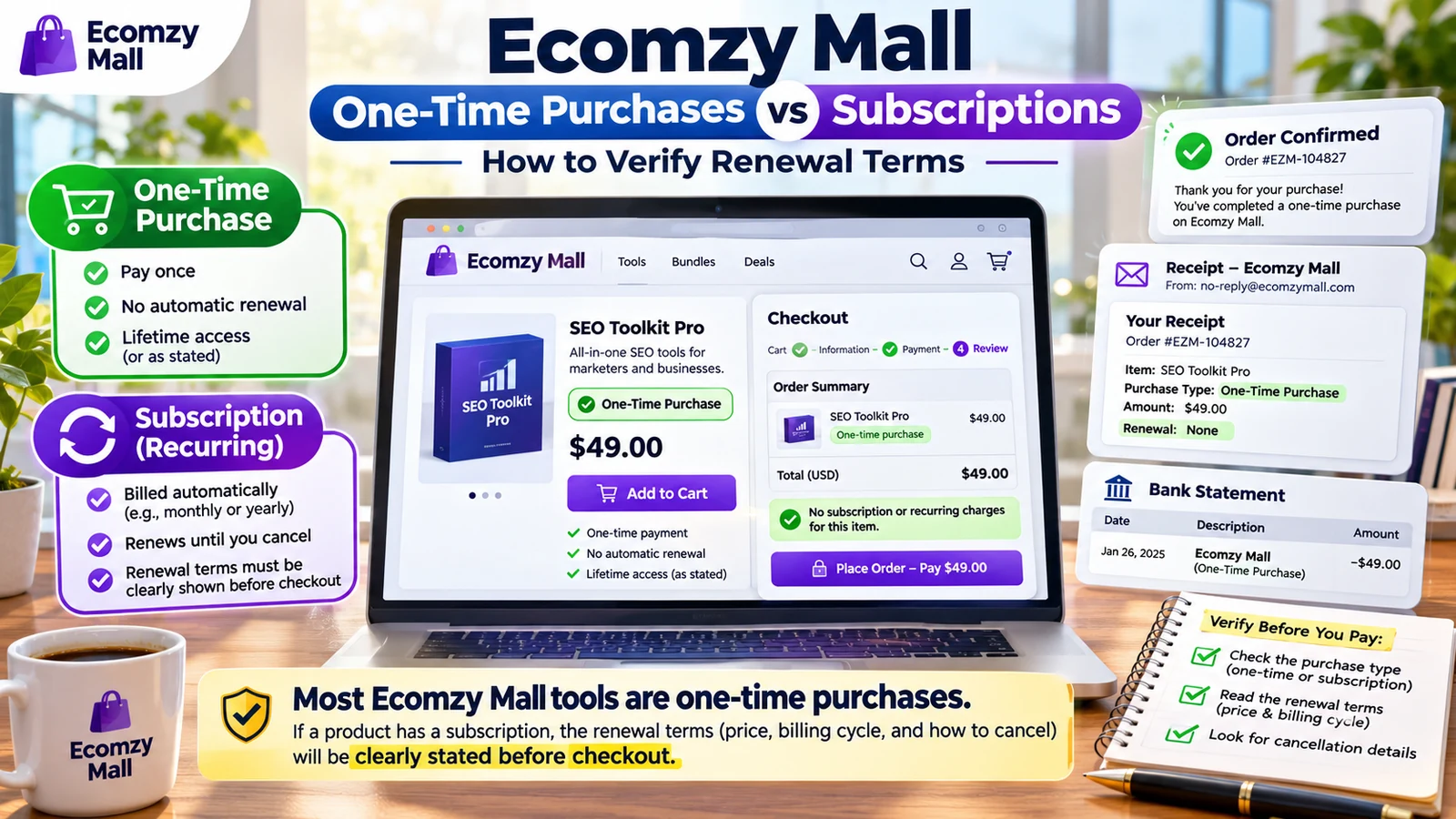
Ecomzy Mall is built around browser-based digital tools that customers can use directly through their account. Its public FAQ says most tools are sold as one-time purchases: a customer pays once and keeps access to the purchased tool. That is a straightforward and appealing model for someone who wants help with a specific task without taking on another recurring subscription. The same FAQ also recognizes that an individual product may use a subscription model, in which case the renewal terms should be clearly stated on the product page before checkout.
This creates a simple but important principle: do not infer the billing model from the brand alone. A one-time price for a particular tool is different from a recurring payment for continued access to a service. This article explains how to make that check, how to keep clear records, and what to do if the receipt or bank statement later seems inconsistent with the offer.
The platform at ecomzy.com has its own store subscriptions and service plans, with conditions that should not be automatically applied to purchases from mall.ecomzy.com. Ecomzy Mall’s FAQ is the relevant starting point for purchases of its digital tools. Keeping the two services separate makes the buyer’s billing expectations much easier to understand.
Why a one-time tool purchase is attractive
For a customer solving a specific problem, a one-time purchase offers predictability. They choose the appropriate tool, complete the questions, and receive the resulting guidance through the browser. If the tool is a one-time purchase as described in the offer, the customer does not need to keep a monthly subscription active merely to return to the purchased tool.
Ecomzy Mall’s FAQ reinforces this point: purchased tools are associated with the customer account and can be accessed and used again. It describes browser-based operation without requiring a separate app installation or a downloaded program. This arrangement makes repeat use convenient, especially for customers who move between a phone, tablet, and computer. It also reduces the chance of losing a purchased utility because an old device is replaced.
A single payment can be easier to budget for than a new recurring expense, while account-based access means the customer can revisit the tool as needs change. The exact feature set belongs to the individual product, however; buyers should not interpret “pay once” as a promise of future unrelated products, premium upgrades, or every feature the service might introduce later. The product page and published terms define what is actually included.
What makes a subscription different?
A subscription generally creates an ongoing payment authorization under which charges recur according to a disclosed billing interval until cancellation or other termination. A product page might describe a monthly membership, annual access, or recurring service package. The relevant details include the recurring amount, interval, start date, renewal policy, cancellation method, and what happens to access when payments stop. Those disclosures should be visible before the customer confirms payment.
Ecomzy Mall’s FAQ states that if a product uses a subscription, the model is clearly disclosed on its product page before checkout. This is a useful expectation because it gives buyers a direct place to verify renewal terms without guessing from a bank statement later. It does not mean that every tool has a subscription option, nor that every purchase is a recurring arrangement. The platform specifically says most of its tools are one-time purchases.
If the listing instead states a single price and one-time access, there is no reason to treat it as an automatically recurring plan unless other checkout terms say otherwise. In case of conflicting wording, do not proceed until support clarifies the actual terms. A checkout decision should be based on one consistent understanding of the cost.
Five checks before submitting payment
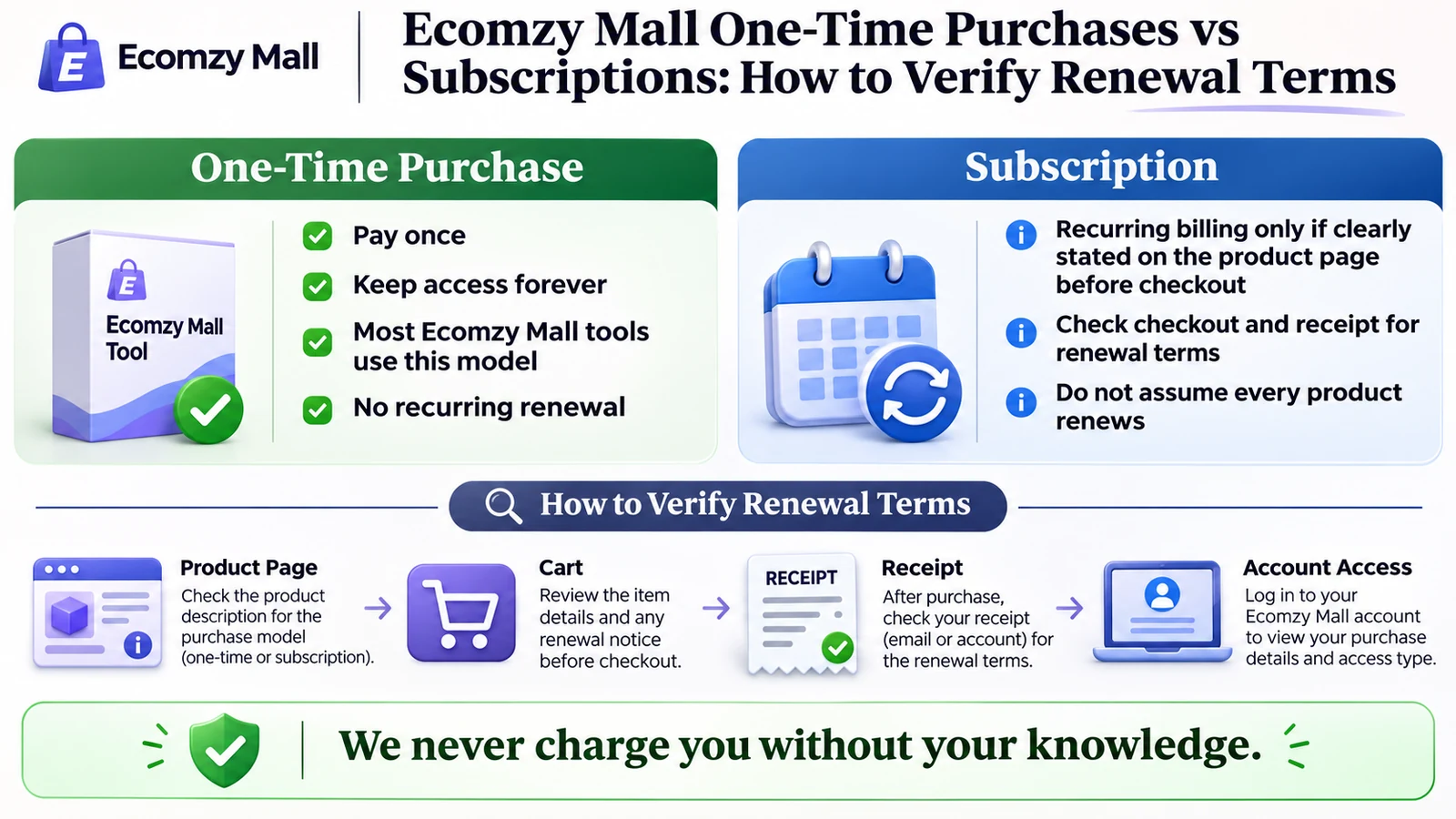
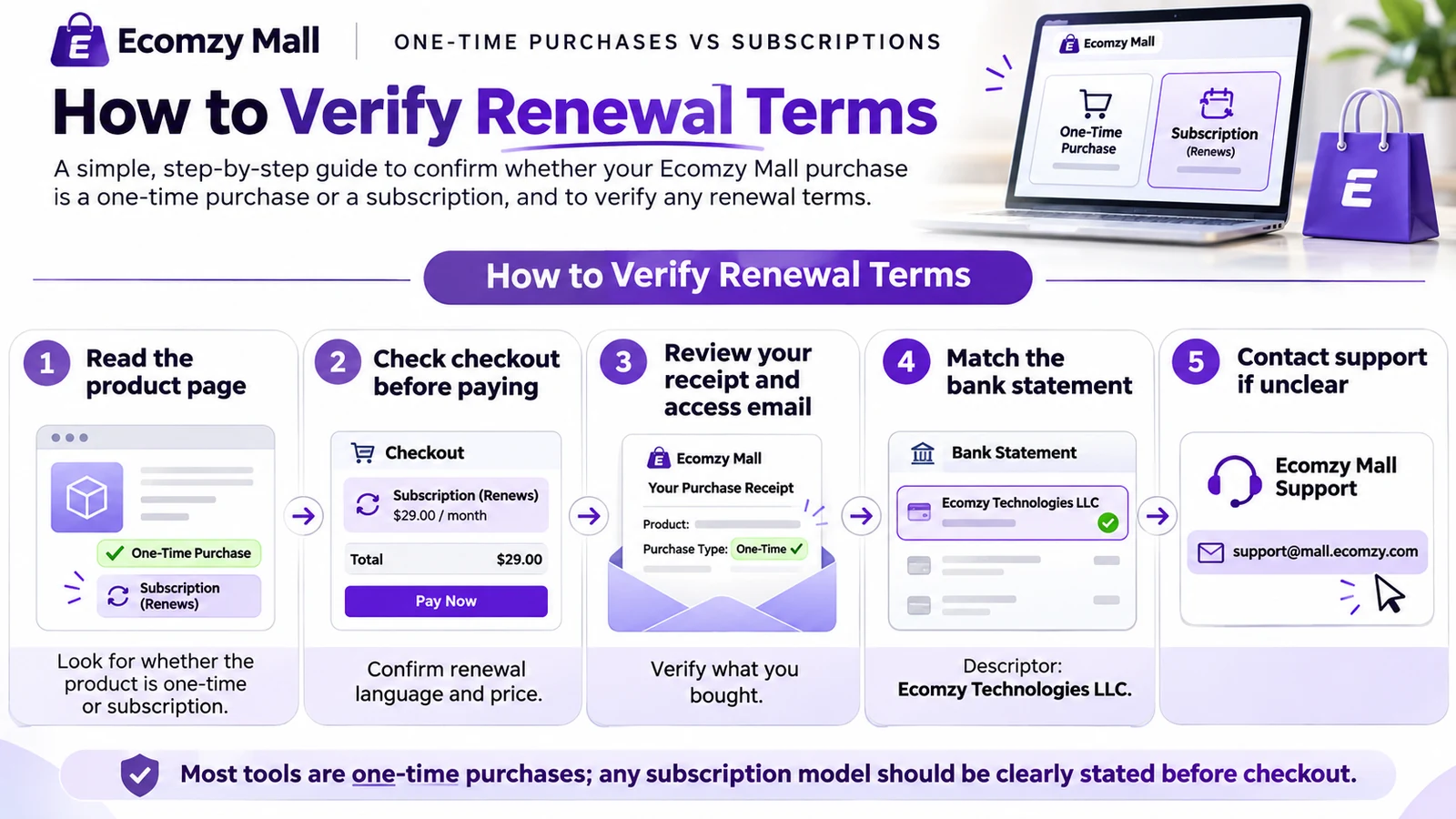
The first check is the product itself. Read the title, description, and any note about access duration or usage. Confirm that the product solves the problem you intend to address. The second check is the purchase model: find the one-time or subscription language, rather than assuming every digital item is sold the same way. The third check is the complete amount displayed at checkout, including any tax or other explicitly disclosed charge. Keep a record of the final total shown.
Fourth, if the offer recurs, note the billing interval, renewal timing, and cancellation instructions. A month-to-month plan and an annual plan create very different budgeting commitments. Fifth, verify the email address used for checkout. Ecomzy Mall links purchases to the account and sends access instructions to the purchase email. Using an unexpected or mistyped address can create an avoidable access issue after an otherwise successful transaction.
The buyer knows what was purchased, when money should move, and how to retrieve the product later. They also create a sensible record if the receipt must be matched to a statement or a support request. This is not a sign of distrust; it is routine purchase hygiene that helps people use digital services with confidence.
The receipt as a record of the transaction
After payment, Ecomzy Mall says the customer receives an email with access instructions and can find the purchased tool through their personal account. The receipt or confirmation should be retained because it connects the transaction with the item, purchase date, and amount paid. A bank statement alone rarely supplies enough detail to identify the exact product and access terms. In contrast, the purchase confirmation explains what the customer actually bought.
If the purchase is one-time, the receipt becomes evidence of that particular sale and a useful reference for future support conversations. If a product is sold as a subscription, the buyer should retain the renewal disclosures alongside the receipt. A quick screenshot with the date visible is often enough for personal recordkeeping.
Keep this material in a secure location rather than uploading financial documents publicly. Payment confirmations may contain personal email addresses, partial card details, or order identifiers. A sensible record preserves the necessary facts while minimizing unnecessary exposure. When contacting support, provide the order reference and the email used at checkout, but do not send full card numbers, passwords, or sensitive banking credentials.
How Ecomzy Mall account access works after purchase
The platform’s FAQ describes a convenient account-based delivery flow. Once payment is confirmed, a purchase confirmation email explains how to access the product, and the tool should be available through the user’s Ecomzy Mall account. Since tools operate in the browser, buyers do not need a separate mobile app or software installation. That can be particularly helpful for someone using the same purchase on multiple devices.
If the access email does not arrive, the FAQ recommends checking spam and promotions folders and then logging in directly with the email used at checkout. If the purchase still is not visible, the next step is to contact support at the address published by Ecomzy Mall. Checking the correct account first avoids duplicate payments.
One-time purchase access should be understood in relation to the purchased tool, not as membership in every other tool on the site. The FAQ’s “use it anytime” statement concerns purchases associated with the customer’s account. For exceptional products, the individual product description still governs what is offered. Users should also maintain a current email address and a working login method so that the account remains recoverable long after the original payment.
Reading a statement without jumping to conclusions
Ecomzy Mall’s FAQ states that charges appear as Ecomzy Technologies LLC on bank statements and that prices are charged in US dollars. This helps buyers recognize a legitimate transaction even when the bank descriptor does not exactly match a product’s marketing title. Different banking interfaces may abbreviate or format merchant descriptors, so the important task is to compare the posted date, amount, and known purchase record rather than relying only on a short line of text.
A subscription may produce additional transactions according to its disclosed renewal schedule. If a buyer sees a second charge, the first step is to check whether a separate purchase, a different product, or a disclosed renewal explains it. They should also distinguish a pending bank authorization from a final posted charge. Duplicate-looking pending entries do not always represent two settled payments.
Never transmit complete card details or login secrets by email. A clear side-by-side comparison usually makes it easier for support to locate the transaction and clarify whether it belongs to a one-time tool or a recurring arrangement.
A sample comparison: one-time tool and monthly service
Consider two hypothetical offers, used only to demonstrate the billing distinction. Product A is a browser-based planning tool priced at $29 as a one-time purchase. The buyer pays $29 at checkout and receives access to that specific tool. There is no next monthly charge arising from this example merely because the customer uses the tool again in December. Reuse belongs to the purchase entitlement, as long as the offer describes the tool this way.
Product B is a hypothetical $15-per-month membership. If the checkout identifies it as a recurring monthly service, the buyer should expect the disclosed renewal pattern unless the subscription is canceled according to its terms. Three completed monthly payments would total $45 before any applicable tax or other disclosed amounts. These numbers are illustrative only; they are not statements of Ecomzy Mall’s current tool pricing. The point is how a customer’s financial obligation differs.
A buyer who has both Product A and Product B in the same account might see one fixed product purchase and separate periodic membership charges. That does not mean the same tool was billed twice. This is why labeling purchase types clearly in personal records can save time later.
Cancellation rules: what can and cannot be assumed
For a one-time purchase there is normally no recurring renewal to cancel. If someone paid for a tool once, the appropriate questions concern access, support, and any applicable refund policy, not disabling a subscription that does not exist. It is still reasonable to check the specific product terms, because future or optional services could be offered separately. A buyer should not confuse ending an account with reversing the original sale.
For a true subscription, the critical questions are how to cancel, when cancellation becomes effective, and whether paid access continues to the end of the current period. Ecomzy Mall’s FAQ establishes that subscription products must be disclosed before checkout, but it does not provide one universal cancellation timeline covering every hypothetical subscription item. Do not invent that missing detail or copy terms from Ecomzy’s separate ecommerce-platform subscriptions. Use the exact product terms or request written clarification from support.
This distinction also helps publishers describe the service fairly. It is accurate to say that most Ecomzy Mall tools are one-time purchases, and that a product which uses subscription billing should say so before payment. It is not accurate to claim that all items are one-time purchases, that every subscription lasts for a specific period, or that canceling any hypothetical subscription always gives the same access outcome. Editorial precision supports confidence more than a blanket claim.
Refunds and renewals should not be confused
Ecomzy Mall’s public FAQ describes a thirty-day money-back guarantee and directs users to its refund policy for the full conditions. That customer-friendly policy is separate from the question of recurring billing. A refund request concerns reversing a charge that has already been paid. Cancellation concerns stopping future scheduled charges under a recurring arrangement. Some customers need one action, others need both, and a support team should not treat them as interchangeable.
For a one-time tool buyer, the refund process is more relevant than a subscription cancellation page. The buyer should identify the product, payment date, and issue, then follow the marketplace’s published contact process. For a customer who actually has a subscription, support should verify whether there is both a current-period charge to review and a future renewal authorization to end. Those are separate decisions and should be documented separately.
The FAQ states that refund requests are processed promptly and that bank posting times may take several business days. Customers should distinguish a platform-issued refund from the date their bank actually credits the account. The original transaction and the refund may appear as separate lines, sometimes on different statement dates. Keeping the receipt and the support confirmation helps identify both records without mistakenly concluding that a replacement charge occurred.
How to distinguish Ecomzy Mall from Ecomzy stores
Ecomzy Mall and the main Ecomzy platform serve different purposes. Ecomzy Mall sells digital tools that operate through its own account experience. The ecommerce platform offers store-related subscriptions and services whose terms are published separately on ecomzy.com. Someone researching “Ecomzy subscriptions” could easily end up on the wrong legal page or mix prices from the store platform with the marketplace’s one-time purchases.
The simplest check is the exact domain and product. A purchase at mall.ecomzy.com should be evaluated through the marketplace’s product page, FAQ, terms, and support channel. A subscription attached to a turnkey store belongs to the store platform’s own contract. This distinction is especially important when a bank descriptor is less detailed than the checkout page.
A careful editorial article must avoid transferring one service’s billing rules to the other. Ecomzy’s published store terms contain subscription arrangements that are not evidence that every Ecomzy Mall tool renews monthly. Equally, Ecomzy Mall’s favorable one-time purchase model does not prove that a separate store plan has no recurring charges. Name the platform, quote the correct source, and follow the specific transaction.
A practical recordkeeping checklist
Before paying, save the product title, description, one-time or recurring label, displayed total, and any renewal terms. Immediately afterward, retain the receipt and confirmation email. If the product requires an account, confirm that the purchased tool appears under the expected email address and works on the device you normally use. These simple checks establish both the payment record and the delivered access.
Once a statement arrives, match the merchant descriptor, currency, amount, and approximate date with the saved transaction. If the bank applies its own currency conversion, compare the original US-dollar charge before treating a different local-currency amount as a billing discrepancy. When a subscription exists, add the next renewal date and cancellation procedure to the record. When it does not exist, label the purchase “one-time” so that occasional future use of the tool is not mistaken for renewed billing.
For businesses recording digital tool expenses, this documentation also helps separate one-time software or content expenses from ongoing service subscriptions. Accounting treatment depends on the business and local rules, so the records should be sufficient for a bookkeeper without pretending to provide universal tax advice. The operational goal is straightforward: know what was purchased, what was charged, and what continuing obligations, if any, were accepted.
Frequently asked questions
Are all Ecomzy Mall products recurring subscriptions? No. The official FAQ says most tools are one-time purchases and that subscription-based items, if offered, are clearly labeled before checkout. Can a one-time tool be used again? The FAQ says purchased tools remain accessible through the account and can be reused. Do I need to install an app? No; the service describes browser-based access on common devices.
What should I check if I cannot find my purchase? First verify the checkout email, check spam and promotions, and sign in with the same address. Contact the marketplace’s published support email if the item is still missing. What merchant name appears on my statement? The FAQ identifies Ecomzy Technologies LLC. Does a paid purchase automatically create another recurring charge? Not if the specific offer was clearly one-time; any subscription terms must be disclosed before checkout.
Does a refund mean my recurring agreement was canceled? They are separate concepts. Ask support to confirm both the transaction status and the future renewal status when a recurring purchase is involved. Can I use the Ecomzy store subscription terms for Mall purchases? No. The separate ecommerce platform’s terms should not be silently applied to a purchase from mall.ecomzy.com.
Bottom line
Ecomzy Mall’s one-time purchase approach is well suited to people who want a specific, reusable digital tool without adding an unnecessary recurring commitment. The official FAQ says most products use this model, that purchases remain available through the customer’s account, and that any subscription-based offer must clearly state its billing model on the product page. This gives customers a practical framework for knowing what they are paying for.
The most reliable buyer routine is to check the individual listing, confirm the checkout summary, save the receipt, and match it to the bank statement if needed. Separating a one-time tool purchase from a recurring service and from Ecomzy’s separate store platform protects against confusion while preserving the convenience of an account-based digital marketplace.
Primary sources and verification
- Ecomzy Mall Frequently Asked Questions
- Related independent coverage: Ecomzy Mall review