
The brand on the website is not always the company on the contract. Separate the regulator, legal entity, regional domain and payment processor.
Verified: October 26, 2026 · Ecom Ratings · 2,634 words

A broker’s advertising name is not necessarily the legal entity that holds your account. The distinction can affect the regulator you can contact, the contract’s governing law, the services covered by a license and the information you should retain if a complaint escalates. FXCess, T4Trade and IronFX make a useful case study because current websites, historical documents and regional versions contain different company names. A logo alone cannot resolve them.
This analysis identifies the entities disclosed on pages and official registers checked in October 2026. It does not claim that these three brands all belong to the same corporate group, or that every person visiting one of their websites is offered the same contract. In particular, T4Trade publicly identifies Tradeco Limited in Seychelles, while several IronFX and FXCess pages identify Notesco companies. The relevant question is narrower: which exact entity appears in the account agreement presented to a particular customer at signup?
The short answer from currently visible sources
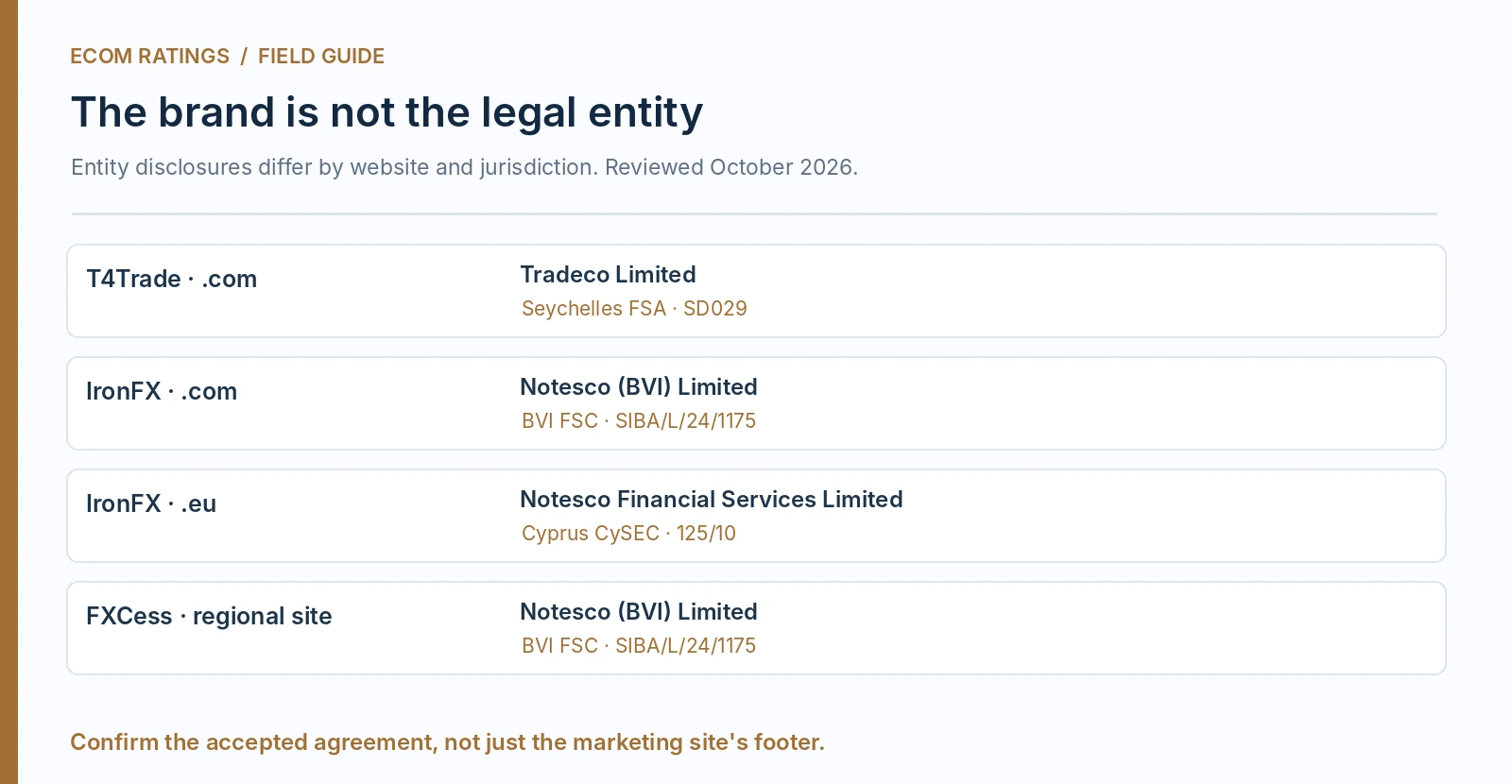
T4Trade’s published Client Services Agreement identifies Tradeco Limited, a Seychelles-incorporated company, and its Seychelles Financial Services Authority license SD029. The Seychelles FSA’s regulated-entities listing also associates Tradeco Limited with the T4Trade domain. IronFX’s global .com website identifies Notesco (BVI) Limited, while its European .eu legal-documents page identifies Notesco Financial Services Limited, regulated by Cyprus’s CySEC under 125/10. The FXCess regional website checked here identifies Notesco (BVI) Limited under BVI license SIBA/L/24/1175.
These disclosures should not be merged into one universal contract. The BVI Financial Services Commission’s public investment-business register lists Notesco (BVI) Limited as a currently regulated entity in relevant categories. That confirms information about the company in the register; it does not prove that a random customer using a different URL signed a contract with that company, and it does not extend Cyprus protections to a BVI account.
| Brand and reviewed site | Entity disclosed | Regulator or register | What still needs confirmation |
|---|---|---|---|
| T4Trade, t4trade.com | Tradeco Limited | Seychelles FSA, SD029 | Customer’s accepted agreement and jurisdiction |
| IronFX, ironfx.com | Notesco (BVI) Limited | BVI FSC, SIBA/L/24/1175 disclosed | Whether the opened account uses this entity |
| IronFX, ironfx.eu | Notesco Financial Services Limited | Cyprus CySEC, 125/10 disclosed | Whether customer is onboarded by EU entity |
| FXCess, fxcess-id.com | Notesco (BVI) Limited | BVI FSC, SIBA/L/24/1175 disclosed | Actual signup route and signed terms |
Why the website footer is useful but insufficient
A website footer gives the operator’s public representation at a particular address and time. It is a valuable first clue, not the entire contractual record. A broker may use country-specific sites, redirect applicants based on residence, publish localized terms or change its legal structure over time. A customer can enter through one marketing domain and later accept terms in a different registration portal. The accepted document, not an article about the brand, is the decisive evidence of the contracting counterparty.
A careful review records the exact web address, its regional suffix, the date, the legal entity in the footer, the link to the Terms of Business or Client Services Agreement, and the name in the account-opening confirmation. If the contract identifies another entity than the marketing page, pause to obtain an explanation before funding the account. A brand can operate within a legitimate multi-entity structure, but different legal parties can carry materially different obligations.
Do not infer ownership merely because two brands use a similar name, trading interface, promotional language or payment intermediary. For these three names, the public evidence supports specific disclosed entities on specific sites. It does not support the broader claim that all three are legally interchangeable. This distinction is especially important when search results reproduce old corporate descriptions without dates.
FXCess: why historical legal documents need a date stamp
The FXCess regional site examined for this guide currently says that services on that site are provided by Notesco (BVI) Limited and states BVI investment business license SIBA/L/24/1175. Its legal-document page expressly distinguishes those services from affiliate entities. The regulator’s own BVI register provides an independent company-level check. That combination is stronger than a generic third-party review asserting that FXCess is “licensed offshore” without naming a company.
There is, however, a genuine historical-document complication. A previously published FXCess Terms of Business document hosted under an fxcess.com PDF path identified Notesco Int Limited, incorporated in Anguilla with registration number A000001800. That archived document should not be silently rewritten as Notesco (BVI) Limited; the company names and jurisdictions differ. At the same time, a historical or cached PDF does not demonstrate which agreement a new applicant accepts today. Current document version, originating domain and individual onboarding record matter.
This is precisely the kind of information gap an ordinary “FXCess Review” often misses. A useful due-diligence question is not simply whether a regulator number is printed in the footer. It is whether the entity named in your particular agreement matches the name and license in the regulator’s current public register, and whether an older document is still used for your account. If those documents conflict, ask for a written clarification and save the response.
T4Trade: a different corporate name and a different regulator
T4Trade’s Client Services Agreement, version dated May 20, 2025, names Tradeco Limited, company number 8422971-1, and describes authorization under Seychelles FSA securities dealer license SD029. The agreement states that the English version prevails over translations and explains acceptance through electronic account opening. A reader should understand that clicking an acceptance box may be the act of entering a contract with the named company; it is not merely agreeing to a generic website cookie notice.
The Seychelles FSA’s regulated-entities page separately lists Tradeco Limited and websites associated with it, including T4Trade. Checking the register independently matters because promotional materials can be copied, outdated or used by an unrelated domain. A regulator listing tied to the exact legal company helps establish that the company and authorization exist, though scope and account eligibility still require scrutiny.
The disclosed Seychelles status does not establish that the account is supervised by Cyprus’s CySEC, the UK’s FCA or a U.S. securities regulator. Nor does a broker’s use of a familiar trading platform establish a local financial-services license in the customer’s home jurisdiction. Residents of countries with restrictions should check whether the service may legally be offered to them, separately from whether the company holds authorization elsewhere.
IronFX: the .com and .eu distinction is material
IronFX provides a clear example of why the domain and the contract must be preserved. The global ironfx.com disclosure examined here identifies Notesco (BVI) Limited, with BVI FSC license SIBA/L/24/1175. The European ironfx.eu legal-documents page instead identifies Notesco Financial Services Limited and CySEC license 125/10. Those are not interchangeable legal entities, even if both sites use the IronFX trading name.
A reader encountering a search result about IronFX’s CySEC license should not automatically assume that every account opened via the global domain benefits from the same investor-protection and complaint framework. Any available statutory compensation coverage, segregation rules, leverage limitations and dispute routes need to be read against the precise licensed entity, customer classification and applicable rules. We deliberately avoid asserting a universal compensation figure for all IronFX customers.
The global IronFX site also names NBV Management LTD as facilitating payment services to Notesco (BVI) Limited. A payment facilitator’s appearance on a bank or card statement does not by itself make that company your trading counterparty. It can be part of the payment chain without replacing the licensed provider of brokerage services. When you see multiple company names, ask which one is the broker, which receives funds, and which handles the payment as an agent or service provider.
How to verify a broker in an official register
Begin with the full legal company name, not merely the brand. Search the financial regulator’s official register and inspect the company entry for authorization status, permitted activities, registration identifiers and listed trading names or web domains where available. Save the register URL and date. A search result snippet is not proof: open the original regulator record and make sure it refers to the same company name, not a lookalike name.
For Notesco (BVI) Limited, use the BVI FSC regulated-entities investment-business pages. For Tradeco Limited, use the Seychelles FSA capital-markets register. For Notesco Financial Services Limited, use the Cyprus regulator’s records and the firm’s European legal disclosures. These are separate checks, because authorization granted to company A does not become company B’s authorization merely through a shared marketing group.
The next step is to read the scope, not just the status. The register may classify the firm as dealing as agent, dealing as principal or arranging investment transactions. Find out which activities the customer-facing agreement covers. Watch for suspended, withdrawn or historical entries; a once-valid authorization is not proof of current status. If a company is absent, do not automatically call it fraudulent; verify spelling, legal suffix and recent changes, and seek direct confirmation from the regulator.
Seven fields to capture from the actual agreement
A defensible evidence file should contain the legal name, company registration number, regulator and license number, registered address, governing law, dispute or complaint procedure, and the date/version of the accepted terms. These seven fields connect the marketing representation to the contractual party. Include any schedule on margin, execution, conflicts of interest, client money and withdrawals that formed part of acceptance.
Also save the URL and timestamp of the download, account-opening email, confirmation screenshot and any clickwrap receipt if available. Avoid relying on an account dashboard that may later replace old documents with newer versions. If the broker updates terms, retain both versions and identify when each purportedly applied. A later version may supersede the old one prospectively or under conditions spelled out in the agreement; do not assume which version governs an earlier transaction.
This record is valuable even if no dispute occurs. An accountant may need to establish who paid a withdrawal, a compliance reviewer may need the source of funds, and a customer may need to show which company acknowledged a complaint. The first objective is documentary consistency. If company names change across the paper trail, obtain a written entity-mapping explanation before treating the discrepancy as solved.
Geographic restrictions: a license is not an invitation to everyone
A company can be regulated in one jurisdiction and unable or unwilling to serve residents of another. The FXCess and IronFX websites publish lists of restricted jurisdictions. Their wording and coverage may differ by domain and update. A U.S. visitor in particular should not interpret the existence of a globally accessible English-language site as evidence that trading is available to U.S. residents. This article does not recommend opening an account with any of the three brokers.
Check residency, tax residence, professional or retail classification and any local solicitation restrictions against the applicable current terms. VPN use, a foreign telephone number or a payment card issued abroad does not create lawful eligibility. A client classified as professional in one legal regime may also face different protections from a retail client. Record the exact customer category instead of relying on statements about average leverage or bonus eligibility.
Regional terms influence operational expectations as well. Available payment methods, account leverage, negative-balance protections, complaint routes and legal jurisdiction can vary. That is why a “three brokers ranked by regulation” table can be misleading unless every row specifies an entity, country of residence, customer class and date.
Deposit recipients and payment intermediaries are not the broker
Customers often notice a surprising payee on their bank statement and assume the trading account belongs to that company. Sometimes a broker uses a payment service provider, collection agent or related company to process funds. That is a common structural possibility, but it should not be asserted as a fact about an individual transfer without documentation. The banking payee, licensed brokerage firm and website operator may be different parties with different roles.
Before depositing, verify payment instructions inside an authenticated, official portal and check whether the client agreement authorizes funding through named third parties. If you receive changed wire details by email, confirm through a known official channel. Keep transaction references, receipts and evidence tying the payment to the account. If withdrawal instructions point to a different entity or country, ask for the contractual basis for the route and the security checks required.
Do not treat a successful deposit as proof that the recipient is regulated to provide brokerage services. Equally, do not assume that a Cyprus-based payment facilitator makes a BVI brokerage contract CySEC-regulated. Regulation attaches to the relevant authorized entity and licensed activity, not to the location of every company in the payment chain.
What regulatory status does and does not tell you
A current regulator listing supports the conclusion that a named company has the listed authorization. It does not independently prove every advertised execution claim, withdrawal time or future financial condition. The regulator’s remit and available complaint mechanisms can differ sharply between jurisdictions. For a meaningful comparison, identify concrete customer protections and procedures that apply to the particular company and account category.
For example, an EU-regulated retail CFD relationship may involve a framework of retail conduct rules distinct from an offshore account relationship. That observation is about different regulatory structures, not a claim that every investor with an IronFX account automatically qualifies for EU protections. The applicable entity and residency must be established first. Avoid extrapolating from generic phrases like “funds are safe” or “fully regulated” without the underlying client-money terms.
The same caution applies to trading risk. A license never removes the possibility of market losses, margin closeouts or leveraged-product risks. All three brands’ public materials include warnings about losing capital. This article evaluates company identity and evidence quality, not whether a strategy, instrument or broker will be profitable.
A repeatable five-minute identity check before funding
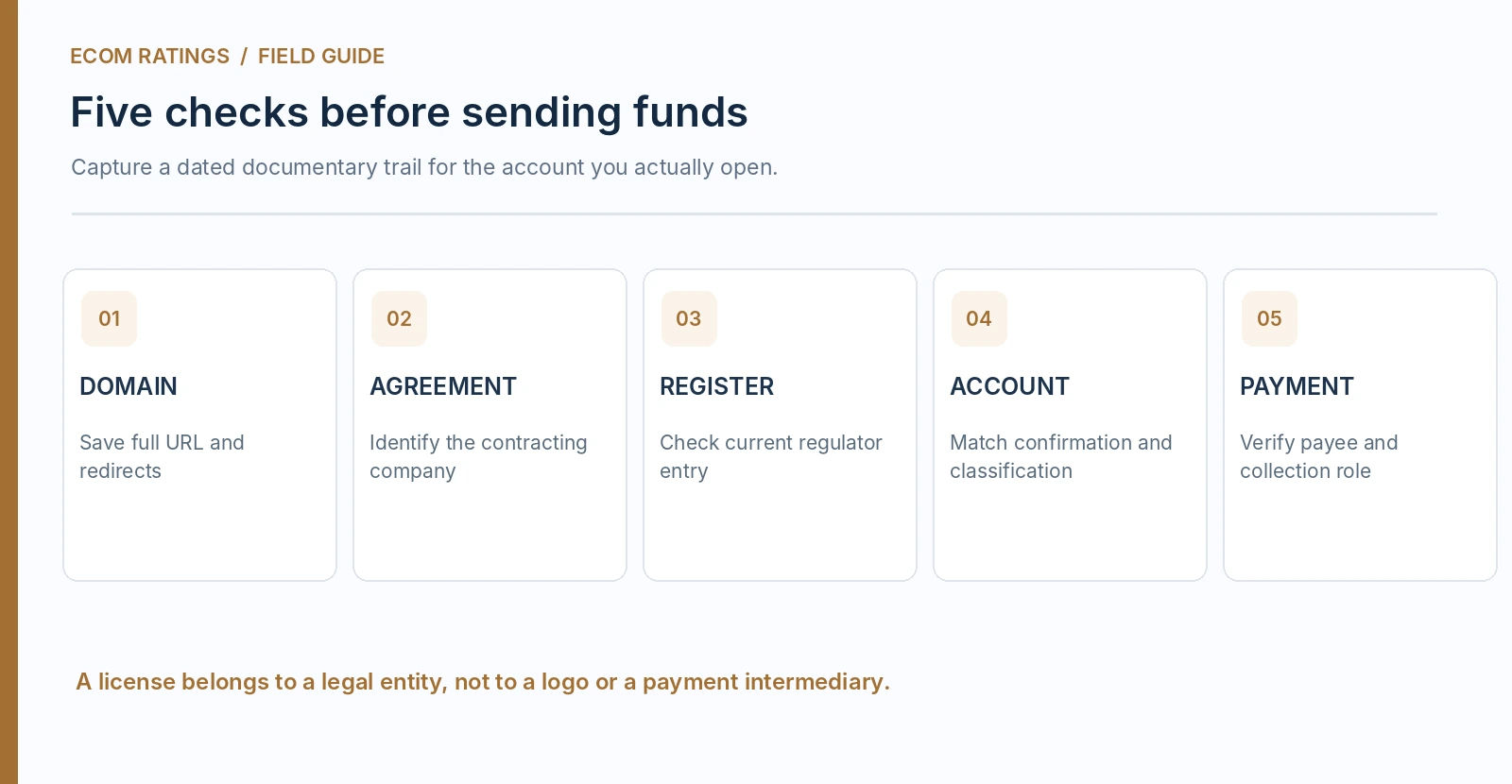
First, record the exact domain and any redirect reached through the sign-up button. Second, open the legal-documents section and download the agreement that onboarding asks you to accept. Third, underline the contracting company’s full name and identifier. Fourth, match that name against the proper regulator’s live register and note the licensed activity. Fifth, compare the legal name on the account confirmation and funding documentation with what you found.
If the parties do not align, stop at the documentary question: “Please confirm the legal entity with which my account contract is concluded, the applicable regulator and license number, and the governing-law clause.” Ask for the answer in writing. A broker may have a straightforward explanation involving a regional entity, but it should not require the reader to guess. Do not send identity documents to an unverified contact address supplied in a search advertisement.
A review publisher should run this protocol separately for every brand and region. Keeping a date-stamped evidence sheet makes later updates more credible and makes it possible to correct a stale article without silently changing the identity of a legal entity.
FAQ: questions often missed by broker comparison sites
Are FXCess, T4Trade and IronFX legally one company?
The reviewed public sources do not support treating all three as one contracting company. T4Trade identifies Tradeco Limited in Seychelles. IronFX and FXCess sources identify particular Notesco entities in BVI or Cyprus. Legal relationships, if any, do not erase the distinct parties named in their agreements.
Is IronFX always regulated by CySEC?
No such universal conclusion follows from the sources. Ironfx.eu identifies a CySEC-regulated Cyprus firm; the global Ironfx.com disclosure identifies a BVI company. A reader must identify the entity that accepted their individual account.
Which FXCess entity is the right one?
The checked FXCess regional site currently discloses Notesco (BVI) Limited. An earlier FXCess agreement publicly identified Notesco Int Limited in Anguilla. Treat version and account path as essential evidence. The accepted agreement and current regulator record control the factual answer for an individual account.
Does a payment processor’s name on my receipt identify my broker?
Not necessarily. A payment intermediary can collect or process funds without being the entity providing the trading service. Compare the receipt and payment instructions with the brokerage agreement, and ask for written clarification if the named parties differ.
Editorial conclusion
The best broker identity test starts with the exact legal entity on the document a client accepts. Current official materials point to Tradeco Limited for T4Trade, different Notesco entities across IronFX sites, and Notesco (BVI) Limited on the checked FXCess regional site. Historical FXCess documents reinforce why a brand-only answer is unsafe. Confirm the domain, contract version, regulator entry and payment-party roles before drawing conclusions about applicable protections. Corporate identity is verifiable; an advertising name alone is not a legal opinion.
Primary documentation and verification links
- Seychelles FSA: Capital Markets Regulated Entities
- T4Trade: Current Client Services Agreement (May 2025)
- IronFX global site: BVI entity disclosure
- IronFX EU: legal documents and Cyprus disclosure
- FXCess regional legal documents: BVI disclosure
- FXCess historical Terms of Business: Notesco Int Limited
- BVI FSC: Notesco (BVI) Limited in the investment-business register
- Ecom Ratings: FXCess profile
- Ecom Ratings: T4Trade profile
- Ecom Ratings: IronFX profile