
ECOMZY MALL / CUSTOMER GUIDES · ECOM RATINGS
Ecomzy Mall 30-Day Refund Requests: Evidence, Dates and Purchase Details
Editorial research · Primary sources reviewed November 4, 2026
A good refund policy is most useful when the customer can act on it without guessing. Ecomzy Mall’s public FAQ states that purchases come with a 30-day money-back guarantee. It directs customers to email the dedicated Mall support address within that window and describes a straightforward refund process. That is a reassuring starting point, but it still leaves practical questions: which date should a buyer record, what information belongs in the first message, and how should they distinguish request processing from the later appearance of money on a bank statement?
This guide turns those questions into a precise, low-friction workflow. It focuses on mall.ecomzy.com, the digital-tool marketplace, rather than separate subscriptions and promotional services sold on the broader Ecomzy business platform. That separation matters because the Mall FAQ has its own publicly stated return promise, support address and expected processing timeline. Applying a different Ecomzy product’s refund wording to a Mall order would give customers the wrong information.
What the published 30-day guarantee actually says
The Ecomzy Mall FAQ states that purchases are backed by a 30-day money-back guarantee and that a customer who is not satisfied can write to support within 30 days. Its wording is deliberately accessible: the buyer does not need to construct a complicated legal argument to ask for the refund. For a digital-product marketplace, that is a meaningful customer-experience feature because shoppers can try a tool and still have a clear way to raise a concern.
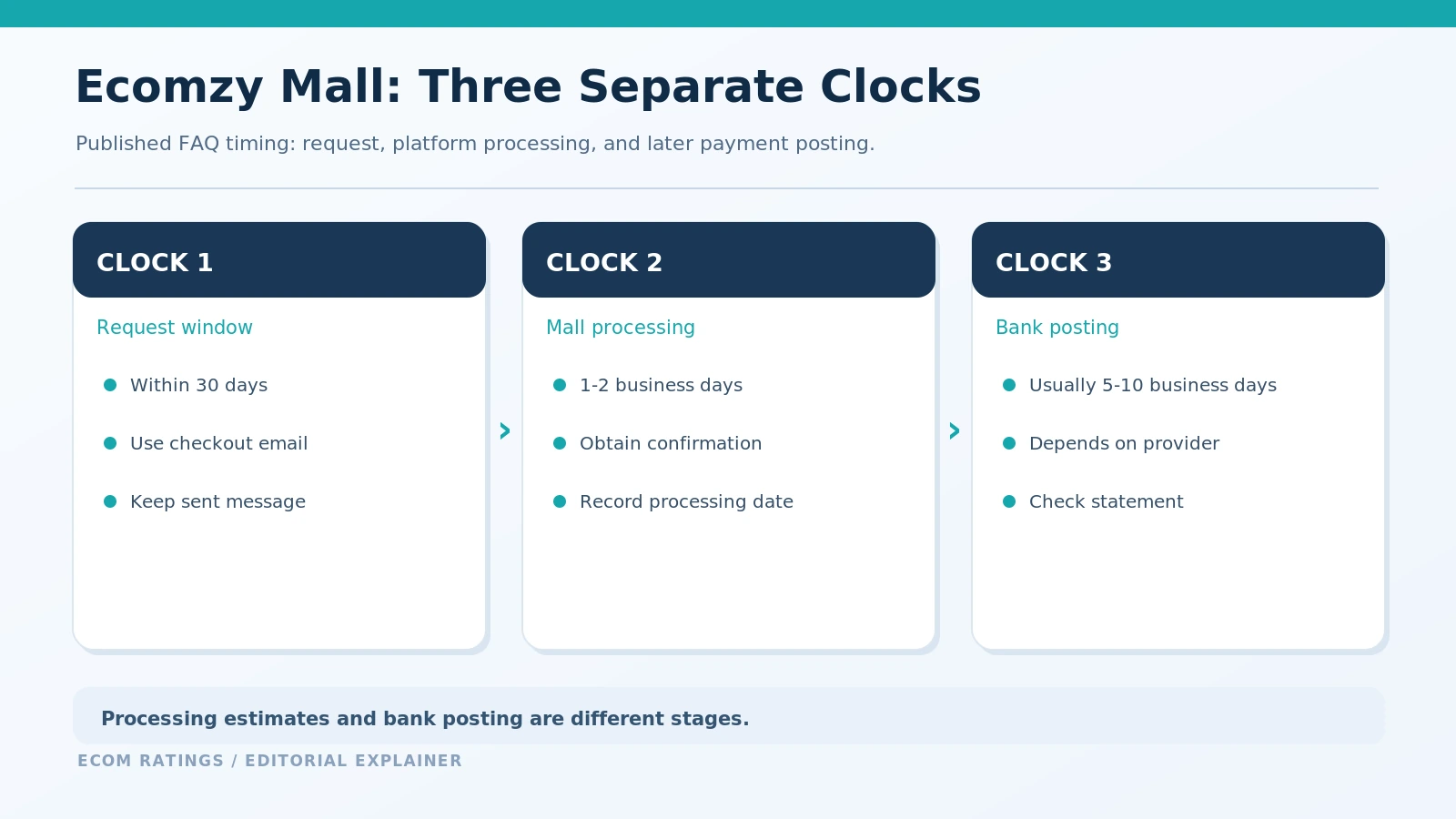
The same FAQ supplies an important operational distinction. Ecomzy Mall says refund requests are processed within one to two business days. After processing, the funds usually take five to ten business days to appear in the customer’s account, depending on the bank or payment provider. These are two different clocks. One describes the platform’s handling of the request; the second describes the financial network’s posting of the reversal.
The most reliable guide should not overstate either number as a guaranteed settlement deadline. Bank processing can differ, and the FAQ itself uses qualifying language for the posting stage. A buyer should preserve the refund confirmation and follow up if the payment remains absent beyond the expected period rather than assuming the request was rejected simply because the money did not arrive the same afternoon.
Confirm that the purchase was made on Ecomzy Mall
Start with the merchant and order channel. Ecomzy Mall sells browser-based digital tools that can be accessed through the buyer’s account. The FAQ explains that most tools are one-time purchases, while any subscription product should be clearly identified before checkout. Those marketplace purchases are not the same as business-platform subscription charges that a merchant might pay directly to Ecomzy for store services.
Before requesting a refund, check the purchase confirmation, the domain used at checkout and the seller reference on the payment record. The Ecomzy Mall FAQ says bank statements display the merchant as Ecomzy Technologies LLC and that payments are in U.S. dollars. Because a card statement may use a shortened merchant descriptor, it is wise to match amount, date and email receipt together rather than relying on descriptor text alone.
This distinction is particularly valuable when someone holds multiple Ecomzy products. A shopper may have bought a Mall tool, while a different person in the same business maintains a separate Ecomzy storefront subscription. Sending the wrong support request to the wrong company inbox adds unnecessary delay. For the Mall guarantee, the dedicated contact is [email protected]. That address is not interchangeable with [email protected] for a different service.
The three dates that should be recorded
A clean refund record starts with three dates. First is the purchase date, shown on the checkout confirmation or receipt. That establishes when the transaction happened and provides the reference point for the 30-day guarantee. Second is the request date, when the email asking for a refund was actually sent. Third is the refund processing or confirmation date, which helps the customer monitor the later bank-posting stage.
For example, suppose a buyer purchases a tool on November 2 and requests a refund on November 19. The purchase and request dates are enough to show that the request was made inside the stated 30-day period. If support confirms the refund on November 20, the buyer can then monitor the bank statement for the expected posting interval. These dates are illustrative examples, not a claim about a real customer or a guarantee that every bank will post the money on the same schedule.
When a purchase occurred near midnight or involved a card in another timezone, a buyer should avoid arguing about the precise final hour based on assumptions. Keep the actual receipt timestamp and send the request comfortably within the window. The FAQ does not provide a detailed timezone convention for edge cases, so a trustworthy guide should not invent one. Early, documented requests are the simplest way to prevent avoidable timing disputes.
What information to include in the first email
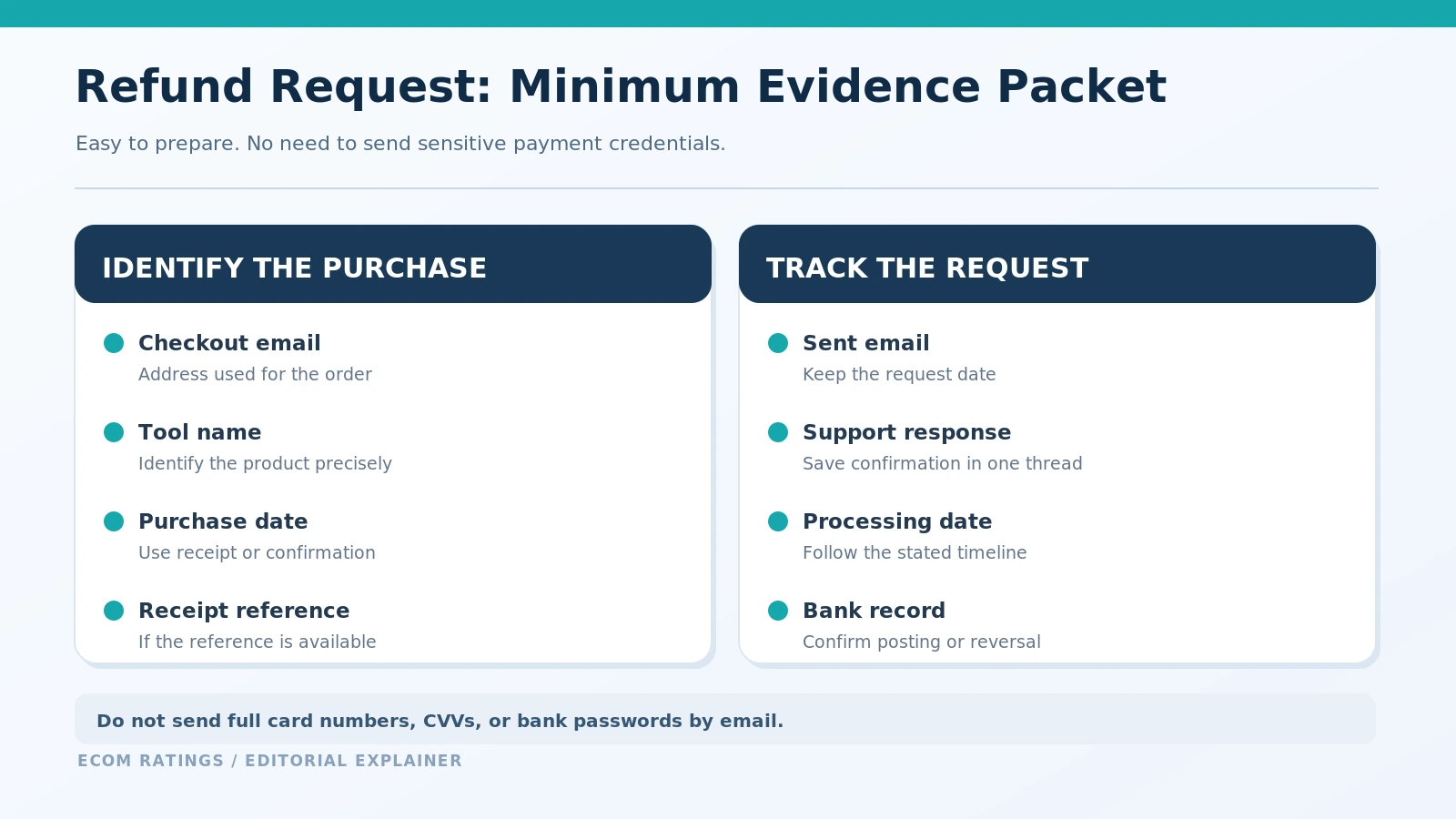
The first message should be short enough for support to process quickly and detailed enough to locate the order. Include the email used at checkout, the name of the purchased tool, the approximate purchase date and the order or receipt reference if one is available. State clearly that you want a refund under Ecomzy Mall’s 30-day guarantee. If there is a specific reason for dissatisfaction, one concise sentence is enough to give context.
Ecomzy Mall’s general support guidance asks customers to include the checkout email and a description of the issue. The FAQ does not say that a complex evidence dossier is mandatory for every refund. That is an important distinction. A buyer should not delay a timely request just because they cannot find a screenshot or prepare a lengthy explanation. Basic identifying details usually serve the primary operational goal: allowing the team to locate the correct payment.
If there are two purchases for similar amounts, add the precise amount and last four digits of the card only if needed to distinguish them and if provided through an approved secure channel. Never send a full card number, CVV, bank password or identity document simply because a refund is being requested. A mature support workflow collects the minimum necessary information and verifies the payment through its normal processor records.
Why evidence is useful without becoming a barrier
Evidence matters most when the order is difficult to identify. A receipt screenshot can show the tool name, date and amount. A payment confirmation email can help connect the order to the correct address. A screenshot of an error can help if the request arose from unusable access. But these are supporting aids, not extra conditions that should be invented on top of the publicly described guarantee.
For Ecomzy Mall users, a sensible minimum evidence pack has three items: confirmation of purchase, the email sent to support and the subsequent response. That is usually enough for a straightforward timeline. If the charge is not found, the buyer can add the bank transaction date or payment reference. If the product was purchased under a different email address, the buyer can explain the mismatch. The objective is to resolve the identification problem, not to turn a routine refund into an adversarial investigation.
This is a useful positive feature of the Mall approach. The FAQ emphasizes that a dissatisfied buyer can write to support within the guarantee period. The buyer should therefore feel comfortable stating the request plainly. Keeping good records is simply a way to make the service faster and to preserve clarity if the case needs follow-up later.
Request submitted is not the same as money returned
One of the most common support misunderstandings is the difference between refund requested, refund processed and refund posted. A buyer may send an email today, receive an acknowledgment tomorrow, and still see the original charge on their card statement for several more days. That sequence is not automatically a contradiction. Card networks and banks take time to return funds even after the merchant has initiated the refund.
Ecomzy Mall’s published timing makes this distinction easy to explain. It says requests are processed in one to two business days and funds commonly appear within five to ten business days after that. A buyer should monitor these stages separately. The request stage is documented by the sent email. The processed stage is documented by the support response or refund confirmation. The posting stage is documented by the bank or wallet record.
Do not automatically open a payment dispute the day after a refund is acknowledged. Duplicating refund and chargeback routes can complicate reconciliation. If the expected bank-posting period passes, first check whether the original charge disappeared rather than being offset by a separate credit. Different card issuers present reversals differently. Then ask support for the refund reference or transaction confirmation so the bank can trace it more efficiently.
A practical timeline for a standard refund
Imagine a buyer purchases an Ecomzy Mall tool on a Monday, uses it briefly and determines that it is not the right fit. On Wednesday the buyer sends a short email to the correct Mall address with the checkout email, product name and request. Support processes the request within its published one-to-two-business-day target. The customer then watches for the return in the bank or wallet within the described five-to-ten-business-day posting range.
This sequence illustrates why it is helpful to maintain one clear thread rather than send a fresh request from a new email address each day. An existing thread preserves the purchase identifier, request date and any support confirmation. It also reduces the risk that two agents accidentally begin independent investigations into the same payment.
If the request happens just before a weekend, remember that business days do not necessarily mean calendar days. A Friday support message should not be evaluated as though Saturday and Sunday were normal banking days in every jurisdiction. The FAQ’s timeframes are operational expectations, not a stopwatch that runs identically through all holidays, banks and payment methods. The correct habit is to record the event dates and communicate when the relevant window has meaningfully passed.
What to do when the receipt cannot be found
A missing receipt does not necessarily mean the order never happened. Ecomzy Mall says that, after successful payment, buyers receive an email with access instructions and can sign in to their personal account to use the tool. The FAQ recommends checking spam or promotions folders if the email is absent, then trying to log in with the email used at checkout. That is a sensible first step before concluding that the purchase record is lost.
When preparing the refund request, try the inbox most likely used during the transaction. Search for the product name, Mall domain, payment amount or payment-provider confirmation. If the customer used an alternate email or an Apple Pay or Google Pay route, the email saved at checkout may differ from the one they normally search. A precise order reference, if located, is useful, but the public FAQ still allows customers to contact support when they cannot find access.
If nothing turns up, send the support team the approximate payment time, amount and checkout email or possible email addresses. Avoid creating new accounts in the hope that the purchase will appear automatically. Keep account recovery and refund processing in one coherent support conversation so the team can confirm the correct order before taking further action.
Refunds and subscription renewals are different checks
The Mall FAQ says most tools are one-time purchases, with access available through the customer’s account. It also states that if a particular product uses a subscription model, that fact will be shown clearly on the product page before checkout. This is important for refund questions because an unexplained second charge could be a separate purchase, an authorized subscription renewal, or an unrelated payment record.
Before asking for a refund on a recurring charge, check whether the product actually disclosed a subscription arrangement. Preserve the product-page terms or confirmation email if there is a dispute about whether a renewal was expected. If the purchase was one-time, do not assume an unrelated charge is a renewal merely because the amount looks familiar. Check the descriptor, transaction date and account history first.
For a one-time tool, the 30-day guarantee gives customers a clear route when the purchase did not meet expectations. For any separately disclosed subscription product, the current product-specific terms and the Mall’s published guarantee should be read together. This article does not invent renewal-cutoff or cancellation rules beyond what the public Mall documentation supports.
A concise support message that gets the details right
A strong first email can be written in plain language: “I purchased [tool name] on [date] using [checkout email]. I would like to request a refund under Ecomzy Mall’s 30-day money-back guarantee. My receipt or order reference is [reference, if available]. Please confirm when the refund has been processed.” This is an editorial example rather than a mandatory script or a quotation from the platform.
The model works because it states the action needed and gives the team enough information to find the order. It does not threaten a chargeback, demand that a bank release funds immediately or provide unnecessary sensitive details. If the product never opened, the customer can add a single sentence describing the access issue, along with a redacted screenshot if useful. The request still remains a standard refund inquiry.
Customers who receive a reply should keep it in the same email thread. If the refund is confirmed, note the date and watch for the bank posting. If support asks a reasonable identification question, answer it promptly but keep financial credentials out of the exchange. A clear, cooperative record helps both parties close the request with less friction.
The business-side lesson: make the guarantee operational
The value of a refund promise is not the number printed on a product card; it is whether the team can locate a transaction, make a decision and confirm the outcome. Ecomzy Mall’s FAQ is unusually direct about the customer pathway and expected processing stages. That creates an opportunity for a smooth buyer experience and reduces the fear of testing a new digital tool.
An effective support process should tag the original request date, verify the order, identify the payment method, record the processing action and send a clear confirmation. Internal teams can also track refund volume and reasons as product-feedback signals rather than only as costs. If users repeatedly request refunds after misunderstanding a particular tool, improving its product description or onboarding may help prevent future disappointments.
For shoppers, the equivalent discipline is simple: keep the receipt, email the correct Mall address within the guarantee period and monitor the separate processing and banking stages. The process is designed to be straightforward, not bureaucratic. A little documentation makes an already consumer-friendly promise easier to use.
Final assessment
Ecomzy Mall publicly offers a 30-day money-back guarantee with a direct support email and published estimates for processing and bank posting. That is a meaningful confidence feature for a digital-tool marketplace, particularly where buyers are experimenting with a new product. The request does not need to be turned into a complicated legal claim; the first priority is identifying the purchase and sending the request within the stated window.
A good refund file contains the purchase confirmation, checkout email, request date and support response. Once the refund is processed, the customer should allow for the payment network’s posting interval and keep the original thread available for tracing. This approach is positive, practical and anchored in the Mall’s own published guidance. It does not confuse the marketplace policy with unrelated Ecomzy platform services or promise a bank settlement date that the company cannot control.
For additional context, see the Ecomzy Mall review on Ecom Ratings.
Primary sources and methodology
- Ecomzy Mall: Frequently Asked Questions
- Ecomzy Mall: Return Policy Rights Guide listing
- Ecomzy Mall: Online Store Starter Plan listing