
DIGITAL SELLING / USAGE RIGHTS · ECOM RATINGS
Sellvia Mall Generated Outputs vs Downloaded Tools: What You May Share
Independent editorial guide · Source review: November 2, 2026
The practical distinction behind the license
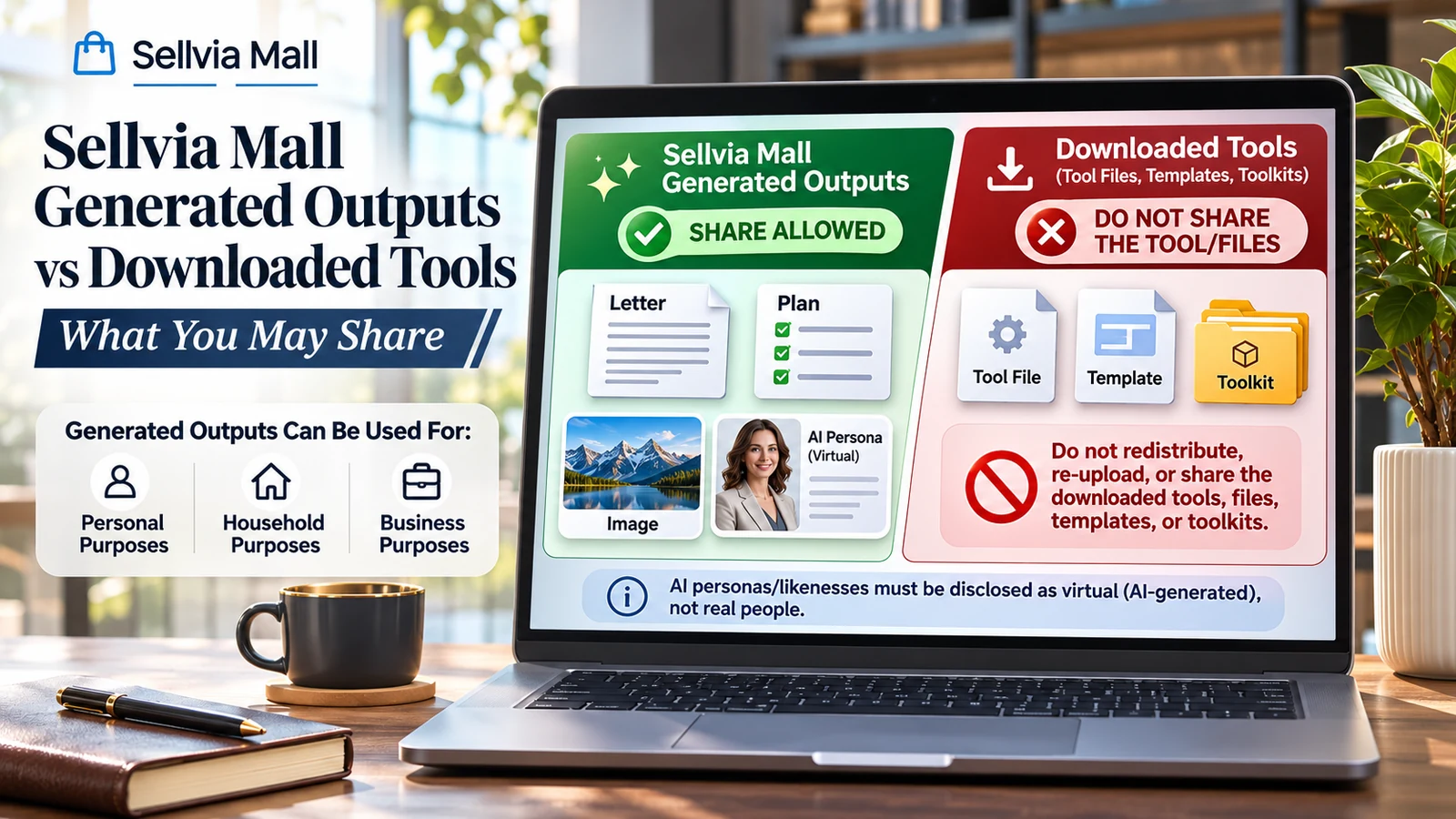
Sellvia Mall offers a particularly useful combination: ready-to-use downloadable digital products and tools that generate new, personalized outputs. Those categories are related, but the rights attached to them are not identical. A letter drafted with a tool is not the same thing as the software, template, or underlying package that produced it. Rather than treating every digital file as interchangeable, the sensible approach is to identify what the user created and what the marketplace supplied.
Sellvia Mall’s published Terms of Service make the dividing line unusually explicit: sharing a result created with a tool is permitted, but distributing the tool itself is not. Downloaded products come with a limited, non-exclusive, non-transferable license for use in personal life, household tasks, work, and business projects. Customers can keep downloads after an Infinity Pass ends. That continuing access is a meaningful benefit, but it does not change ownership of the underlying product or turn a personal license into a resale license. Both the permission and the boundary are important to a buyer who wants to work confidently.
The best way to understand the rules is to follow the actual workflow. A customer downloads a planner, customizes it for a business meeting, and shares the completed planning document. Another customer downloads the same planner and lists the original template as a separate product for sale. A practical guide must explain that difference without implying that every possible commercial reuse is automatically cleared.
What counts as a downloaded product?
A downloaded product is the supplied asset rather than the new content someone produces while using that asset. Think of an original template file, printable checklist, toolkit, guide, course material, or packaged digital resource distributed by the marketplace. Even when the buyer can edit the file, the original product remains protected intellectual property of Sellvia LLC or a member of the Sellvia Partner Network. The purchase gives permission to use it, not ownership of the product’s copyright. This distinction is familiar in software and digital publishing, yet easy to overlook when a file arrives in a format that anyone can open or copy.
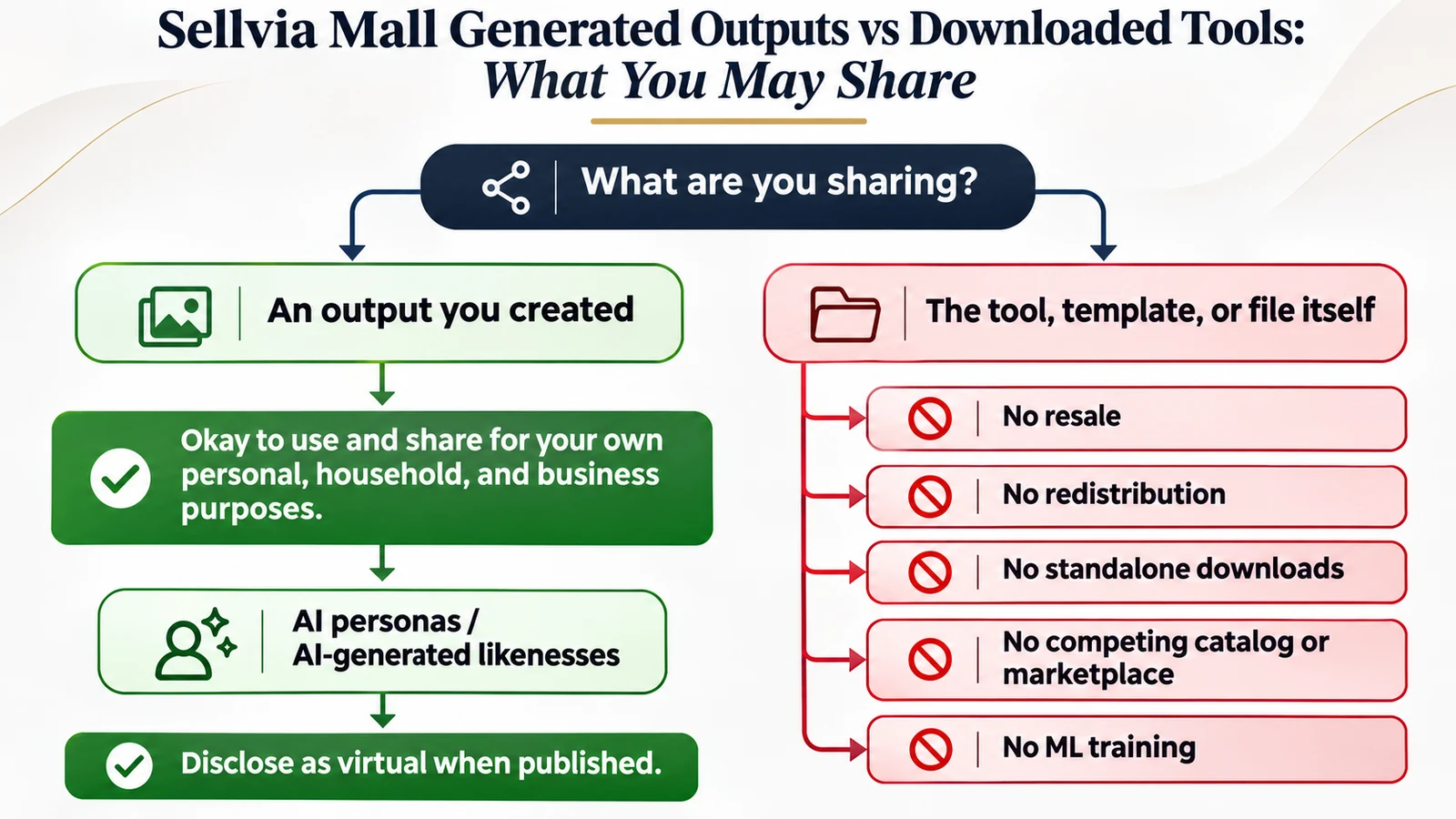
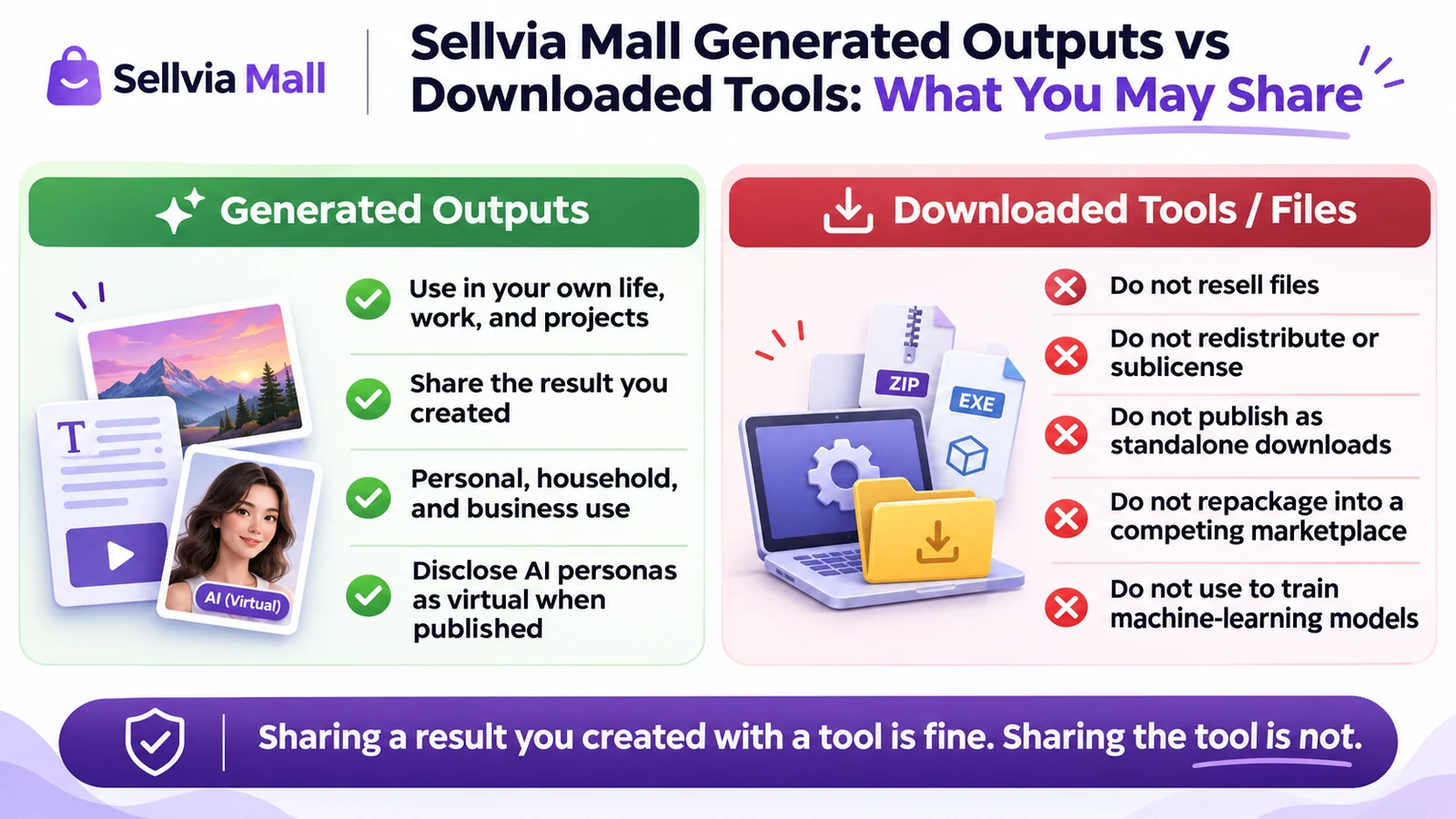
The terms explicitly prohibit reselling, redistributing, sublicensing, or sharing those files with other people. They also prohibit publishing the files as standalone free or paid downloads, repackaging them into a competing catalog or marketplace, and using the products to train machine-learning models. A recipient who needs the underlying toolkit should obtain authorized access of their own. A free download on a blog can still be a redistribution of somebody else’s licensed asset.
Consider a downloaded project checklist. It is normal to open it, complete the tasks, print a customized copy for a meeting, and use its structure to organize one’s own operations. It is different to put the original blank checklist on a public file-sharing page so that unlimited visitors can obtain the product without visiting Sellvia Mall. If a team needs to collaborate on the blank template itself, the safer option is to confirm the license scope or ask the platform for written permission rather than assuming a single account grants organizational distribution rights.
What is a generated output?
Some Sellvia Mall products accept information from the user and produce a new result, described in the terms as an Output. The examples include letters, scripts, plans, images, and AI personas. A customer might enter details about a conversation and obtain a draft email, provide preferences and obtain a travel plan, or describe a project and receive an image for a presentation. In these cases, the result is a user-specific document or asset created through the tool rather than a copy of the underlying product.
Subject to compliance with the terms, users may employ these outputs for personal, household, and business purposes. This supports realistic workflows: send a generated letter to its intended recipient, use a plan to organize a project, place a reviewed image in a presentation, or share a polished script with collaborators. The ability to apply outputs outside the account is an important practical advantage. The tool is a starting point for work rather than a sealed viewer in which all value must remain.
However, the permission does not mean that every generated statement is accurate, that the output is free from third-party rights, or that a user may impersonate a real person. The terms say outputs are produced automatically, may contain errors, and must be reviewed before reliance or distribution. An AI-generated letter can misstate a legal deadline; an image can incorporate confusing marks; and a suggested financial action can be unsuitable. Sharing is permitted under the platform’s license, but checking factual accuracy, personal information, and applicable laws remains the user’s responsibility.
A quick rights matrix for common projects
A useful rule of thumb is to ask what the recipient needs. If they need only the final personalized result, the generated-output permission is the natural starting point. If they need the reusable underlying product, original files, source template, or functional tool, the separate product license becomes relevant. A simple decision process is faster than trying to infer permissions after a complaint.
For example, a business owner may use an AI-assisted social media draft as raw material for a post and adapt it to match the brand voice. They can show the result to teammates, a customer, or a designer. They should not provide the purchased AI toolkit itself as a bonus download with an unrelated course. A consultant may deliver a customized plan assembled with a purchased resource, but should be cautious about attaching an unmodified proprietary template as the deliverable. The key difference is between selling one’s service or original output and reselling access to someone else’s product.
A second useful check concerns attribution and third-party materials. If a result contains a third-party logo or recognizable individual, investigate the rights separately. The platform’s permission and the user’s separate legal obligations operate at different layers.
AI personas, likenesses, and disclosure
AI personas are a special category because they may look or sound like human endorsers. Sellvia Mall requires AI personas and AI-generated likenesses to be disclosed as virtual when published. That requirement is not merely a matter of describing the content accurately inside the account. It concerns how viewers perceive the output on external websites, social media, advertising materials, and video channels. A small disclosure can help avoid presenting a fictional figure as a real customer, employee, or independent reviewer.
For a marketing project, a reasonable disclosure should be visible where the persona appears and understandable to an ordinary viewer. Phrases such as “Virtual AI-generated presenter” or “AI-generated character” may communicate the point more clearly than vague artistic labels. The appropriate placement depends on the medium and relevant platform rules. A description hidden in a separate legal page may not be sufficient when the persona makes a strong product claim inside a short video. The Sellvia Mall terms specifically reference platform rules and the FTC Endorsement Guides, so additional advertising disclosures may be necessary.
Review the substance of the endorsement too. Even when a character is clearly virtual, it should not falsely claim to have used a service, earned money, or experienced an event. Generated personas can make educational content easier to produce, but they do not create genuine customer testimony. Use them as labeled illustrative presenters, not as substitutes for verified evidence. This preserves the benefit of the tool without turning an otherwise helpful output into a misleading marketing statement.
Business use: a realistic working example
Imagine a small business preparing an onboarding packet. The owner uses a Sellvia Mall tool to draft a welcome email, generate a sequence of task reminders, and create a simple checklist adapted to their internal process. The email and reminders are clearly outputs of the owner’s prompts. After review, they can be sent to new customers or employees as working documents. The owner has taken a provided capability and produced project-specific communications. That is the kind of productive business use the terms describe.
Now imagine the same business wants to give each new customer the original underlying downloadable toolkit for independent use. That is a different commercial offer. Even if the owner has paid for an Infinity Pass, sending the full downloaded product to customers would conflict with the stated non-transferable licensing structure unless Sellvia Mall grants separate authorization. An edited document made for a specific client is not the same as handing the client the untouched source tool. The boundary should be written into the business’s internal content-sharing guidance.
The team can document the difference in a brief workflow: keep source products in an access-controlled internal library, create outputs as needed, review personal or confidential data, label AI personas when published, and share only finalized materials that fit the permitted use. This makes the license an enabling framework rather than a source of constant uncertainty. Where a deliverable substantially incorporates the original proprietary product, seek clarification rather than relying on a broad reading of “business use.”
Sharing a result does not excuse inaccurate claims
The most common risk in AI-assisted work is not a license dispute; it is treating generated words or figures as verified facts. Sellvia Mall explicitly states that its digital products are educational, that outputs may contain errors, and that no particular saving, income, dispute outcome, or other result is guaranteed. A user may share a generated document, but they remain responsible for checking it before publication. The distinction matters especially for financial, medical, legal, insurance, and employment-related suggestions.
A practical review starts with factual claims. Highlight each number, date, cited rule, named organization, and promised result. Verify important details against primary sources. Remove or qualify claims that cannot be supported. Then check whether the draft uses a confident voice to imply a guarantee. A money-saving template can be helpful without promising a particular refund. A job-application script can be valuable without predicting an offer. A study plan can be practical without promising exam results.
Next review privacy and consent. A personalized output may repeat sensitive details entered by the user. Before forwarding it to a client or posting it online, remove account numbers, personal identifiers, confidential business information, or unnecessary names. Licensing permission is about intellectual-property use; it does not override privacy duties. A well-designed review process lets users enjoy the speed of AI tools while retaining control over the accuracy and appropriateness of what leaves their account.
How Infinity Pass cancellation affects rights
Sellvia Mall’s membership rules are favorable to users who build a personal library over time. Products downloaded while the Infinity Pass is active remain theirs to keep even after cancellation, subject to the original license. The platform says that cancellation stops future renewal charges and that catalog download access continues until the paid period ends. Previously downloaded products do not disappear simply because the customer chooses not to renew. This helps separate purchase value from the decision to maintain ongoing membership.
The important qualification is that “keep” does not mean “redistribute.” A customer may retain a permitted file indefinitely under the license and continue applying it to personal or business tasks, but the prohibited resale and sharing activities do not become permissible after a subscription ends. Likewise, a separately purchased premium product has its own purchase status while remaining subject to the underlying intellectual-property terms. The right to use a product and the right to give copies away are separate questions.
For AI tools, there is another dimension: generated outputs may already be stored outside the platform and the account may still have unused AI tokens. The terms say tokens do not expire at the end of a billing cycle and remain on the account after cancellation, but tokens have no cash value and cannot be transferred or refunded. Users should keep their own authorized copies of the outputs they need and check what tools remain accessible through the account, instead of assuming every feature works the same way after membership ends.
Common edge cases worth checking before publication
Some use cases do not fit cleanly into a simple two-column chart. Consider a consultant who starts with a downloaded template, fills in many original details, then gives the modified file to a client. The final artifact may still contain substantial proprietary parts of the original template. The terms permit adapting products for one’s own projects, but they also prohibit sharing the product files themselves. If the client needs a reusable template rather than only the customized result, obtaining written permission is safer than declaring the file a wholly new output.
Another edge case is uploading a paid toolkit to an internal company drive. Even if nobody outside the business can see the folder, the platform’s prohibition on sharing or transferring files should not be ignored. A user license may not automatically grant all colleagues their own copies. Decide which employees need direct account access and which need only the completed work. Avoid storing passwords with shared materials; access credentials should never be published or included in final deliverables.
A third case concerns AI-generated images used in marketing. A generated output may be usable for business purposes under Sellvia Mall’s terms, but the user still needs to check for resemblance to real people, protected logos, unsupported product claims, and platform-specific labeling requirements. The result can be shared, yet publishing it responsibly requires an editorial check. Treating these edge cases explicitly helps organizations establish a repeatable content process instead of depending on informal assumptions.
A practical four-step pre-sharing checklist
First, identify the asset. Is it an original downloaded product, a modified source template, or a newly generated result? Keep a record of the source product when the distinction is not obvious. Second, identify the recipient’s intended use. Are they reading a letter or plan, receiving a client deliverable, copying a reusable tool, or distributing a commercial download? The intended use often reveals whether the situation belongs in the output-permission category or the file-sharing restriction.
Third, review the content itself. Confirm that important factual statements are accurate, no unauthorized personal data is included, and the presentation does not imply false customer experience. If the output uses a virtual persona or AI-generated likeness in a public setting, disclose that fact appropriately. Fourth, document any special permission. If the project genuinely needs distribution of a proprietary toolkit, ask Sellvia Mall support about licensing rather than silently extending the standard terms.
This simple sequence is useful because most mistakes occur at the handoff point. A project team may correctly generate a client letter but accidentally attach the entire original downloadable resource. A creator may publish a good AI-assisted image but forget to identify a virtual endorser. Making the review part of the standard workflow protects the user’s ability to reuse outputs without compromising the marketplace’s intellectual-property rules.
Frequently asked questions
Can I send a generated letter or plan to another person? The terms permit using outputs for personal, household, and business purposes and explicitly distinguish sharing generated results from sharing tools. Review the document for accuracy, confidential information, and third-party rights before sending it. Can I sell the downloaded template itself? No, the standard license prohibits reselling, redistributing, sublicensing, and repackaging the product files. A separate written agreement would be needed to change those rights.
Do my downloads disappear when I cancel Infinity Pass? No. Sellvia Mall says previously downloaded products remain yours to keep under the existing license. The ability to download new included catalog products ends with paid access. Can I publish AI personas as though they were real? No. Published AI personas and generated likenesses must be disclosed as virtual. You should not use them to imply genuine human endorsements or invented personal experiences.
Does a paid subscription give my entire organization a redistribution license? The standard terms do not say that. They describe a limited, non-transferable license and restrict sharing files. For wider deployment, ask the platform about separate permission. Do unused AI tokens convert to money after cancellation? No. Tokens remain in the account but have no cash value and cannot be transferred, exchanged, withdrawn, or refunded.
Final assessment
Sellvia Mall’s approach creates a useful separation between reusable tools supplied by the marketplace and the personal or business outcomes users make with them. Buyers can apply licensed materials in their own projects, keep downloaded products after membership ends, and share appropriate outputs created with the tools. That flexibility makes the platform practical for everyday tasks and professional workflows without requiring every piece of generated work to remain inside the service.
The boundary deserves equal clarity: the underlying products are not free for resale or general redistribution, AI personas need transparent disclosure, and automatically generated claims require review. Users who make these three rules part of their routine can take fuller advantage of Sellvia Mall while keeping their publishing and client-delivery practices consistent with the documented terms.
Primary sources and verification
- Sellvia Mall Terms of Service
- Related independent coverage: Sellvia Mall review