
PLATFORM RESEARCH / SHOPIFY B2B PAYMENTS · ECOM RATINGS
A practical decision guide for merchants who need to separate ordinary net terms from deposit and partial-payment controls.
Editorial research · Sources verified October 26, 2026 · Practical implementation guide
THE ESSENTIAL RULE · Net terms and deposits are different
Shopify lists net payment terms across its B2B plans, but deposit requirements, partial payments, and payment requests by fulfillment are Plus-only capabilities. Many merchants think of all of these as “pay later” tools, yet they solve different cash-flow problems.
Verified against Shopify documentation: October 26, 2026. Shopify B2B has become more accessible on lower-tier plans, but payment control remains one of the most important dividing lines between ordinary B2B support and the more advanced workflows available on Shopify Plus. The specific confusion appears again and again in search: can a merchant offer net terms on Basic or Advanced, and if so, does that also mean they can require a deposit or collect the remainder in stages? The answer is no.
This article focuses on that gap. It explains the difference between net terms and deposits, shows which payment controls appear in Shopify’s current B2B plan matrix, and walks through realistic cases where the missing feature is not B2B itself but the particular payment workflow a merchant wants. In other words, the useful question is not “Do I need Plus for B2B?” but “Which payment behavior am I actually trying to create, and is that behavior part of the lower plans or a Plus-only control?”

The short answer: net terms are broadly available; deposits are not
| Capability | Basic / Grow / Advanced | Shopify Plus |
|---|---|---|
| Net payment terms for B2B companies | Available | Available |
| Payment reminders | Available | Available |
| Vaulted credit cards / ACH where supported | Available in the documented matrix | Available |
| Deposit requirements for companies | Not available | Available |
| Deposit requirements on draft orders | Not available | Available |
| Partial payments | Not available | Available |
| Payment requests per fulfillment | Not available | Available |
That matrix is the heart of the article. A merchant on Basic, Grow, or Advanced can absolutely run B2B accounts and offer net terms. They can let a company pay immediately, in seven days, in thirty days, or on other documented term structures. What they cannot do on those plans is configure a required percentage deposit as part of those payment terms, or use the broader Plus-only advanced payment controls that support staged payment collection more flexibly.
Why merchants confuse these features
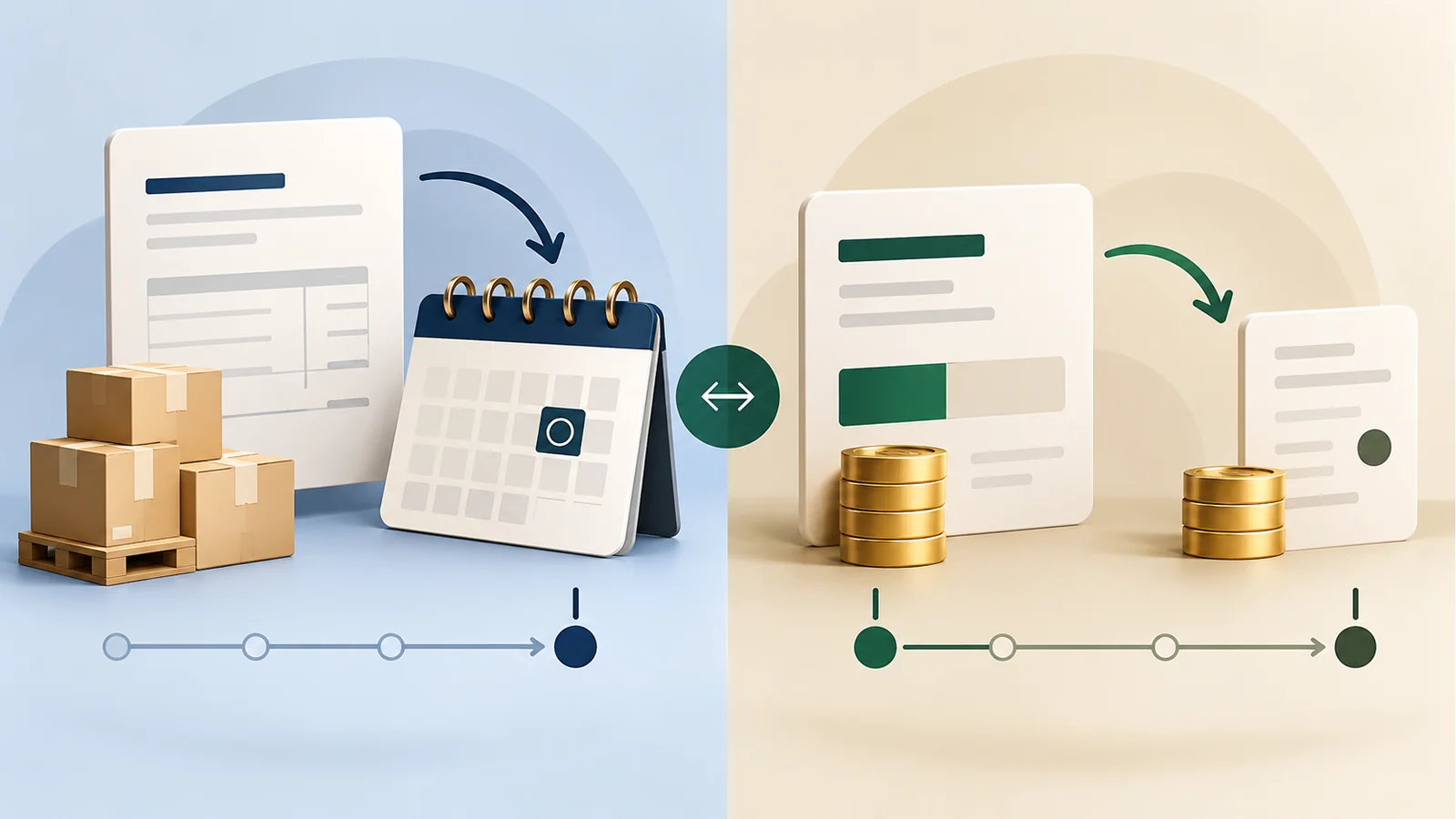
Operationally, both net terms and deposits feel like “not fully paid today” workflows. A buyer checks out, the order is created, and some or all of the cash comes later. But the commercial meaning is different. Net terms answer the question, “How long does the buyer have to pay?” Deposits answer the question, “Must the buyer commit part of the money now?” Those are separate controls, and they matter differently to risk, cash flow, and fulfillment policy.
A second reason for confusion is that Shopify’s B2B expansion onto lower plans changed the old mental model. Historically, some merchants associated almost all serious B2B workflows with Shopify Plus. Today, companies, locations, catalogs, and net terms are no longer restricted in that same way. However, the advanced payment layer still creates meaningful plan separation. Search results often compress those nuances into a vague claim like “B2B is available on Basic now,” which is true but not detailed enough for payment workflow planning.
What net terms actually do in Shopify B2B
Net terms let you define when payment is due after order creation. Shopify documents options such as due immediately, net 7, net 15, net 30, net 45, net 60, and net 90, as well as due on fulfillment and, for draft orders, fixed dates. These terms can be assigned to company locations and also applied on draft orders. Customers can then see the terms on their orders and, during the term period, log in and pay earlier if they choose.
This is extremely useful for wholesalers whose main commercial need is extending credit rather than splitting collection into multiple payment events. A merchant might allow established retailers net 30, ship after standard credit approval, and then collect through saved payment methods or manual processes in the admin. That is not a weak version of B2B. It is a perfectly valid B2B workflow. The limitation arises only when the merchant wants to mix “pay later” with a required partial payment upfront.
What deposits add on top of net terms
Shopify describes deposit requirements as an addition to payment terms. A merchant can require that a percentage of the order be paid when the order is created, with the remaining balance due according to the selected payment terms. Conceptually, this creates a hybrid workflow: partial cash collection now, deferred collection later. Shopify also notes that deposits can be paid by credit card or by a manual payment method such as a bank deposit.
From a business standpoint, this changes the risk profile of the order. Net terms without a deposit extend more unsecured credit. Net terms with a deposit mean the buyer still receives terms, but the merchant reduces exposure and improves cash flow. This is exactly why some merchants discover that lower-tier B2B support is not enough for their use case: the business does not merely want to invoice later; it wants to invoice later after collecting a meaningful commitment upfront.
Which features require Shopify Plus
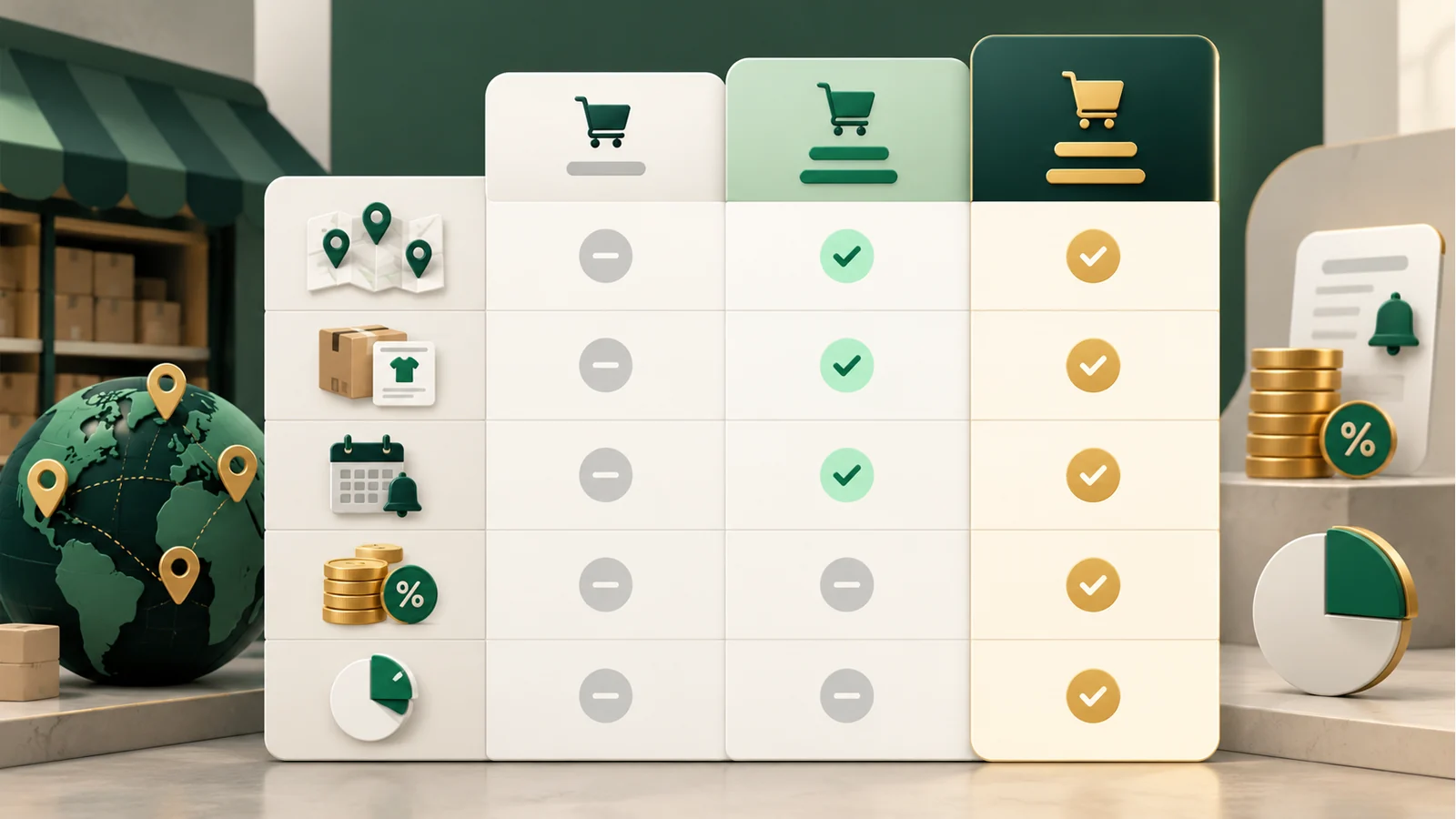
According to Shopify’s current B2B plan comparison and payment-terms documentation, the advanced payment controls that require Plus include deposit requirements for companies, deposit requirements on draft orders, partial payments, and payment requests per fulfillment. It is worth spelling these out individually because merchants sometimes assume deposits are the only missing piece. In practice, the full Plus-only layer is broader.
Partial payments matter when the merchant wants to record or manage multi-step collection beyond a single deposit event. Payment requests per fulfillment matter when cash should be tied to staged shipment or staged delivery. These are not cosmetic extras. They shape how the commercial agreement is operationalized inside Shopify. If a merchant needs those mechanics, upgrading is about workflow fit, not prestige.
Three worked scenarios where the plan line really matters
Scenario 1: a wholesaler just needs net 30
A distributor sells standardized replenishment orders to trusted retail partners. The core commercial need is simple: let approved buyers place orders online and pay within 30 days. There is no need for company-specific deposits, partial capture milestones, or staged payment requests by shipment. In this case, lower-tier B2B support may be entirely sufficient. The merchant should focus on company setup, customer accounts, catalog logic, and collections risk policies rather than assuming that Plus is necessary.
Scenario 2: a manufacturer needs 20 percent upfront
A manufacturer accepts make-to-order or bulky wholesale orders and wants a 20 percent commitment before production starts, with the rest due on net 30. This is where the commercial story changes. Net terms alone do not deliver the required structure. The merchant wants a deposit requirement attached to B2B orders, which Shopify documents as a Plus-only capability. Here the upgrade justification is concrete and easy to explain: the business needs deposit requirements, not simply “more B2B.”
Scenario 3: a merchant collects as orders ship
A merchant fulfills a large wholesale order in waves because inventory arrives in batches. They want to request payment per fulfillment rather than all at once. That is not the same as a deposit workflow, yet it sits in the same family of advanced payment controls. Shopify lists payment requests per fulfillment as Plus-only. Again, the right explanation is precise: the business is not upgrading for catalogs or companies; it is upgrading for a staged collection mechanism.
Deposits are not the same as manual payments
Shopify’s documentation notes that deposits can be paid using a manual payment method such as a bank deposit. This can be misread to mean that manual payment methods are a substitute for deposit requirements. They are not. A manual method determines how the customer pays. A deposit requirement determines what portion must be paid upfront as part of the workflow. You can accept manual payment methods on various plans, but that does not magically create the Plus-only deposit logic.
This distinction matters especially in internal conversations. Sales teams sometimes tell operations, “We can just have them wire the first part.” Perhaps they can, but unless the platform workflow actually enforces or clearly tracks that first part as a deposit, the process becomes partly manual and more error-prone. The real comparison is not “deposit requirement vs bank transfer.” It is “platform-enforced structured partial collection vs an off-platform or manually coordinated workaround.”
How to decide whether Basic, Grow, or Advanced is enough
The decision framework is straightforward if you ask the right questions. First: Do your B2B buyers simply need invoice-style terms, or do they need a split-payment structure? Second: Is one payment event enough, or do you need a deposit plus later balance, or even payment by fulfillment? Third: are these exceptions rare enough to handle outside the platform, or common enough that manual work will become operational debt?
If the honest answer is “we only need terms and reminders,” lower plans may be enough. If the answer is “we frequently need a mandatory upfront percentage,” the discussion is probably already about Plus. If the answer is “we need partials, staged payment requests, and more structured control,” Plus becomes even easier to justify. Framing the decision this way prevents merchants from overbuying because of vague B2B anxiety or underbuying because of vague B2B optimism.
How to set customer expectations and operations
No matter which plan you choose, document the expected payment journey in plain language. Buyers should know whether the order is due immediately, due in net days, due partly now and partly later, or due in fulfillment-linked stages. Internal teams should know which statuses signal that goods can be released. Finance should know whether balances are overdue, partially paid, or awaiting manual recording. Strong platform features help, but clear process language is what keeps the order desk, warehouse, and accounts team aligned.
Another operational point from Shopify’s documentation deserves attention: payment is not automatically captured when payment terms expire. If a B2B customer has saved a card for an order, the merchant still needs to charge that card in the Shopify admin. Merchants should not mistake net terms for automatic collections scheduling. Terms describe due dates; collection actions may still require active operational handling.
A feature audit checklist before you upgrade
| Question | If yes | If no |
|---|---|---|
| Do you only need buyers to pay after the order date, without an upfront percentage? | Net terms on lower plans may be enough | Keep evaluating whether deposits or staged requests are required |
| Do you need a required percentage paid at checkout or order creation? | You are in Plus-only deposit territory | Lower plans likely fit if terms alone solve the business problem |
| Do you need partial payments beyond a simple balance due later? | Plus deserves immediate review | A lower plan may still work if one invoice event is enough |
| Do you need payment requests linked to fulfillment stages? | Plus-only control | Not relevant if fulfillment is not staged |
| Can occasional exceptions be handled manually without constant operational friction? | A workaround may be acceptable in the short term | Platform support matters more when the workflow is frequent |
This checklist closes an information gap that often causes unnecessary platform debates. Once the payment requirement is described precisely, the plan decision becomes much less emotional. “Need net 30” is not the same as “need 20 percent now and the rest after fulfillment.” One can fit on lower plans. The other points directly to Plus.
Common workarounds that create more work than they save
A merchant who lacks deposits on a lower plan usually tries one of three workarounds. The first is to handle the upfront amount outside Shopify entirely, often by separate invoice, wire request, or email confirmation. The second is to place all such orders through draft orders and manually track which buyers still owe a balance. The third is to collect everything upfront and promise an off-platform rebate or credit later. Each workaround can function occasionally, but all three increase operational friction and make reporting harder.
The real issue is not whether these workarounds are possible, but whether they scale cleanly. If only one strategic account per quarter needs special treatment, manual handling may be acceptable. If deposit logic is central to your wholesale model, the workaround becomes the system. At that point the merchant is effectively paying for a lower plan with staff time, exceptions, and reconciliation effort. That is usually the moment when the Plus discussion becomes financially more honest.
How finance and operations should evaluate the upgrade
A useful internal decision memo compares four costs: the platform price difference, the working-capital benefit of collecting deposits, the labor cost of manual workarounds, and the risk cost of errors. Finance should estimate how much cash is tied up when orders go out entirely on terms. Operations should estimate how much staff time goes into manually coordinating split payments. Sales should identify whether customers expect deposits as a standard commercial term. Once those numbers are on the table, the upgrade question becomes less theoretical.
This framing also prevents “feature shopping” without business context. Some merchants genuinely do not need Plus for payments. Others do need it, but not because Plus is fashionable or because B2B sounds complex. They need it because their order economics improve when the platform can enforce a deposit or request payment by fulfillment rather than relying on memory and side processes.
Bottom line
Shopify B2B on Basic, Grow, and Advanced is meaningful and usable, especially for merchants whose main need is account-based buying with ordinary payment terms. But those plans do not collapse the distinction between invoice timing and advanced payment control. Net terms are broadly available. Deposits, partial payments, and payment requests per fulfillment remain Plus-only. If you frame the decision around the exact payment behavior the business requires, the plan line becomes much easier to understand.
For broader platform context, see the Ecom Ratings Shopify review and related ecommerce platform comparisons. This article focuses only on the payment-control question, because that is the part of Shopify B2B where searchers most often need a more precise answer.
Primary sources and verification
- Shopify Help Center: B2B features by plan
- Shopify Help Center: Setting up payment terms in B2B
- Shopify Help Center: Catalogs and pricing in B2B
- Shopify Help Center: B2B and Markets
Ecom Ratings editorial disclosure: This guide is based on current vendor documentation and original worked examples. Product behavior, dashboards, APIs, and plan matrices can change. Re-test in your own account before applying changes to a live store.