
PADDLE / PAYMENTS & TAX / ECOM RATINGS
Paddle EU B2B Invoices: VAT Number Validation and Reverse Charge Scenarios
Editorial research · Primary sources reviewed November 4, 2026
A practical invoice-reconciliation guide for EU business buyers and software vendors using Paddle.
A European business purchasing software through Paddle may see VAT charged at checkout, a tax-free reverse-charge invoice, or a request to correct its billing details. These outcomes can look inconsistent unless the purchaser understands who the actual seller is, which business data Paddle receives, and how the applicable VAT treatment is determined. The complication is particularly visible when a company buys SaaS licenses for colleagues in another EU member state.
This guide explains how to approach the paperwork rather than merely repeating that a business customer should enter a VAT number. It covers Paddle’s Merchant of Record role, the meaning and limits of VAT-ID validation, worked examples of cross-border and domestic purchases, invoice correction, and evidence for finance teams. The examples illustrate mechanisms; they do not replace country-specific tax advice or guarantee a particular checkout result.
Why Paddle’s Merchant of Record role changes the invoice question
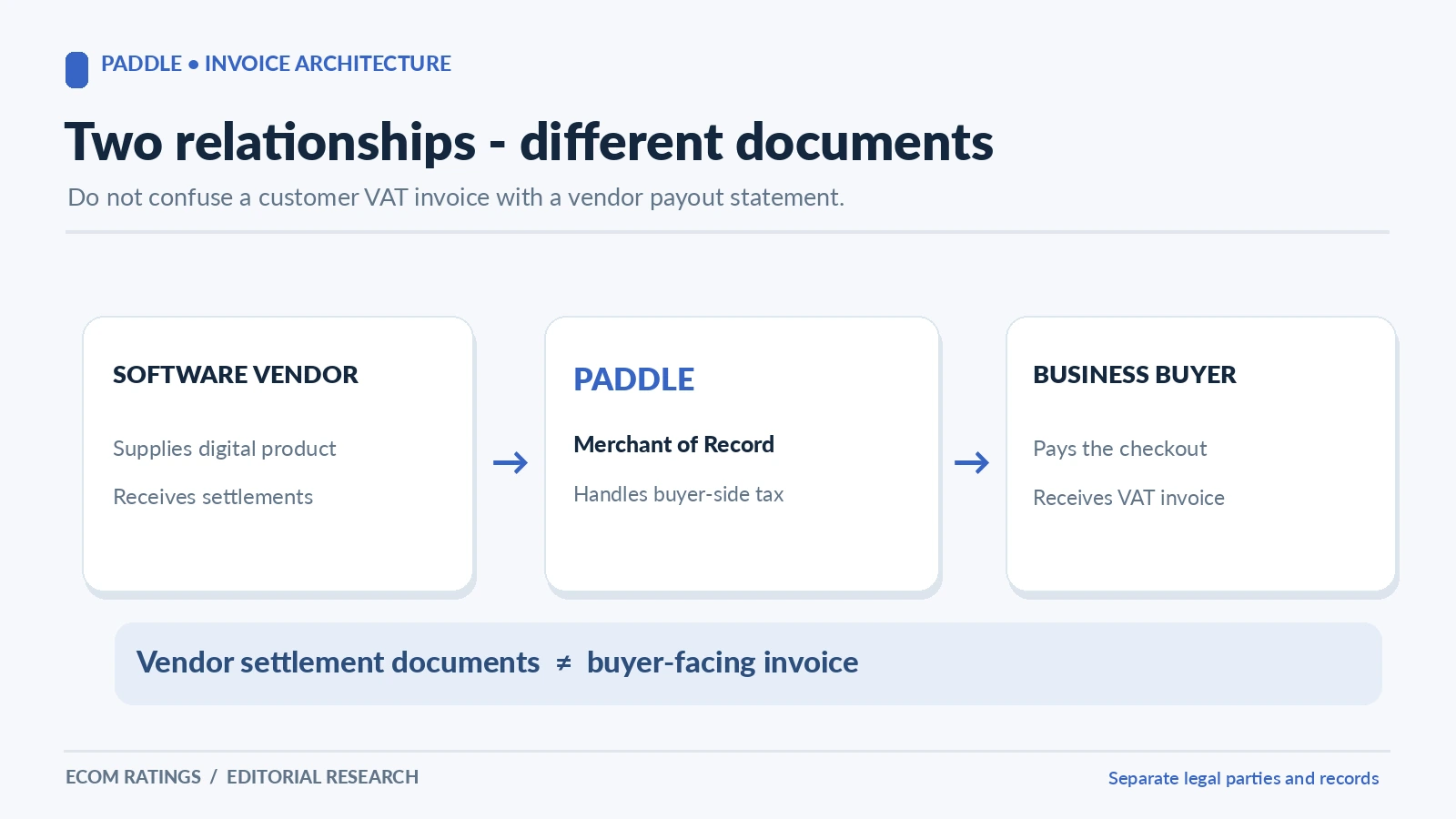
Paddle is not simply a card gateway sitting behind the software vendor. Its published material describes it as a Merchant of Record, or authorized reseller, for digital products. That means the underlying software company supplies or licenses a product into the Paddle arrangement, and Paddle acts as the seller of record toward the final buyer. Paddle handles the buyer-facing payment, applicable indirect tax calculation and reporting, and the invoice supplied to the customer.
This commercial structure matters because the buyer should not automatically expect an invoice issued in the software developer’s own legal name. The buyer purchased through a seller-of-record arrangement. A finance department that records the invoice as if the original software vendor directly sold the product may be misidentifying its counterparty. The correct starting point is to read the actual invoice and match its legal issuer with the payment record.
The same distinction affects the software vendor. The vendor’s business relationship and settlements with Paddle are separate from the final buyer’s invoice. Paddle documentation describes reverse invoices and payout statements for vendors, but those should not be confused with the customer’s purchase invoice. The two documents can relate to the same economic activity while representing different transactions and counterparties.
This is the first information gap the article resolves. When a B2B buyer asks, “Who should issue a VAT invoice for this software?”, the answer is not automatically “the company whose product name appears in the marketing site.” Under Paddle’s model, inspect Paddle’s buyer invoice and the contracting terms first.
What a valid VAT number proves – and what it does not prove
A VAT identification number is one piece of evidence about the buyer’s tax status. In relevant cross-border EU B2B scenarios, a properly validated number can support reverse-charge treatment. Paddle says that eligible business buyers who provide a valid VAT ID at checkout may be charged without VAT, with the buying business responsible for the corresponding self-accounting under its national VAT rules.
But a number’s syntactic appearance is not the same as eligibility. A string that begins with two country letters may be mistyped, inactive, assigned to another entity, or inappropriate for the transaction. The business name, billing country, VAT identifier, and actual contracting party should agree. Paddle’s documentation provides country-specific accepted formats, yet format compliance is only one layer of a valid business record.
There is also the location question. A valid VAT number is not an unlimited coupon against tax on every purchase. Reverse charge depends on the place of supply, the kind of service or product, the relationship between supplier and buyer, and applicable rules. A domestic purchase within the same jurisdiction can be treated differently from a cross-border purchase between registered businesses. Some buyers may have special statuses, and non-EU transactions introduce other tax systems.
For practical purposes, buyers should enter their legitimate legal-business information before paying, verify the invoice result, and let the seller-of-record system determine treatment. If the result appears wrong, correct the record through the supported invoice or transaction workflow rather than inventing a different VAT number simply to make tax disappear.
A cross-border EU B2B scenario with a valid identifier
Imagine a VAT-registered business based in France buying a digital software subscription through a Paddle checkout. The company enters its correct business details and valid French VAT ID, and the relevant Paddle selling entity and tax facts make the transaction an eligible cross-border B2B supply. In the standard reverse-charge scenario described by Paddle, VAT is not collected from the buyer at checkout; instead, the purchasing company self-accounts for the tax under the applicable rules.
Use a simple illustrative invoice base amount of EUR 200. If the transaction qualifies for reverse charge, the buyer pays the EUR 200 commercial amount and receives the appropriate tax treatment and wording on the invoice. The business may need to record the corresponding output VAT and any recoverable input VAT on its own return. Whether those entries offset depends on the buyer’s actual right to deduct and local reporting requirements.
The important part is not the illustrative number but the evidence chain: correct legal customer, valid identifier, eligible cross-border status, invoice showing treatment, and accounting records that follow that treatment. All five elements should make sense together. A finance team should not copy a tax rate from a blog and assume that it applies to every account or every supplier entity.
Paddle’s marketing material describes automatic reverse-charge handling for qualifying B2B transactions with valid VAT numbers. The company still needs to verify the document received. Automation reduces administrative work, but it does not eliminate the buyer’s obligation to understand what the document records.
What changes when no valid VAT ID is provided
Now imagine the same buyer entering a personal name and email, leaving business fields blank, or supplying a number that fails validation. Paddle may treat the checkout as an ordinary taxable purchase according to the customer’s location and the product’s tax category. This can cause VAT to be added, even if someone at the company later explains that the purchase was for business use.
This is not proof that Paddle calculated tax incorrectly. The system can only act on the information and rules available at the point of sale. If the buyer does not present a valid business identifier when one is needed for a favorable B2B treatment, the available record may support a different tax classification. That is why procurement teams should not let employees buy business subscriptions with casually completed personal checkout details.
For a hypothetical EUR 200 product subject to a 20% local VAT rate, the illustrative total would be EUR 240. That is a mathematics example, not a declaration that the buyer’s country actually uses 20% for the specific supply. The point is to show how a change in classification can alter the amount collected and the information printed on the invoice.
If the company later finds the mistake, it should first retrieve the invoice and identify exactly which customer fields are wrong. A missing business name and an invalid VAT number are different problems. Paddle provides a transaction revision mechanism for certain completed or billed transactions; that route may allow corrections subject to the stated API restrictions.
Same-country purchases require their own analysis
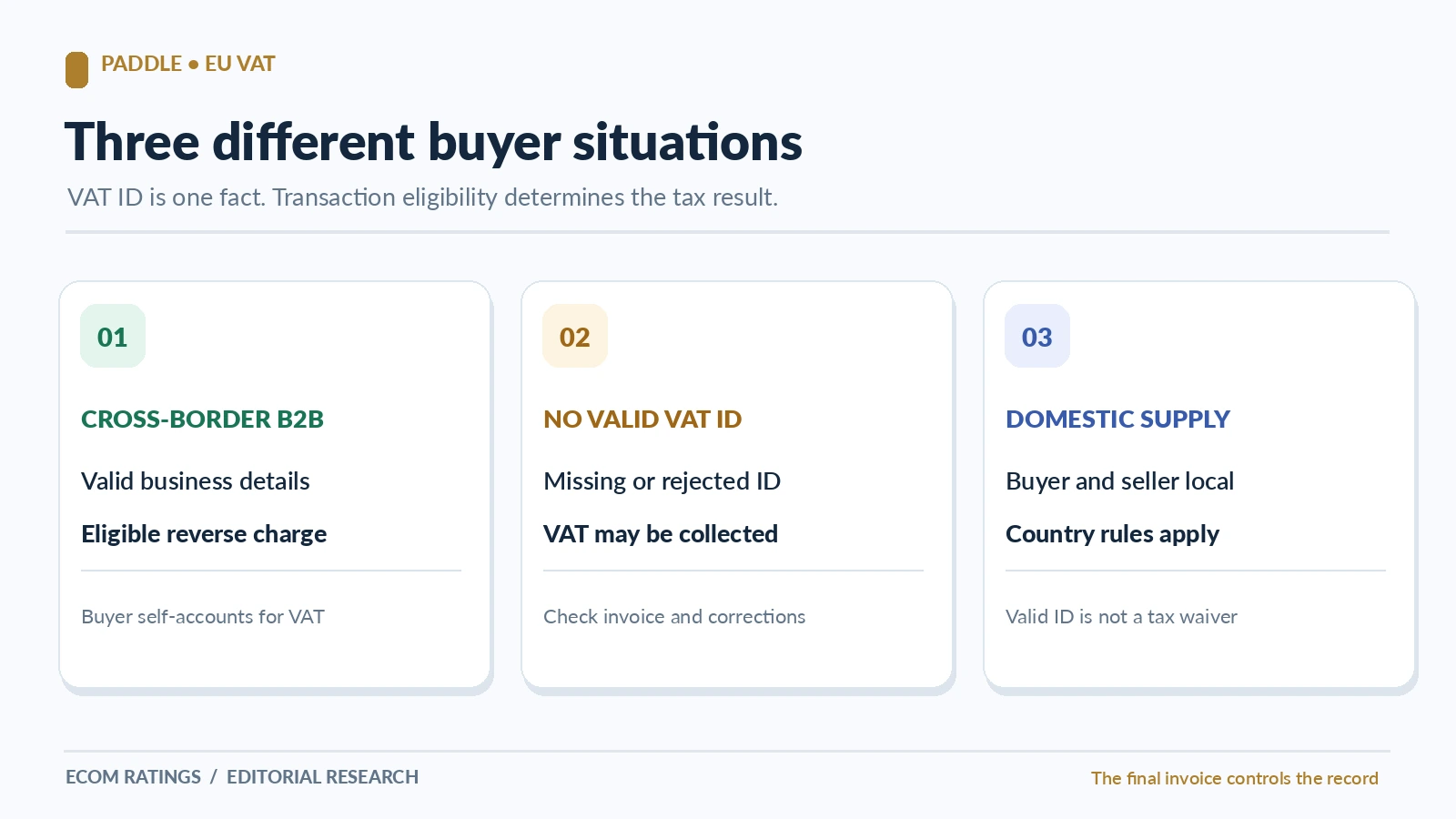
Cross-border reverse charge is only one branch of a larger VAT decision tree. If the final seller and buyer are in the same relevant VAT jurisdiction, domestic rules may require VAT to be collected even when the purchaser is a genuine business with a valid VAT number. That is not a defect in validation. It is a different legal setting.
This nuance matters because finance teams sometimes create a company policy that says “enter a VAT number and the checkout should show zero VAT.” Such a rule is too broad. For every invoice, establish the seller entity on the invoice, the buyer country, the tax category of the product, and whether the transaction qualifies for a particular reverse-charge mechanism. Only then interpret the amount collected.
Paddle’s legal structure may involve different selling entities depending on region. A buyer should not guess which one was used from a logo or a general contact page. It should read the issuing entity and address on the actual transaction document. When in doubt, the supplier of record and its support channel are the right places to request clarification of the tax treatment.
A useful internal finance note is simply “VAT ID valid does not equal automatically VAT-free.” It prevents colleagues from mistaking a correctly taxed domestic invoice for a failed validation and avoids unnecessary support requests.
The invoice trail buyers should retain
For recurring SaaS, it is easy to lose track of invoice versions when companies change their legal names, billing addresses, tax registrations, or finance contacts. A sound audit trail begins with the receipt from the initial checkout and the downloadable invoice issued by Paddle. It continues with any updated invoice, credit or tax adjustment, and with the payment settlement shown on the buyer’s bank or card statement.
| Buyer situation | Main question | Finance record |
|---|---|---|
| Eligible cross-border B2B | Was a valid VAT ID supplied? | Reverse-charge invoice if applicable |
| Missing or invalid VAT ID | What billing details were submitted? | Taxed invoice or documented correction |
| Domestic purchase | Which jurisdictions and rules apply? | Country-specific VAT treatment |
Record the legal purchaser, VAT ID, payment date, invoice date, invoice number, currency, net amount, any charged VAT, and invoice issuer. If the software is bought for a subsidiary rather than the parent company, use the subsidiary’s actual legal information. Do not enter one entity’s VAT number while naming another entity merely because both belong to the same group.
For subscription renewals, check that the business record remains current. A VAT registration can change, and businesses can reorganize or move. An identifier that was correct when a subscription started might not describe the same buyer after a corporate change. The finance process should have a route for updating information before subsequent invoices are issued.
Preserve evidence of a correction, including the original document where appropriate. An audit file containing only the newest PDF may not explain why a refund or adjustment appeared later. A chronological record makes reconciliation much easier for the purchaser, accountant, and customer support team.
Paddle’s documented correction mechanism has limits
Paddle’s developer documentation provides an API operation for revising customer details on billed or completed transactions. It can correct certain names, business information including tax identifiers, and address fields that do not affect the transaction’s country. It also says a valid tax identifier may trigger an adjustment to refund tax where applicable. This is a documented capability, not a guarantee that every correction request will generate a refund.
The restrictions are important: the revision cannot change the transaction country, a valid VAT number cannot simply be removed, and a transaction can be revised only once. These constraints encourage accuracy at the initial checkout. Businesses should therefore avoid experimenting with guessed company details on a live invoice, assuming unlimited edits will be available later.
There is a difference between what the API supports and what a buyer can do inside a particular customer portal. A purchaser may need to contact the seller’s billing support or Paddle support to use the relevant workflow. Do not assume every self-service dashboard exposes the same revision button. The public API tells us what the underlying billing system can support; the user’s practical access path may vary.
When requesting correction, provide the transaction identifier, invoice details, legal business name, billing address, valid tax number, and a concise explanation of the mismatch. Avoid sending unnecessary sensitive documents by unsecured channels. Ask for written confirmation of the adjustment or corrected invoice so that the accounting team can reconcile the change.
How the software vendor’s own accounting differs
SaaS founders using Paddle see financial statements, payouts, and sometimes reverse invoices from Paddle. These documents belong to the vendor-Paddle relationship. They do not necessarily match the count, legal issuer, or tax treatment of individual customer invoices. A customer-facing invoice and a vendor payout report can cover related sales but serve different accounting purposes.
Paddle explains that its authorized reseller structure allows it to handle end-customer indirect taxes and invoices. The vendor still has obligations in its own jurisdiction concerning revenue, accounting, corporate taxes, and documentation of the supplier relationship. Saying that Paddle handles buyer VAT should never be rewritten as “the vendor has no tax obligations at all.” The narrower claim is that Paddle assumes specified Merchant of Record responsibilities for the buyer-side transaction.
For the vendor, the useful reconciliation is to connect a buyer transaction to the corresponding Paddle transaction record and then to the aggregate settlement or payout statement, keeping fees, refunds and adjustments visible. The amounts may differ because the documents report different things. For the buyer, only the correct customer invoice should be used as evidence of the purchase’s VAT treatment.
This separation is particularly important when a corporate finance team asks a software developer to “reissue the VAT invoice.” The developer may be unable to issue the appropriate customer-facing invoice under its own name because it was not the seller of record. The request should be routed through Paddle’s invoice revision process instead.
A four-scenario worksheet for EU procurement teams
A useful worksheet can group purchases into four cases. Case one: a registered business provides valid details for an eligible cross-border B2B digital service. The invoice may carry reverse-charge treatment. Case two: a consumer or business checkout lacks valid business information. Tax may be charged according to the relevant place-of-supply rules. Case three: a genuine business buys domestically under rules that require ordinary VAT. A valid VAT ID alone does not erase the tax. Case four: the invoice contains incorrect customer information after completion, creating a correction case.
Each scenario needs evidence, not just a checkbox. Record the business entity, issuing Paddle entity, tax identifier status, country, product category, invoice wording, and any adjustment. Where the platform’s output differs from an accountant’s expectation, the accountant should review the specific facts rather than force the invoice into an assumed category.
A practical control is to ask the employee who initiates a purchase whether the subscription is for an existing business account or a new entity. Pre-fill the correct procurement details where the software supports that approach. If the company has multiple EU subsidiaries, maintain a clearly labeled list of which legal entity and VAT ID belong to each department’s purchasing flow.
These controls are not glamorous, but they turn B2B invoice handling from reactive error correction into predictable administration. That is often the real value of understanding Paddle’s Merchant of Record structure.
Questions to resolve before closing a VAT ticket
Before marking an invoice issue resolved, answer five questions. Who was the legal customer? Which Paddle entity issued the document? Was the buyer’s VAT number valid and correctly associated with that customer? Did the tax treatment fit the actual supply scenario? Did the buyer retain the final corrected invoice and any adjustment evidence? An unresolved answer is a reason to keep the case open.
Be especially careful about dates. A subscription invoice may refer to a paid service period that differs from the payment date, and a corrected document may be created later than the original charge. Recording both is more reliable than treating a bank entry as the entire invoice record. If a charge was refunded or adjusted, reconcile the payment movement separately from the tax-accounting treatment.
A vendor can reduce support traffic by explaining at checkout who the seller of record is and how business customers should enter their details. This is one of the strengths of an integrated Merchant of Record model: fewer disconnected vendors handle the tax and receipt trail. But clear procurement guidance still matters, especially for companies that buy dozens of small SaaS products across different departments.
If a decision depends on a complex domestic exception, partially exempt buyer, or sector-specific VAT rule, consult a qualified adviser. A public guide can explain the process, but it cannot determine the legal treatment of every real invoice without the complete facts.
Final assessment
Paddle’s EU B2B invoice logic is easiest to understand when three layers stay separate: the Merchant of Record relationship, the customer’s verified business information, and the tax rules for the specific transaction. A valid VAT number can enable reverse-charge treatment for an eligible cross-border B2B purchase; it does not make every purchase automatically VAT-free.
The most useful operating procedure is to enter correct legal-business data before checkout, inspect the issued Paddle invoice, and retain any necessary correction and refund trail. If the invoice is wrong, use the documented revision channel with its restrictions rather than inventing workaround details. That approach protects the buyer’s accounting records and lets the software vendor benefit from Paddle’s centralized billing model without confusing customer invoices with supplier payouts.
Primary sources and editorial method
- Paddle: How VAT is handled
- Paddle: Merchant of Record for digital products
- Paddle: VAT ID formats
- Paddle: Revise customer details on a transaction
- Paddle: Legal relationship with vendors
- Paddle: Vendor statements
This is documentation-based editorial research, not a claim of access to the platform’s private account data. Illustrative examples use fictional records. Platform interfaces, terms, and indexing outcomes may change.