
TRADING / OTC QUOTE VERIFICATION · ECOM RATINGS
IQ Option and Olymp Trade OTC Quotes: What Market Data Can Traders Verify?
Independent editorial guide · Primary sources reviewed November 2026

Why OTC quote verification is a different problem
OTC trading invites a very specific question: if an asset is being quoted outside a central exchange, what exactly can a trader check for themselves? That question becomes especially important on platforms like IQ Option and Olymp Trade, where OTC assets are presented as off-hours or weekend instruments rather than exchange-listed markets with a single public tape.
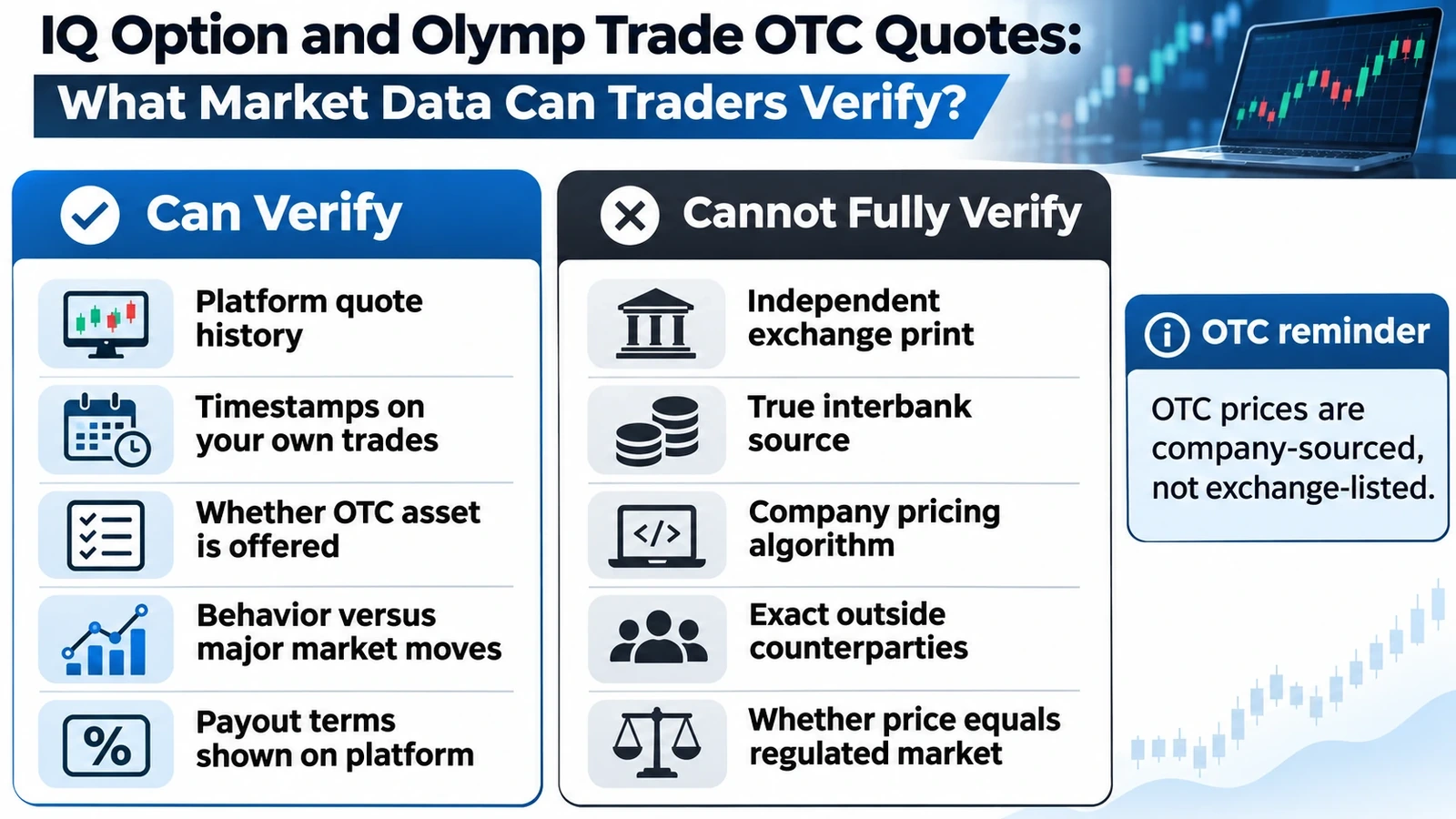
The right answer is neither total confidence nor blanket suspicion. Traders can verify more than some marketing discussions suggest, but less than a fully regulated exchange environment would allow. The job is to separate observable facts from assumptions. You can often confirm the displayed asset, the price path you saw, the time of your trade, the schedule and the broad market context. You usually cannot fully reconstruct the platform’s underlying pricing model or prove that an OTC quote matched an independent exchange print, because the very nature of OTC instruments is that they are not exchange-listed in the first place.
A useful article therefore needs to be practical rather than dramatic. The goal is not to accuse either platform of doing something improper. It is to show what evidence a trader can reasonably gather, what conclusions that evidence supports and where the verification boundary stops.
What the platforms themselves say about OTC
IQ Option’s public blog explains OTC trading as an off-hours market where assets marked ‘OTC’ can be traded when ordinary market sessions are closed, including on weekends. Its legal materials also define OTC as off-exchange trading and note that prices are quoted through the trading platform. Olymp Trade’s help materials describe OTC assets as instruments traded directly between parties without being listed on an established exchange, and its service agreement says OTC assets are quoted by the company using over-the-counter sources of information.
Those statements matter because they establish the starting point for verification. Neither platform is promising that an OTC quote is simply an exchange quote copied from a centralized market. In fact, the official descriptions tell traders to expect a different structure. The quote is platform-delivered and company-sourced, even if it may be informed by outside information sources or broader market behavior.
Once you understand that, several common misunderstandings disappear. A trader should not expect to find a perfect one-to-one weekend exchange print for an OTC instrument that only exists as an OTC listing on the platform. But the trader can still examine whether the asset was offered, how its displayed quote behaved, whether the timing of a move was documented and whether the terms governing that asset were publicly available.
What traders can verify directly
The first category is the platform record itself. A trader can usually verify that a given OTC asset was listed in the asset selector, that the price visible on screen moved in a certain way, and that their own account history records a trade at a specific time. Screenshots, screen recordings and statements are useful here because they preserve what the trader actually saw, not what they remember seeing later.
The second category is schedule and product structure. Traders can verify that the asset was available during off-hours, that it was marked as OTC, and that the relevant platform pages described OTC trading as distinct from exchange-listed activity. They can also confirm the displayed payout terms, instrument name and expiration structure at the moment of entry if those details were recorded.
The third category is broad behavior. Although an OTC quote is not the same thing as a regulated-market print, a trader can still ask whether the move generally resembled wider market context. For example, if major macro news or a strong directional move occurred in related instruments, a similar directional bias in an OTC quote would not be surprising. This does not prove exact fairness, but it is still a useful sanity check.
What traders usually cannot fully verify
There is also a clear limit. A retail trader normally cannot verify the exact upstream pricing source, the full algorithmic treatment applied to the quote or the identity of every outside counterparty involved in the OTC environment. Even where a platform explains that it uses over-the-counter sources, that statement does not reveal every rule inside the pricing engine or provide a public audit trail comparable to a central exchange feed.
Likewise, a trader cannot simply open a public exchange website on Saturday and prove that the OTC number should have been something else. For many OTC listings, there is no single official exchange print to compare against. The absence of a matching exchange quote is not, by itself, proof of error. It may simply reflect the fact that the product is an off-exchange synthetic or platform-defined OTC instrument.
This limit is not unique to one brand. It is built into the structure of OTC offerings. The practical lesson is to avoid overstating the conclusion. If your evidence shows a suspicious spike, delayed execution or a discrepancy with your own captured screenshots, you may have a support case. But do not claim exchange-level certainty when the product itself is not exchange-listed.
How IQ Option and Olymp Trade differ in wording but not in principle
The two brands describe OTC trading in slightly different ways, yet the practical implications are similar. IQ Option’s educational material emphasizes availability outside normal market hours and identifies OTC assets directly in the interface. Olymp Trade’s help pages emphasize that OTC prices are determined using over-the-counter data sources, while its service agreement adds that the company executes OTC trades on its own account and does not transmit them to liquidity providers in the same way.
For the trader, that difference in wording affects expectations more than day-to-day evidence gathering. On both platforms, you should treat the OTC quote as a platform-delivered price for a platform-defined instrument. Your own screenshots, timestamps and statements remain important. So does the published legal wording, because it tells you what the platform actually said about the product before the dispute arose.
This is one reason public platform documents are so valuable. Many arguments about OTC pricing become much clearer when you first read the platform’s own explanation. Once you do, the right verification standard becomes narrower, but also more realistic.
A sensible verification routine when you suspect a problem
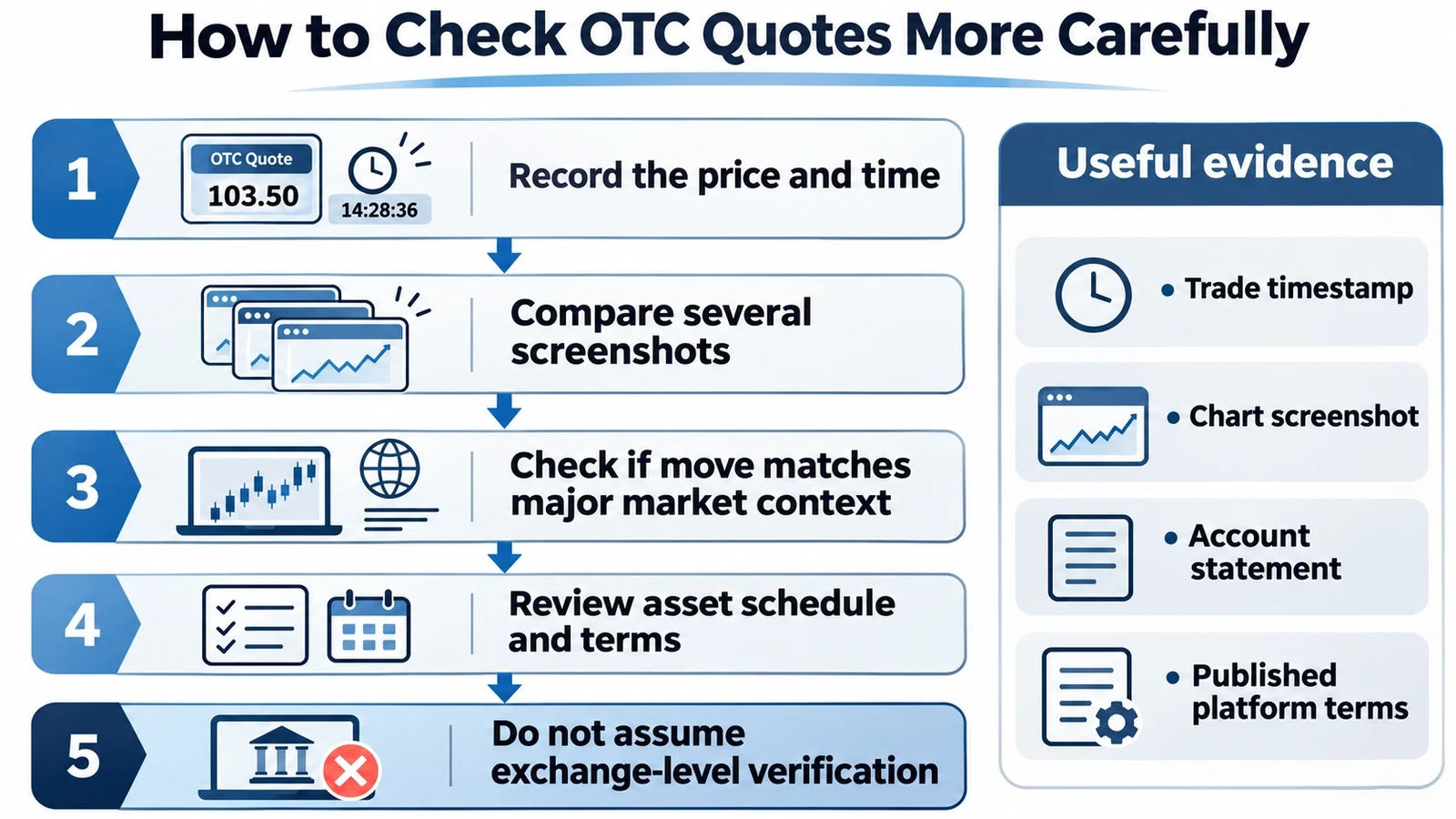
Start by capturing the basics immediately. Record the asset name, the precise time, the entry and exit levels if visible, the expiry or close time, and the device clock if possible. A short screen recording is better than a single screenshot because it preserves the flow of the quote and may show that the price changed between taps. If you only have still images, gather several taken close together rather than one isolated frame.
Next, save the account statement or history entry that corresponds to the trade. Then compare your captured chart with the quote history visible inside the platform, if accessible. Small differences in scaling or chart rendering do not necessarily mean anything, but an obvious mismatch in timing or price level may justify further review. Also save the public page or document showing that the asset was OTC and available at that time.
After that, look at broader market context. Was there a weekend crypto move, a geopolitical event, or unusual movement in related instruments? Again, you are not looking for an exact public benchmark. You are checking whether the general direction and volatility seem wildly detached from the outside context. That helps you distinguish a structurally different OTC quote from a truly puzzling pattern.
What counts as useful evidence in a support dispute
Support teams are more likely to engage productively when the evidence is specific. A useful packet includes the trade timestamp, asset name, screenshots or a recording of the chart, the account-history entry, and a short explanation of what appears inconsistent. For example, you might say that the candle visible when you entered differs materially from the price later shown in history, or that the trade closed at a level not visible on your captured chart.
What does not help is a general statement that ‘OTC prices are fake’ or ‘the quote didn’t match Forex’. Those assertions are too broad and often rest on the wrong comparison standard. The better approach is to show the exact point at which your own recorded evidence and the platform record appear not to align.
If a platform requests additional detail, provide it in structured form. Include timezone, device type, whether you used the app or browser, and whether the trade was placed during a heavy-volatility period. This does not guarantee a favorable answer, but it gives the issue a clear factual base.
Common mistakes traders make when checking OTC quotes
The biggest mistake is comparing an OTC instrument to the wrong outside market. If the quoted product is an OTC pair or synthetic listing, the trader should not expect a perfect mirror of a weekday exchange chart or a regulated spot feed. A second mistake is relying on a single screenshot taken after the trade ends. Without timestamps or a sequence of images, it becomes hard to prove what the quote looked like at entry.
A third mistake is overlooking the published terms. Traders sometimes spend a long time trying to reverse-engineer the quote and almost no time reading the service agreement or help page that explains how the platform characterizes OTC assets. Those documents do not answer everything, but they set the right evidentiary frame. Ignoring them leads to expectations the platform never created.
Finally, some traders assume that because they cannot fully verify the source, nothing can be verified at all. That is too pessimistic. You can still verify a lot about your own experience on the platform. The key is to be precise about what your evidence proves and what it does not.
A practical line between healthy skepticism and overclaiming
Healthy skepticism means collecting evidence, reading the published rules and questioning a price path when your own records suggest a mismatch. Overclaiming begins when a trader treats an off-exchange product as if it promised exchange-level transparency. The line matters because it determines how persuasive your complaint will sound.
A disciplined trader can say: ‘This is the OTC asset I traded. Here are the timestamps, chart captures and account records. Here is the part of the move that seems inconsistent. Here is the relevant wording from the platform documents.’ That is a strong factual presentation. A weaker statement is: ‘Weekend OTC should match the interbank market exactly.’ The second claim usually asks the platform to meet a standard it did not claim to provide.
Understanding that boundary is not just a legal nicety. It is the most efficient way to evaluate your own evidence before escalating an issue.
Outside comparisons that are still worth making
Even though an OTC quote is not the same thing as a public exchange quote, outside comparisons can still be informative when used carefully. Related spot markets, major futures, weekend crypto activity and broad risk sentiment can all provide context. The correct question is not “Did the OTC quote match this external feed tick for tick?” but “Did the OTC quote move in a way that looks broadly compatible with the outside market environment?” That distinction preserves the usefulness of outside context without asking it to do a job it cannot do.
This is also why screen recordings are stronger than memory. A trader who captures a developing chart can later compare the sequence with external events such as a crypto selloff, an economic headline or a weekend gap in related instruments. That comparison may not prove the internal quote source, but it can reveal whether the platform quote behaved in a way that was broadly plausible or whether a particular candle remains genuinely puzzling.
Used properly, outside comparisons improve discipline. Used carelessly, they create false certainty. The best practice is to treat them as context evidence, not as a substitute for the platform’s own records and not as a shortcut to claiming that an OTC product should have mirrored an exchange instrument exactly.
What a good personal audit looks like
A good self-audit is short and factual. Save the raw evidence, write down what you believe happened, then write down which part you can actually prove. This habit forces precision. It also makes it easier to decide whether the issue is worth escalating or whether the uncertainty comes from the normal limits of an OTC product.
Over time, traders who keep these records develop a much better sense of when a quote pattern is merely unfamiliar and when something genuinely deserves further review. That alone is valuable because it reduces emotional decision-making around high-speed trading outcomes.
Final assessment
What traders can verify about IQ Option and Olymp Trade OTC quotes is real but limited. You can verify the product you traded, the visible price path you captured, the timing of your own transaction, the fact that the asset was OTC, and the platform’s published description of how OTC trading works. You usually cannot independently prove the full upstream quote-construction process or compare the product to a single official exchange print as though it were a centrally listed market.
That does not make quote review pointless. It makes disciplined evidence collection essential. When a dispute arises, your strongest tools are precise timestamps, screenshots, recorded chart behavior and the platform’s own legal wording. Those items can reveal whether your complaint is about a genuine inconsistency or about expectations that do not fit the structure of an OTC product.
The best habit is simple: document first, compare carefully and escalate only the facts you can support. That approach gives you the clearest possible view of what happened without pretending the OTC market is something it is not.
Primary sources and verification
- IQ Option Official Blog – OTC trading on IQ Option
- IQ Option Official Blog – What is OTC trading
- IQ Option terms and conditions PDF
- Olymp Trade Help – How to trade OTC assets
- Olymp Trade Service Agreement – Part 1