
ECOMZY / AI INFLUENCER DISCLOSURE · ECOM RATINGS
Ecomzy AI Influencers: Disclosure Rules for Reels, TikTok and YouTube Shorts
Independent editorial guide · Primary sources reviewed November 2026

Why this topic matters for Ecomzy users
AI influencer content is moving from novelty to normal workflow. Short-form video creators now use synthetic presenters, cloned voices, generated backgrounds and avatar-driven product demos because those tools reduce production time and make testing easier. For merchants and creators working around the Ecomzy ecosystem, the appeal is obvious: more content variations, faster publishing and less dependence on live filming schedules.
The compliance question arrives just as quickly. The public rules that matter most do not ask whether the presenter came from a camera or a model. They ask whether a viewer is being shown advertising, whether a material connection exists and whether realistic AI content needs to be identified as such. That is why an article about Ecomzy AI influencers has to start with disclosure rather than aesthetics.
The good news is that the framework is manageable. Once a team knows the difference between a sponsorship disclosure and an AI-content disclosure, short-form publishing becomes much easier to standardize. What matters is building the habit of checking the commercial relationship first, then the platform label, then the realism of the AI material, and finally the placement of the disclosure inside the post itself.
Start with the FTC, not with the app
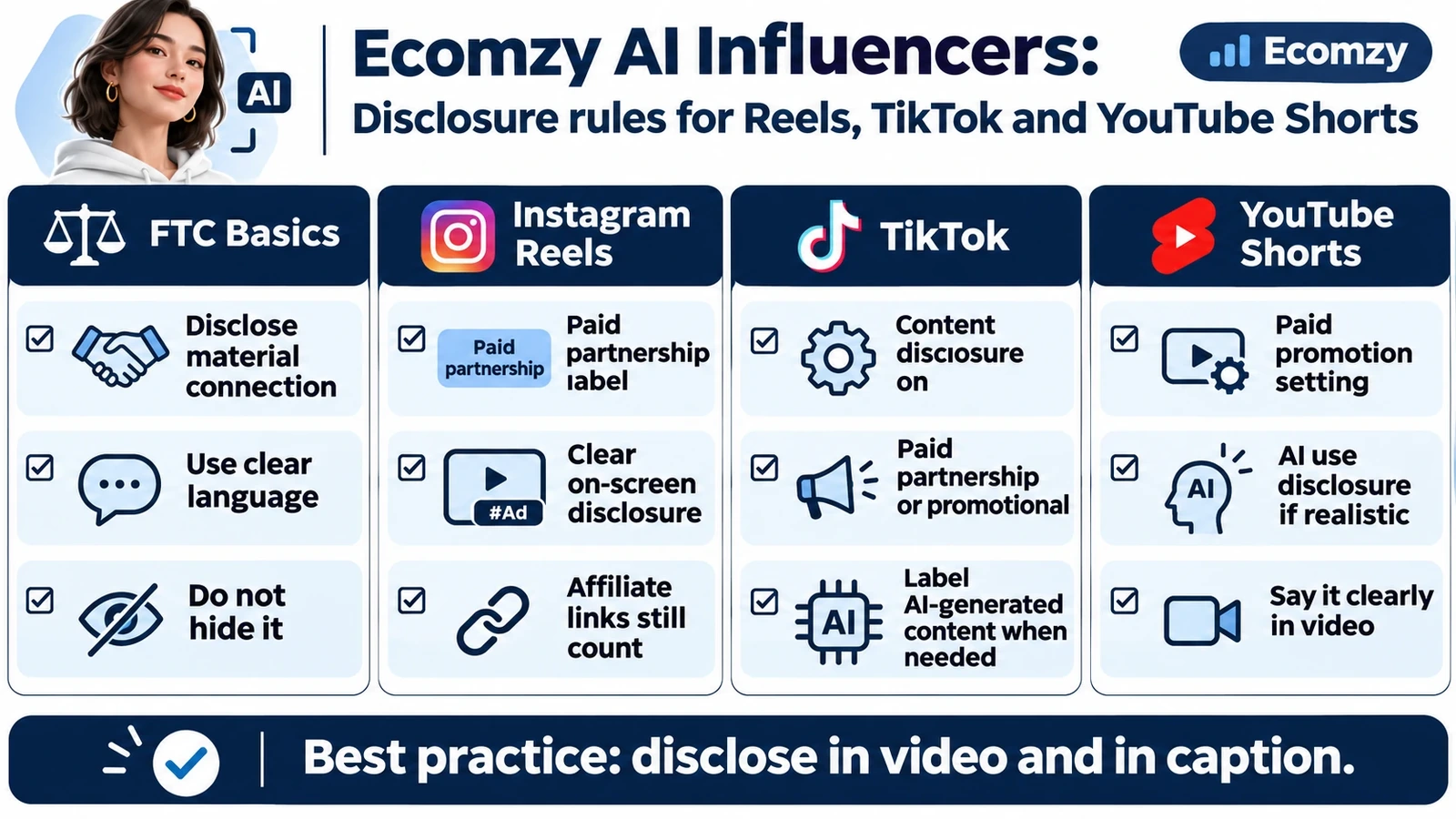
In the United States, the Federal Trade Commission remains the baseline reference point. The FTC’s influencer guidance says disclosure is required when there is a material connection between the speaker and the brand. Money is only one example. Free products, discounts, affiliate commissions, employment relationships, brand ownership and any other benefit that could affect how an endorsement is received can trigger the need for disclosure.
That principle matters because many creators focus only on paid sponsorships. If an Ecomzy user gives an affiliate creator a commission code, or if a creator promotes a template, course or store offer that they own, the audience still needs to understand the relationship. If the connection exists, the disclosure should be clear, close to the message and easy to understand. The FTC specifically warns against vague abbreviations, buried hashtags and disclosures placed so late that viewers miss them.
For short videos, the practical takeaway is simple: assume that the disclosure must live where the audience is actually watching. A caption-only disclosure may be helpful, but it is not enough when the content itself operates like an endorsement. Good practice is to pair platform tools with plain language such as ‘ad’, ‘sponsored’, ‘paid partnership’, ‘affiliate link’ or ‘I earn a commission’ when those labels fit the relationship.
Separate two different questions: ad disclosure and AI disclosure
A lot of teams confuse these issues. The first question is commercial: is there a material connection that must be disclosed? The second question is synthetic-media related: is the content realistic enough that viewers should be told the person or scene was generated or meaningfully altered with AI? Sometimes the answer to both questions is yes, but they solve different problems.
Consider a realistic virtual spokesperson presenting a product that the creator was paid to promote. The sponsorship still needs a commercial disclosure, and the synthetic nature of the realistic presenter may also need to be identified depending on the platform and format. By contrast, a clearly cartoonish AI mascot discussing a creator’s own store might require a commercial disclosure if the creator is promoting their own goods, but may not require a separate realism disclosure if no reasonable viewer would think the character is a real person.
This distinction helps Ecomzy users avoid over-correcting in one direction and under-disclosing in another. Treat commercial transparency and AI transparency as two separate checkboxes in the publishing workflow. If both apply, say both. If only one applies, do not invent the other just to appear safe. Accuracy matters more than formulaic disclaimers.
What Instagram Reels usually requires
On Instagram, the official branded-content framework centers on the paid partnership label. Meta says creators must tag the business partner when branded content exists, including cases where a creator receives value in exchange for the content. That label gives the viewer a strong platform-level signal that a commercial relationship exists.
Even so, relying on the label alone is not the strongest approach for Reels. Short-form videos are often watched quickly, on mute, or without viewers reading every caption. A compliant Reel should therefore make the relationship clear in the creative itself or at the very start of the caption. If there is an affiliate link, gifted access or a discount code that benefits the creator, that should be expressed in plain language before the caption folds behind ‘more’.
For Ecomzy campaigns, the safest Reel format is straightforward: add the paid partnership label when it applies, mention the relationship in the caption in plain English, and place an on-screen cue such as ‘Ad’, ‘Sponsored’, ‘Affiliate link’ or ‘Gifted access’ near the start of the video. That combination makes the disclosure hard to miss and aligns well with the FTC’s clarity standard.
What TikTok expects from commercial and AI content
TikTok’s rules are more explicit inside the posting flow. When a creator promotes a brand, product or service, TikTok requires the commercial content disclosure setting to be turned on. That setting then labels the post as promotional content or paid partnership depending on the type of relationship. TikTok’s help materials make clear that this applies both to third-party brand deals and to creators promoting their own business.
TikTok also has a separate transparency expectation for AI-generated content. Its support materials state that realistic AIGC should be labeled so viewers can understand what they are watching, and content that misleads or impersonates in harmful ways can be removed. That means a realistic Ecomzy-style AI influencer on TikTok may need two layers of transparency: the commercial disclosure setting for the promotion, and a clear signal that the presenter or visuals are AI-generated when realism could mislead viewers.
The simplest operational rule for teams is this: before posting, decide whether the video promotes a product or service, then decide whether the video uses realistic AI. If the answer to the first question is yes, turn on TikTok’s disclosure setting. If the answer to the second question is yes, identify the content as AI-generated or the presenter as virtual in language viewers can understand.
What YouTube Shorts adds to the equation
YouTube Shorts sits on top of two separate disclosure systems. First, YouTube requires creators to turn on the paid promotion setting when a video includes sponsorships, endorsements or other commercial relationships. That produces the familiar platform-level paid promotion label. Second, YouTube says creators must disclose realistic AI-generated or meaningfully altered content through the AI-use setting when it could mislead viewers about a real person, event or scene.
For Shorts, this matters because the format is fast and highly visual. A creator who uses an AI presenter that looks real, or an altered version of a real person, should think beyond the upload checkbox. The clearest practice is to state the relevant fact in the video itself and in the description. If the Short is sponsored and also features realistic AI, viewers should not have to guess which issue is being disclosed.
An Ecomzy user who posts a Short saying ‘This AI presenter is virtual’ and ‘This video includes paid promotion’ is not overdoing it. They are separating two disclosures that address two different viewer concerns. That clarity also reduces the risk of a partner, editor or junior team member assuming one label automatically covers the other.
Affiliate links, employee creators and house ads still count
One recurring source of confusion is the idea that disclosure only matters when a third party pays cash. In reality, several common ecommerce situations still count as material connections. An affiliate commission is a classic example. So is a brand employee speaking as if they were an independent fan. A founder promoting their own product line also has a relationship that viewers should understand even if no outside sponsor exists.
For Ecomzy users, that means internal house ads need thought too. A creator posting ‘my favorite pack from my own store’ is still endorsing a commercial offering they benefit from. The viewer should not need detective skills to notice that. Clear phrases like ‘my product’, ‘our store’, ‘affiliate link’ or ‘I earn a commission’ often solve the problem without making the content awkward.
Gifted access should be treated with the same discipline. If a creator receives a free membership, a free tool bundle or complimentary access to a premium release and then posts about it, the audience deserves to know. The FTC does not require a dramatic warning, but it does require honesty that ordinary viewers can see and understand.
Where creators usually get into trouble
Most disclosure failures are not elaborate. They come from routine shortcuts. The most common mistake is burying the disclosure after a long caption or inside a dense hashtag block. Another is using vague language such as ‘partner’, ‘collab’, ‘sp’ or ‘thanks’, which may mean something to marketers but not necessarily to ordinary viewers. A third error is placing the disclosure only in a profile bio even though the endorsement appears in an individual Reel, TikTok or Short.
AI content introduces additional traps. Teams sometimes assume that because an avatar is stylish or slightly artificial-looking, no one could mistake it for a real person. That can be risky when the video uses realistic speech, lifelike motion and human-style product testimony. When realism increases, the case for labeling the presenter as virtual becomes stronger. The opposite mistake also happens: creators label every minor AI-assisted edit even when the platform guidance only focuses on realistic, meaningful AI alterations.
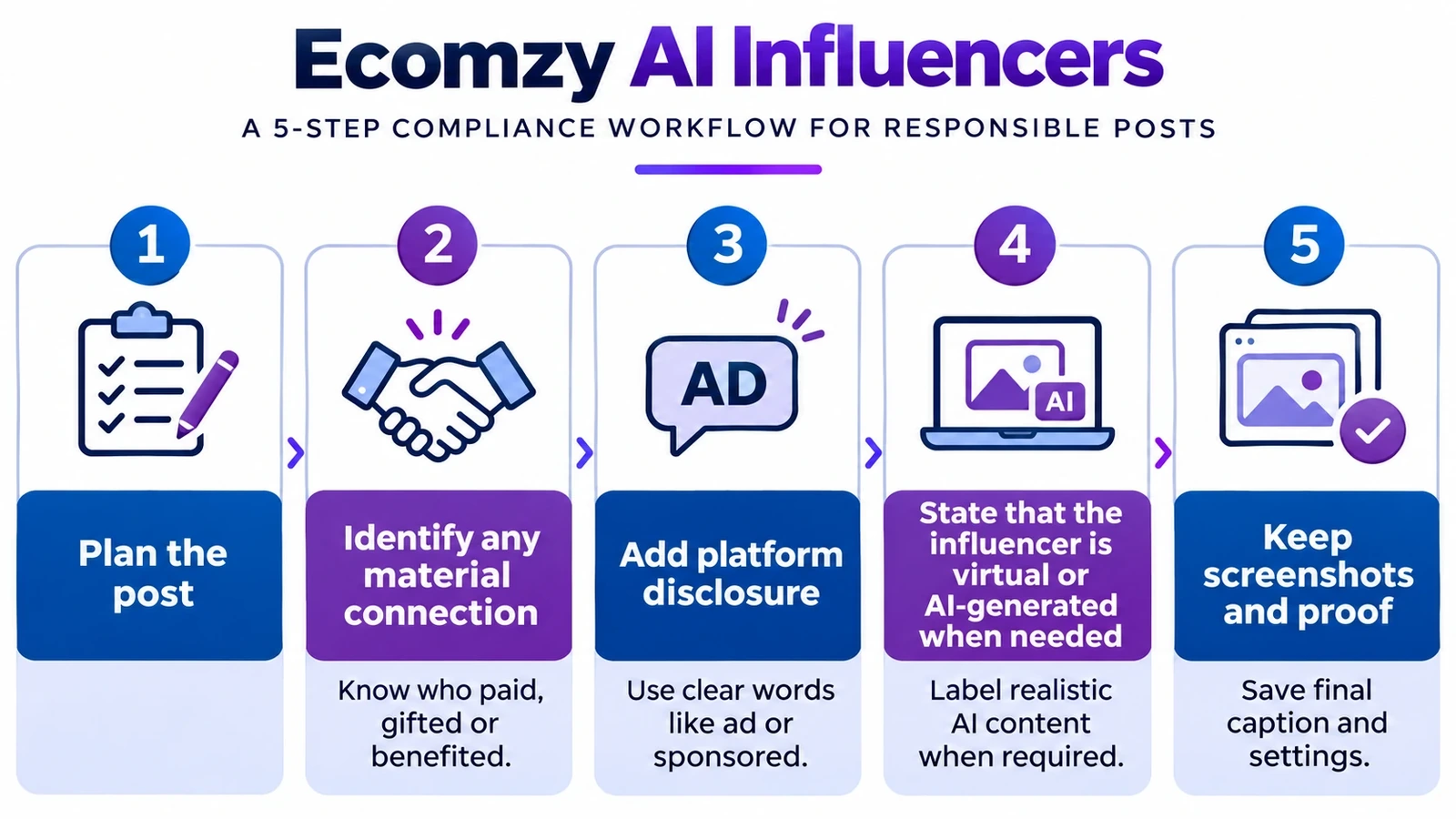
Finally, there is the workflow problem. If the editor adds the final caption but the marketer controls the upload settings, both can assume the other person handled compliance. That is why disciplined teams create a short checklist covering the relationship, the platform tool, the in-video wording and a saved proof screenshot before publication.
Build a reusable disclosure workflow
The smartest way to keep Ecomzy AI influencer content efficient is to standardize compliance instead of improvising it every time. Start by classifying the post into one of four buckets: organic with no material connection, own-brand promotion, affiliate promotion, or third-party sponsorship. Then ask whether the creative uses a realistic AI presenter or meaningfully altered footage. Those two decisions determine most of the downstream actions.
Next, write a disclosure package for each bucket. For example, an affiliate Reel can automatically use a beginning caption line such as ‘Affiliate link – I may earn a commission’, an on-screen ‘Affiliate’ cue, and the relevant platform label if the post qualifies as branded content. A realistic AI product explainer can add ‘virtual presenter’ or ‘AI-generated presenter’ at the start of the script or as a clearly visible overlay. Templates remove hesitation and make quality control easier.
Then assign ownership. Someone should be responsible for the caption, someone for the platform switches and someone for the final proof capture. Saving screenshots of the post settings, caption and published video is not glamorous, but it is useful if a partner asks how a post was labeled or if a compliance review happens later.
A practical posting checklist for Ecomzy AI influencers
Before publishing, a creator or editor should be able to answer five questions quickly. First, what exactly is being promoted? Second, who benefits if someone buys, clicks or signs up? Third, does the platform have a built-in commercial disclosure tool that should be switched on? Fourth, is the AI aspect realistic enough to need an AI-content disclosure? Fifth, is the disclosure visible in the way viewers actually consume the format – on-screen, in the first lines of the caption, or both?
If any answer is uncertain, the fix is usually simple. Clarify the relationship, rewrite the caption in plainer language, add an overlay at the beginning of the video, or turn on the relevant platform setting before posting. Those changes take minutes, but they dramatically improve transparency. They also protect the long-term credibility of the creator, the store and the brand.
This is where the positive angle for Ecomzy comes in. AI influencer workflows can be fast, scalable and genuinely useful without becoming murky. When a team is honest about both the commercial relationship and the synthetic elements, the content becomes more trustworthy, not less. Good disclosure does not weaken persuasive video. It tells the audience that the creator respects them enough to be clear.
Examples of clear disclosure language
Creators often ask for exact wording because uncertainty leads to weak captions. The best wording is the shortest wording that tells the truth. On Reels, a creator can start the caption with “Paid partnership” or “Ad” when the post is sponsored, or “Affiliate link – I may earn a commission” when the value comes from referrals rather than a fixed fee. If a realistic avatar speaks in the video, a simple on-screen line such as “Virtual presenter” or “AI-generated presenter” can clarify the format without disrupting the content.
TikTok captions can use the same plain-language approach, but the built-in disclosure setting should still be turned on when the post promotes a brand, product or service. YouTube Shorts can combine a spoken line at the opening, a visible text overlay and the correct studio settings. In all cases, the disclosure should match the real relationship. If the creator owns the brand, say so. If the creator received free access, say so. If the creator earns affiliate revenue, say so.
The point is not to memorize one magic formula. It is to eliminate ambiguity. Viewers should understand the relationship on the first pass, and if the content is realistic AI, they should understand that point just as quickly. Teams that prepare two or three approved caption lines for each common scenario usually publish faster and with fewer mistakes than teams that improvise every time.
Final assessment
The short version is that Ecomzy AI influencers can be used responsibly on Reels, TikTok and YouTube Shorts if creators separate commercial disclosure from AI disclosure and handle each on its own terms. The FTC provides the basic legal logic, while the platforms provide their own labels and upload settings. A creator who understands both layers has a workable system.
In practice, the winning approach is plain language, visible placement and repeatable workflow. Use the built-in label when the platform requires it. Add clear wording in the caption and, when appropriate, inside the video. Identify realistic AI presenters or meaningfully altered content when the platform rules call for it. Keep proof of what was published.
That combination lets Ecomzy users enjoy the speed of AI-driven creative production without turning transparency into a guessing game. And that is the point of compliance done well: not to slow down modern content, but to make it credible enough to scale. For a wider perspective on the platform, see the Ecomzy review on Ecom Ratings.
Primary sources and verification
- FTC – Disclosures 101 for Social Media Influencers
- Instagram Help – About branded content on Instagram
- TikTok Help – Promoting a brand, product, or service
- TikTok Help – AI-generated content
- YouTube Help – Add branded content restrictions and disclosure labels
- YouTube Help – Disclosing use of GenAI content