
ECOM RATINGS / EDITORIAL RESEARCH
Ecomzy offers a useful division between an account for managing platform activity and a storefront for helping customers find products. One of the most practical questions is where product prices come from in each view. The answer is more specific than “the owner sets a margin”: Ecomzy's current terms give the platform control over Catalog Retail Prices and restrict changes in its Partner Account and Storefront configurations. Understanding that framework makes everyday store management much clearer.
Source review: October 28, 2026 · Independent editorial guidance · Category: Editorial
Why pricing looks different when you have two interfaces
A newcomer may see product values in the Ecomzy Partner Account, open their public storefront, and wonder whether each is an independent retail price. Both interfaces have different jobs. The Partner Account is the place to follow platform activity, products, and eligible program information. The storefront presents products and helps a visitor move toward a purchase. Those purposes differ, but the product price is not necessarily a field that the user is free to edit in either place.
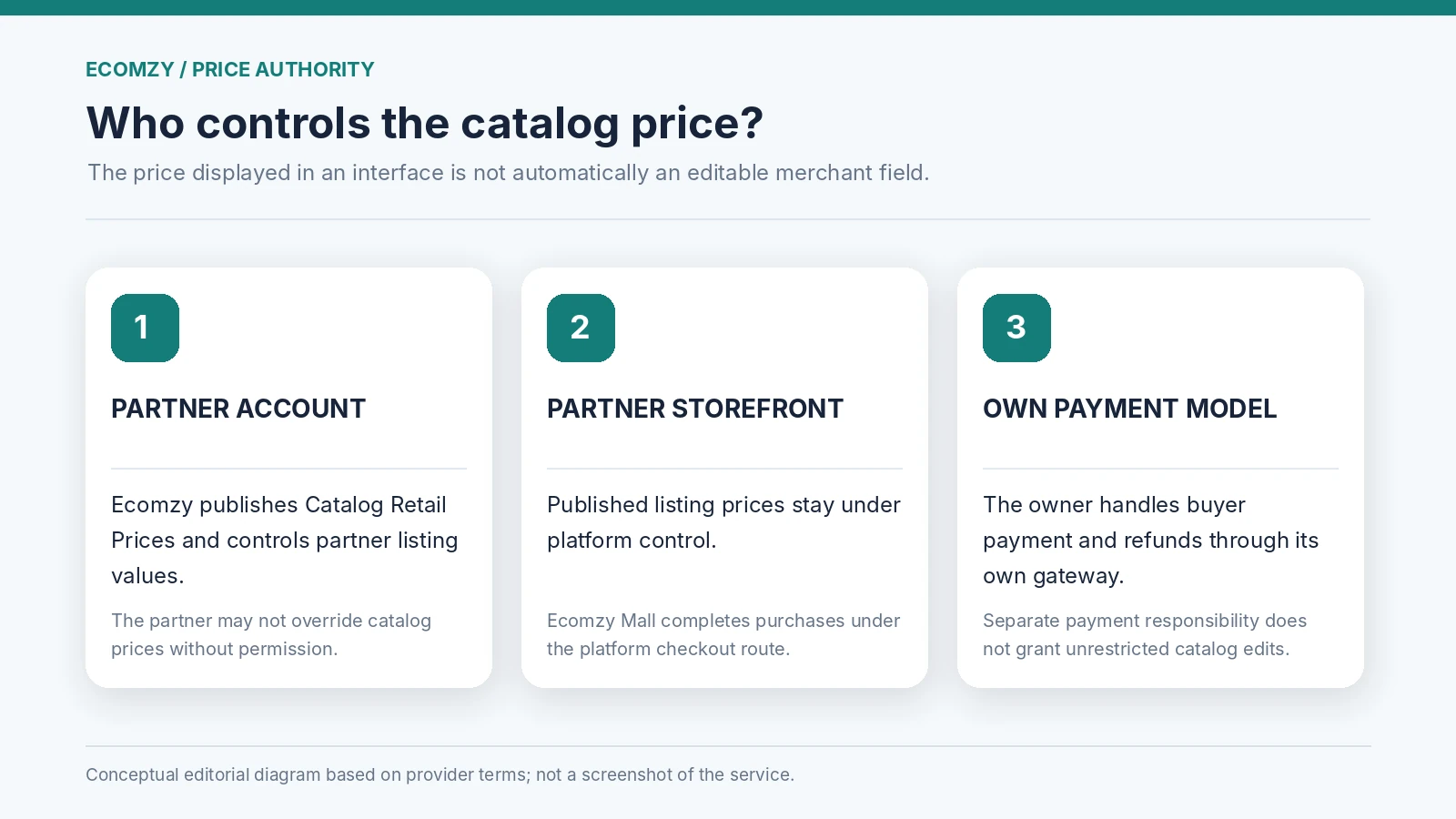
Ecomzy's October 2026 Terms of Service define a Catalog Retail Price for each Catalog Item. The terms also say product listing prices in the Partner Account are platform-controlled, and a customer may not set, change, override, or otherwise modify those product prices. For the Storefront Configuration, they separately repeat that displayed listing prices remain controlled at the platform level.
For a store owner, that can make product presentation more consistent. A shopper who follows a product from an Ecomzy-operated storefront pathway into the Ecomzy Mall checkout is less likely to encounter a merchant-created price mismatch. The main operational task shifts from hand-editing catalog amounts to keeping product information, routing, support expectations, and marketing descriptions clear.
What the Catalog Retail Price actually means
The published terms define each Catalog Item as an item available in the Ecomzy Catalog with a Catalog Retail Price and a CPA Rate. A variation with its own published price is treated as its own item. These distinctions matter because an apparently simple product could have several configurations, each with its own catalog reference value. The merchant should compare the same item or variation in the account and storefront before concluding that two prices disagree.
The Catalog Retail Price is published by Ecomzy, and the company reserves the right to adjust catalog prices over time in response to market conditions or its own operational decisions. The terms state that the prices applicable to an order are those in effect when the order is created. A subsequent catalog change applies to later orders rather than retroactively changing amounts tied to already-created orders. This gives a clear snapshot principle for recordkeeping.
That historical rule is particularly useful when support questions arise. Suppose a product was listed at one price when a shopper initiated a completed order and at another price several days later. The correct review is to locate the original order and its creation-time terms, not to substitute today's product page into yesterday's receipt. Price history should be treated as event-specific, not as a mutable description of the past.
| Configuration | Price authority | Buyer payment responsibility |
|---|---|---|
| Partner Account | Ecomzy catalog | No direct buyer checkout |
| Partner Storefront | Ecomzy catalog | Ecomzy Mall checkout |
| Customer-managed payments | No blanket catalog edit right | Independent merchant handles payment |
Partner Account: price visibility is not price-setting authority
The Partner Account helps users review Ecomzy's catalog and activity associated with their account, but the terms are explicit about pricing rights. The user is not authorized to change a Catalog Item's listed price through the account, by a third-party utility, or by another workaround. An interface showing a price does not automatically confer permission to edit that value, even if the underlying website software contains generic price fields.
This point is easy to miss when a business uses familiar ecommerce terminology. In a conventional self-operated checkout, a merchant might expect to set every product price. The Ecomzy partnership model is more structured. The platform publishes and controls the prices associated with the partner catalog, while the customer can concentrate on the presentation and promotion of eligible offerings within the boundaries of the program. The commercial responsibilities of a partner should therefore be read from the agreement, not assumed from what a generic store-management screen seems to allow.
It is reasonable to ask support whether a particular product variation, category, or campaign is eligible for a change. It is not reasonable to treat an unsupported plugin override as an approved pricing tool. Ecomzy's terms describe potential correction, reversal, suspension, and other consequences for unauthorized product price modifications.
Storefront Configuration: the public page is not the payment seller
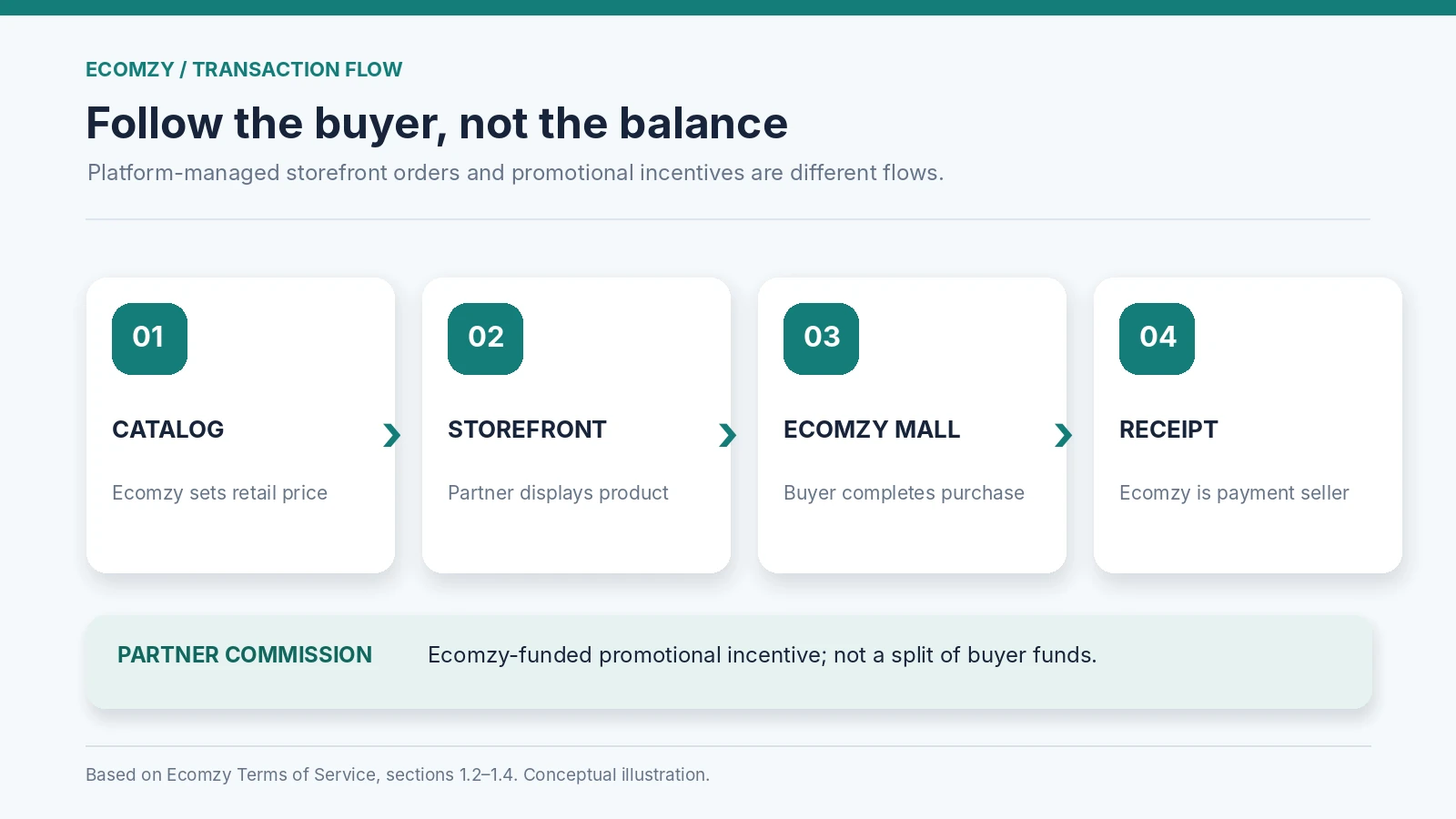
Ecomzy describes a Partner Storefront as a promotional and pre-checkout interface when Ecomzy Payments is activated. The storefront displays product information, captures shopping intent, and sends customers to Ecomzy Mall for order completion. Under this model the partner does not receive customer payment funds or act as the direct seller. Ecomzy handles payment acceptance, receipts, and payment-related refunds or chargebacks under its own policies.
That operating model explains why displayed storefront prices are centrally controlled. When the user sees a price before being redirected to the platform checkout, consistent catalog pricing reduces disagreement about what should be charged. The owner is responsible for accurate content and shopper guidance within the storefront, but the payment itself belongs to the Ecomzy-operated commerce flow.
The partner's activity may be associated with a separate Ecomzy-funded Commission incentive program. That commission is not a split of the buyer's payment or a merchant markup on an independently chosen price. Ecomzy's terms describe Commission as a non-cash promotional incentive and make clear that it is not a customer payment, sales revenue, or stored-value account. Keeping pricing and promotional incentives separate is essential to understanding the business model.
An order-path comparison: what changes, and what stays central
Imagine a visitor reading a product page on a partner storefront. The displayed catalog information helps the visitor decide whether the item is appropriate. When the visitor proceeds to the Ecomzy-operated purchase route, checkout and payment acceptance are completed by Ecomzy Mall. The partner may later see attributed activity within the Partner Account under the rules of the applicable program, but that record is not evidence that the partner collected the buyer's card payment.
Now imagine the catalog price changes after the order is recorded. The correct reference for the historical transaction remains the price effective when the order was created. The owner should not edit prior statements or promotional summaries to force them to match the newest catalog page. Instead, preserve the item identifier, relevant variant, order timestamp, and any available account reference.
This path-based explanation is more useful than a generic promise of “full price control.” It identifies the point at which the storefront's promotional role ends and the seller's transaction obligations begin. For shoppers, consistent routing can make the checkout experience simpler. For owners, it sets clear boundaries for what needs to be verified or escalated.
What about a store using its own payment system?
The terms separately describe a Customer-Managed Payments Model. When a customer does not activate Ecomzy Payments and instead operates an independent payment system, the customer acts as the seller to the end buyer, processes transactions autonomously, and accepts responsibility for transaction records, disputes, refunds, fraud risk, and compliance. This is different from the Partner Storefront route, where Ecomzy handles the buyer-facing payment.
However, it would be a mistake to jump from “I operate my own gateway” to “I can change every Ecomzy catalog price.” The current terms explicitly prohibit customer alteration of Partner Account listing prices and impose additional restrictions on actively promoted products. They do not grant a blanket right to override the platform's catalog prices simply because a customer uses separate payment infrastructure. The actual pricing permissions in a customer-managed store need to be confirmed against the agreement, configuration, and any written authorizations.
This distinction helps prevent two different business models from being conflated. Payment responsibility answers who collects money and handles transactions; catalog pricing authority answers who may change the published price of the platform's items. A user should obtain confirmation of both before building any automated price rules or promotional discounts.
How to tell a genuine catalog change from an unauthorized override
A platform-controlled catalog still can change. Ecomzy reserves the right to update the Catalog Retail Price and related reference rates. A legitimate catalog update is different from a customer's unilateral attempt to rewrite the number on a live storefront. Store owners should look for the item-level price published in the Ecomzy Catalog, its effective timing, and whether the visible storefront has synchronized correctly.
If a price appears inconsistent, the recommended sequence is to capture the Catalog Item identifier, the visible listing price, the order or product page URL, and the time the difference was observed. Compare the same variation rather than two similar products. If the mismatch persists, ask Ecomzy support which catalog price is current. This is a better approach than guessing which screen can be overridden.
Do not use third-party scripts to rewrite values merely to make a page look more competitive. A temporary cosmetic adjustment might create a mismatch at checkout and introduce unnecessary support disputes. A controlled, documented correction is safer for customers and for the partner's account.
Product promotions add another layer of restrictions
Ecomzy's terms include rules for actively promoted products. Once the promotion begins, customers are not permitted to change the prices, materially rewrite or replace listings, or remove promoted items on their own. These rules exist alongside the broader platform-control provisions and matter during paid promotional activity. A store owner planning a major catalog cleanup or merchandising change should check whether the affected products are in an active promotion before making edits.
This is not a reason to avoid improving a storefront. It is a reason to distinguish ordinary editorial planning from changes to a live promoted product. New category content, helpful explanations, and improvements elsewhere on the site may still be valuable, subject to applicable service rules. But an active promoted listing should not be treated as a freely editable experiment when the agreement restricts modifications.
For planning purposes, keep a small campaign register: product identifiers, current published prices, activation dates, links to the terms that apply, and any approved changes. This creates a visible handoff between marketing decisions and catalog governance. It is especially useful when several team members maintain the same site.
Pricing, commission, and service fees are different columns
One of the strongest conceptual distinctions in Ecomzy's current documentation is between Catalog Retail Price, Commission, and service fees. Catalog Retail Price is the published reference price for an item. Commission is an Ecomzy-funded promotional incentive allocated under the partner program if its conditions are met. Service fees are amounts the user may owe to Ecomzy under the applicable subscription, order-processing, or promotional service rules. Treating those three concepts as one “profit margin” would misrepresent the arrangement.
For example, an owner may see a reference price in the catalog, a separate account entry recording promotional eligibility, and a charge for an optional service. Those entries are not three successive deductions from one shopper payment passing through the owner's account. The terms explicitly separate end-customer payments retained by Ecomzy from commissions funded through Ecomzy's corporate resources.
That separation also improves recordkeeping. Use distinct columns for catalog reference price, service charges paid from the owner's funds, and promotional commission entries. Preserve the creation date and the source of each entry. This avoids treating a change in catalog price as if it were a change in a bank balance or a direct sales settlement.
A simple product-pricing audit for partners
Once a month, sample a set of active catalog items. For each, record its Catalog Item ID, variation where relevant, current Catalog Retail Price, product-page title, storefront URL, and whether it is being promoted. Compare the product as shown in the account with the product as displayed publicly. If a visitor is redirected to Ecomzy Mall, inspect the checkout destination and ensure it is the expected official site before drawing conclusions about the final sale.
When a mismatch appears, save a screenshot with the date and write down whether the issue involves a stale display, an outdated link, a different variation, or an item newly updated by Ecomzy. Report the difference rather than editing the listing price. If an order was already created, check its historical information separately. The Ecomzy terms anchor order amounts to the price in effect at order creation, which is exactly the timestamp an audit should preserve.
This routine can make the storefront feel more dependable to shoppers and make partner operations easier to manage. It does not require special code or a speculative pricing formula. It requires consistent item matching and respect for the platform's current catalog data.
How to explain pricing to a shopper in plain language
Customer communication should avoid unnecessary financial jargon. If a shopper asks why the product price shown on the storefront is the price charged at Ecomzy Mall, a clear answer is that the item is drawn from the Ecomzy catalog, and the platform controls its published listing price in the relevant storefront configuration. If a shopper wants to know who handles a refund, explain that the Ecomzy-operated checkout is the seller for the platform-managed purchase route, and direct the buyer to the appropriate service channel.
If the owner operates an independent payment setup instead, do not reuse that answer. The merchant may be the direct seller under a separate customer-managed arrangement, with different dispute and refund responsibilities. The pricing authority for Ecomzy catalog items still needs to follow the governing terms and any applicable permissions. Clarity about both the checkout operator and the listing price helps prevent avoidable confusion.
A strong support answer is short but accurate. It does not promise the owner can manually change the price on request, invent a private discount schedule, or describe commission as a direct share of customer funds. Transparent boundaries are a real benefit when a catalog is maintained centrally.
What flexibility remains when prices are centrally managed?
Central control of catalog prices does not mean the owner has nothing useful to do. The merchant can focus on explaining product use cases, creating helpful navigation, building a recognizable brand presence, directing relevant visitors to the correct listing, and measuring which marketing activities produce qualified interest. The exact editing permissions depend on the store configuration and whether products are under active promotion, but a storefront still needs human judgment about audience and presentation.
The trade-off is that a user seeking fully independent control over every catalog price must not assume that right is included in the Ecomzy Partner Account model.
For a practical business decision, compare the effort saved by platform-managed pricing against the pricing flexibility your specific plan requires. It is the one that matches the actual business configuration, the rights given in writing, and the owner's marketing strategy.
Matching product variations without accidentally comparing different prices
Before raising a pricing question, check whether the account and storefront are showing precisely the same Catalog Item. Ecomzy's terms treat separately priced variations as distinct Catalog Items, so two similar-looking configurations may legitimately carry different published prices. Preserve the variation identifier, not just the shared product name. Also confirm that the screens were captured at comparable times, since Ecomzy can update its catalog rates for future orders.
That small habit improves support quality. Instead of asking why “the same product” has two prices, a partner can identify the exact item, variation, published amount and timestamp. It helps distinguish a catalog update from a display mismatch and supports the platform's centrally managed pricing model.
Bottom line: price display and price authority are not the same
The Partner Account and the public Ecomzy storefront are different interfaces, but their displayed Catalog Retail Prices are not independent owner-selected markups. Ecomzy's current terms assign control of those prices to the platform. Under the Partner Storefront arrangement, shoppers complete payments with Ecomzy; under independently managed payments, the customer takes on payment responsibility but should not infer unlimited catalog price-editing rights.
The practical advantage is a more consistent, easier-to-explain catalog flow when the documented model is followed. Track the correct item, preserve historical order details, keep promotional restrictions in mind, and ask for written clarification before implementing price overrides. That produces more useful operational guidance than either promising total pricing freedom or assuming every storefront works identically.
Sources and editorial method
Ecomzy official Terms of Service, sections 1.0, 1.1, 1.2, 1.3, and 2.14.6
Ecomzy current pricing and store overview
Ecomzy digital products and service information
This article distinguishes platform-defined prices, payment responsibilities, promotional incentives, and owner-managed checkout. It does not assert that Ecomzy grants an unrestricted catalog price-override right. Reviewed October 28, 2026.