
EDITORIAL RESEARCH / ECOM RATINGS
A trading-cost worksheet that compares actual account fee structures rather than treating a platform name or headline spread as the complete price.
Independent documentation analysis · Sources checked October 28, 2026 · Practical guide

Comparing trading platforms by spread alone can lead to the wrong conclusion. FxPro offers cTrader alongside MetaTrader 4 and MetaTrader 5, but the platform name does not uniquely define the price a trader pays. Account type, traded instrument, position size, commission currency, overnight financing, execution and possible currency conversion all affect the result. A fair comparison begins with the exact account configuration and ends with the amount actually debited when a position is closed.
The practical rule: compare the same instrument, at the same time, for the same size and holding period. Add the round-trip spread cost and both sides of any commission, then add applicable swap or financing and account-currency conversion. Do not mistake an advertised minimum spread for the average cost a real strategy will experience.
Platform and account type are separate choices
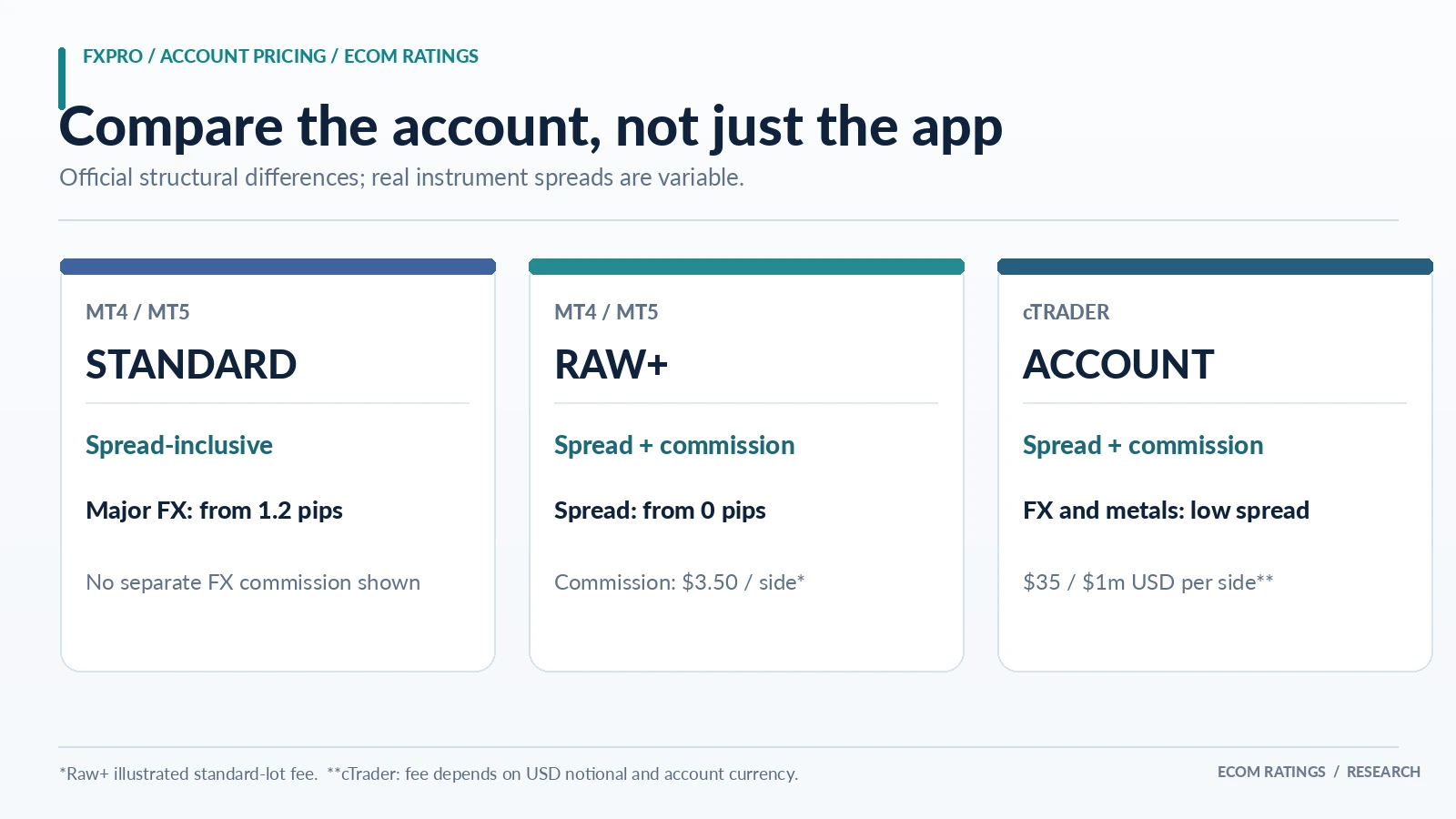
FxPro’s official platform comparison currently shows several distinct account structures. MT4/MT5 Standard uses an all-inclusive marked-up spread for many instruments, with no separate FX commission in the standard pricing presentation. MT4/MT5 Raw+ advertises tighter raw-style spreads and a separate commission, with Elite following similar pricing while offering rebate conditions. cTrader is presented with low spreads plus commission on forex and metals, and different spread treatment for selected other CFD categories.
This means it is misleading to compare “the cTrader spread” to “the MetaTrader spread” as though all MetaTrader users have the same account. MT4 Standard and MT5 Raw+ can produce different results even when opened through the same broker. The clean comparison has three columns at minimum: cTrader, MT4/MT5 Standard, and MT4/MT5 Raw+. Elite should be modeled separately if rebates are relevant and the trader actually qualifies for them.
Platform functionality can affect execution habits, too. cTrader supports depth-of-market information and different order-management tools, while MT4 and MT5 have their own automation, indicator and position-management environments. Those features are not direct fees, but they influence strategy selection, how orders are submitted and whether a trader can reproduce the same setup on every platform. In a cost comparison, separate platform features from explicit charges rather than treating better charting as a cash saving.
The all-in cost formula and its limits
For a closed position, a practical accounting formula is: spread cost + opening commission + closing commission + net financing or swap + currency conversion and other applicable charges. If the trader expects slippage relative to a chosen benchmark, include that as a separate execution-cost estimate rather than hiding it inside the quoted spread. Slippage is not a fixed broker commission; it depends on market conditions and the order route.
For standard spot-forex examples, the spread cost can be approximated as the spread in pips multiplied by the pip value of the selected lot size. With EUR/USD, one standard lot is commonly 100,000 units of the base currency, and a one-pip change represents $10 in the quote currency. A 1.2-pip spread therefore represents approximately $12 for that one-lot position, before any other cost. The figure scales with position size: 0.10 lot would have about one-tenth of that spread cost under the same conditions.
The formula is simple, but live data are not. Spreads widen or narrow, swap rates update, conversion rates move, and commission schedules can be entity- or account-specific. Use these mechanics to build a worksheet, then fill it with the instrument specifications displayed in the actual FxPro account rather than relying on values copied from a review written months earlier.
Standard spreads versus Raw+ commissions
FxPro’s current comparison describes Standard major-forex pricing as an all-inclusive spread from 1.2 pips. That is a headline starting condition, not a promise that the spread stays fixed during every market session. A trader using this account generally sees more of the trading charge incorporated into the bid-ask spread instead of a separate line item for the same forex trade.
Raw+ has a different structure. FxPro advertises major-forex spreads starting from zero and a commission of $3.50 per side for the specified standard-lot-style pricing. The spread can still be above zero in practice, so “zero plus $7 round trip” is only a theoretical lower-bound combination for a standard USD-denominated example, not a typical cost guarantee. Elite has a related structure but may introduce rebates whose eligibility and terms must be confirmed independently.
This distinction matters for frequent traders. A wider all-inclusive spread may be easier to understand and budget for, while raw pricing can be attractive where the actual spread remains sufficiently tight to offset the separate commission. But no account should win on its label alone. When a strategy trades around news, illiquid hours or less common pairs, the realized spread may dominate the result regardless of the advertised starting point.
How FxPro describes cTrader commission
FxPro’s current comparison lists cTrader commission for FX and metals as $35 per $1 million traded, with the fee considered for opening and closing. Its detailed commission page demonstrates the need to convert the base-currency notional into USD and then, where applicable, into the account currency. For a 100,000-unit EUR/USD trade at an illustrative EUR/USD rate of 1.10, the base-currency notional equals about $110,000. At $35 per $1 million per side, the illustrative commission is $3.85 per side, or $7.70 round trip.
A key nuance is that simplified FAQ phrasing sometimes mentions $3.50 per lot, while the detailed cTrader page applies a USD-notional calculation. The two presentations are not interchangeable for every currency pair and account denomination. A trader should reconcile them using FxPro’s commission calculator and the live contract specification. This article treats the detailed per-million calculation as the basis for its worked EUR/USD example and clearly labels the exchange rate as hypothetical.
Do not double-count commissions. FxPro’s materials note that commission may be charged as a round-turn amount when the position is opened, even though the economic calculation covers both opening and closing. If the account statement shows one commission booking at entry, that does not automatically mean another equal booking will occur at exit. Compare the total round-trip cost, not merely the visual placement of an entry in the ledger.
Worked example: a one-lot EUR/USD round trip
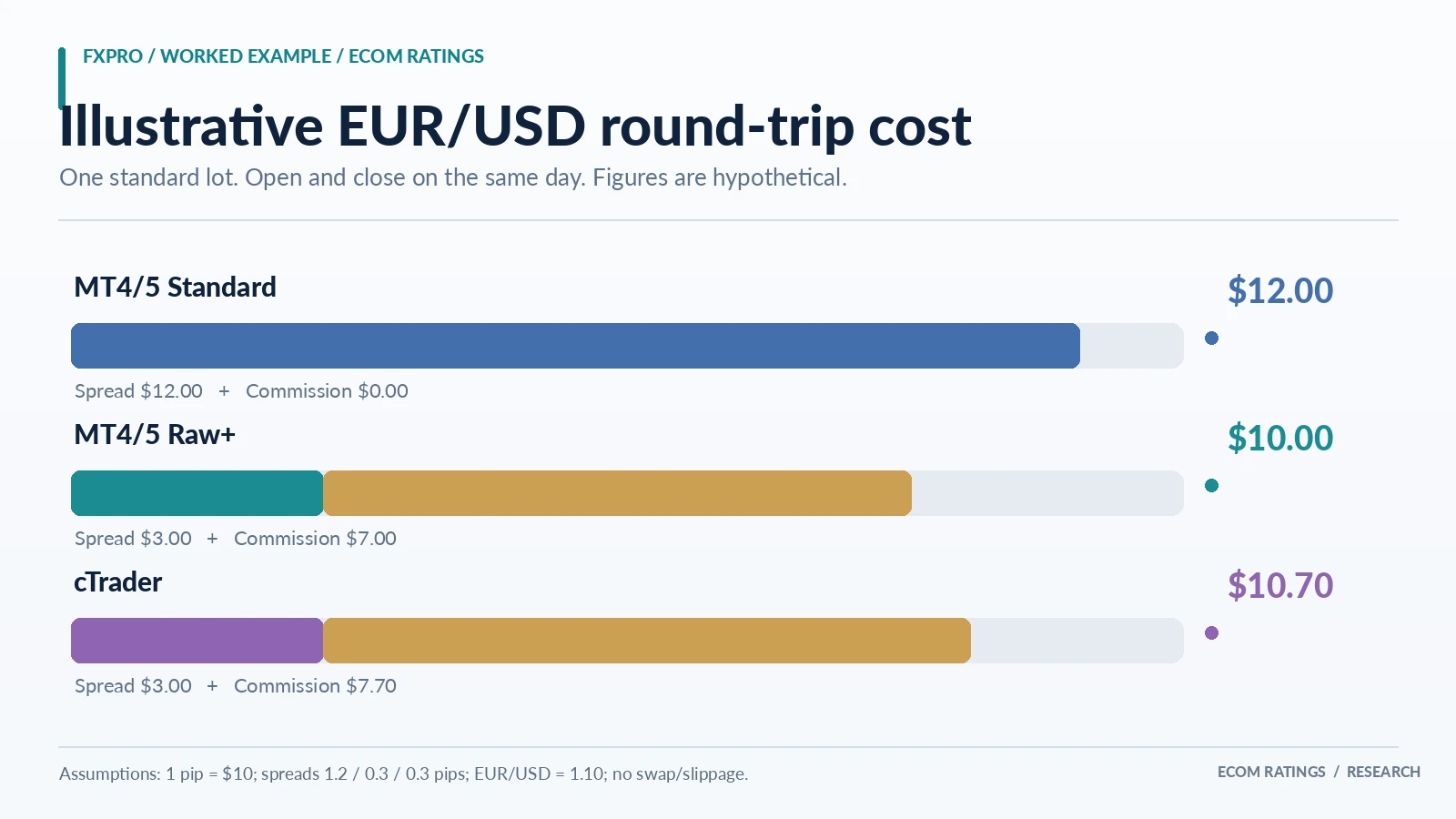
Consider a fictional one-lot EUR/USD position, opened and closed without holding overnight. Assume pip value $10, an illustrative EUR/USD conversion rate of 1.10, and spreads that happen to be 1.2 pips on Standard, 0.3 pips on Raw+, and 0.3 pips on cTrader. These are comparison inputs chosen to demonstrate the method, not observed FxPro quotes or average spreads.
| Cost component | MT4/MT5 Standard | MT4/MT5 Raw+ | cTrader |
|---|---|---|---|
| Assumed spread | 1.2 pips | 0.3 pips | 0.3 pips |
| Spread cost at $10/pip | $12.00 | $3.00 | $3.00 |
| Example round-trip commission | $0 | $7.00 | $7.70 |
| Example total, no overnight carry | $12.00 | $10.00 | $10.70 |
In this deliberately controlled example, Raw+ comes out $2 below Standard and cTrader comes out $1.30 below Standard. Change the assumed cTrader spread to 0.5 pips while keeping everything else constant, and cTrader’s total becomes $12.70. The arithmetic illustrates why platform rankings based only on headline minimum spreads are not robust. A different active-session spread, commission basis or position size can change the order quickly.
A second example: trading a smaller position
Suppose the trader uses 0.10 lot rather than one lot, with the same hypothetical spreads and conversion rate. The spread components scale to $1.20 on Standard and $0.30 on each raw-style account. Assuming the commission scales proportionally with notional and there is no special minimum, the Raw+ round-trip commission is approximately $0.70 and cTrader approximately $0.77. The total becomes roughly $1.20, $1.00 and $1.07 respectively.
Do not infer from this exercise that the account has no minimum order fees or that every instrument follows the same rules. Actual minimum trade size, contract conventions and commission rounding should be confirmed with the broker. The point is to avoid mixing a one-lot quoted commission with a 0.10-lot strategy and creating an artificial cost disadvantage.
The same discipline applies to non-USD account balances. A USD commission converted into EUR, GBP or another account currency may not display as the exact dollar number from a tutorial. Convert at the relevant rate, and consider any currency-conversion mechanics separately if they create additional charge or spread effects.
Swaps and overnight holding change the ranking
FxPro states that swap or rollover charges apply when positions remain open overnight, with instrument-specific rates and calculation methods. Its published swap guide says the charge is applied at a specified UK-time rollover and that rates are reviewed and updated. For FX and metals, a triple charge generally occurs on Wednesday to account for weekend settlement; other instruments may follow a different triple-swap day. Check the current instrument details rather than assuming the weekday is universal.
For a trader who opens and closes positions within one session, the most relevant components are usually spread, commission and execution. For a trader who holds positions for days, weeks or over a weekend, cumulative swap can outweigh small differences in transaction costs. A $2 saving on entry is not decisive if holding costs differ materially over the life of the position.
Swap can be positive or negative depending on side, instrument and prevailing rates, although traders should not assume that a positive value will remain stable. FxPro also documents swap-free accounts subject to conditions. Do not treat “swap-free” as a universally costless option: eligibility and terms must be checked for the specific account, and the commercial model may include restrictions or alternative charges.
An overnight-cost worksheet example
Imagine the same illustrative one-lot trade as before. Assume a net $2.40 financing charge per night for three ordinary rollover events, ignoring any special triple day for the sake of the math. The financing portion is $7.20. Under the earlier spread and commission assumptions, the total would be $19.20 on Standard, $17.20 on Raw+ and $17.90 on cTrader. This is an arithmetic illustration, not an FxPro live swap quote.
Now suppose one of the rollover events is a triple-swap day and the relevant rate remains $2.40 per unit charge. The modeled financing effect could be larger than the simple three-night line. That is why a precise real-world worksheet must use the broker’s actual overnight schedule, the relevant position side, and the instrument’s current swap rate. It cannot simply multiply one arbitrary rate by calendar days.
For traders comparing strategies, record opening date, closing date, number and type of rollover events, long or short side, and actual swap debits or credits. This turns the comparison into a verifiable ledger rather than a rough impression that one platform “has expensive overnight fees.”
Indices, metals, crypto and stocks are different cases
FxPro’s cTrader pricing is not presented as one universal commission applied to every CFD. Its platform comparison states that indices, energy and cryptocurrencies generally use marked-up floating spreads with zero separate cTrader commission, whereas FX pairs and metals use lower spreads plus commission. MetaTrader availability also differs by instrument group, with stock and ETF CFD availability shown for MT5 in the relevant comparison.
This is a frequent comparison error: someone reads the cTrader forex fee and adds it to an index trade, or assumes a Standard forex spread formula applies unchanged to gold. Each instrument has its own contract size, minimum volume, tick size, spread, financing and possibly commissions. Metals may be quoted in price increments such as cents rather than the pips used for forex. The correct method starts from the specific contract specification, not from the platform overview.
For an index CFD, calculate the spread in index points multiplied by the contract’s monetary value per point, then add swap where applicable. For a metal, calculate the difference between bid and ask using the contract quantity and relevant quote currency, and verify the commission model. For share CFDs, confirm whether the instrument exists on the selected platform and read any relevant fee schedule before comparing.
Execution quality and slippage belong in the analysis
An account with a lower displayed spread can still produce a higher realized trading cost if orders consistently fill worse than expected. Execution price matters in fast markets, and stop or limit behavior depends on liquidity, instrument conditions and order type. cTrader and MetaTrader may provide different order-entry and protection interfaces, but the quality of execution must be measured, not inferred from the sophistication of the screen.
A useful test is to record at least a representative sample of comparable trades, including order submission time, intended price, fill price, contemporaneous spread, size and market session. Calculate the slippage relative to an appropriate benchmark, separating adverse and favorable outcomes. The result is observational data for the trader’s strategy; it should not be presented as a broker-wide execution statistic based on a handful of orders.
Be careful about demos. Demo accounts can help test workflows and automate cost calculations, but they may not replicate all live execution conditions. Do not rely on backtested spreads or simulation alone to rank live accounts. A useful comparison combines published fees with actual statement records from a properly controlled trading sample.
Funding, inactivity and conversion costs are not spread costs
FxPro’s funding FAQ states that it does not generally charge its own deposit or withdrawal commission, while third-party providers such as banks may impose costs. It also notes that certain e-wallet withdrawal conditions can produce fees in particular circumstances. These are account-level costs rather than per-trade spread or commission charges. A trader comparing total operating cost should keep them separate but not ignore them.
Currency conversion can arise when commission, swap or trading P&L is expressed in a currency other than the account balance. The result may differ from a simple USD worksheet. If an account offers multiple currencies, choose the one that matches your cash flows where practical and verify the conversion rules. Do not assume a specific conversion fee without an official schedule or statement evidence.
Finally, avoid double-counting deposits and trading cost. A deposit is not itself an expense; a bank fee or conversion spread associated with it may be. Distinguishing cash movements from expenses makes any all-in worksheet much more credible.
A repeatable testing protocol for traders
First, select one instrument, direction and trade size. Second, capture the actual account type and contract specifications on each platform. Third, record spread snapshots during the times when the strategy normally trades, not only at a quiet or unusually liquid moment. Fourth, calculate both sides of commission according to the documented schedule and currency basis. Fifth, add expected swap for the real holding horizon and note any triple-rollover day.
Then test execution. Keep the session, instrument and trading logic as comparable as possible. Finally, compare realized statement entries with the model. If the total differs, identify the source: spread at execution, commission conversion, swap, slippage, a contract-size assumption or another fee. This is more work than reading two marketing pages, but it gives an answer that can be reproduced.
A simple worksheet should include platform; account type; legal entity or country where relevant; instrument; contract size; opening and closing timestamps; spread at entry; commission entries; net swap; currency conversion; and the realized cost subtotal. Keep a note of the documentation date because brokers can update pricing over time.
Bottom line
FxPro cTrader and MetaTrader cannot be ranked fairly by the platform label alone. The real comparison is among cTrader, MT4/MT5 Standard, and MT4/MT5 Raw+ or Elite, with the instrument and holding period held constant. Standard generally embeds its forex charge in a wider spread, whereas Raw+ and cTrader can pair tighter spreads with commissions. Swaps and execution can change the result, especially for longer holding periods.
The article’s sample EUR/USD totals are illustrative, not live quotes. Use them as a calculation template: obtain current broker specifications, verify the applicable commission and swap schedule, run the same instrument through each account and inspect statement entries. That is how “all-in trading costs” becomes a number that can be defended, rather than a vague platform preference.
See also the Ecom Ratings FxPro review for broader account features, risk disclosures and platform suitability.
Primary sources and verification
- FxPro: Platform and account comparison
- FxPro: Commissions and swap charges
- FxPro: Trading and platform FAQs
- FxPro: cTrader platform features
Editorial method: All sample spreads, exchange rates and swap amounts in this article are explicitly hypothetical. The structural differences in account types and fee calculations are based on current FxPro documentation reviewed October 28, 2026. CFDs are leveraged high-risk products; trading costs are only one part of suitability.