
XM / TRADING COST RESEARCH · ECOM RATINGS
XM Swap-Free Trading: Eligibility, Holding Costs and Account Restrictions
Editorial research · Primary sources reviewed November 4, 2026
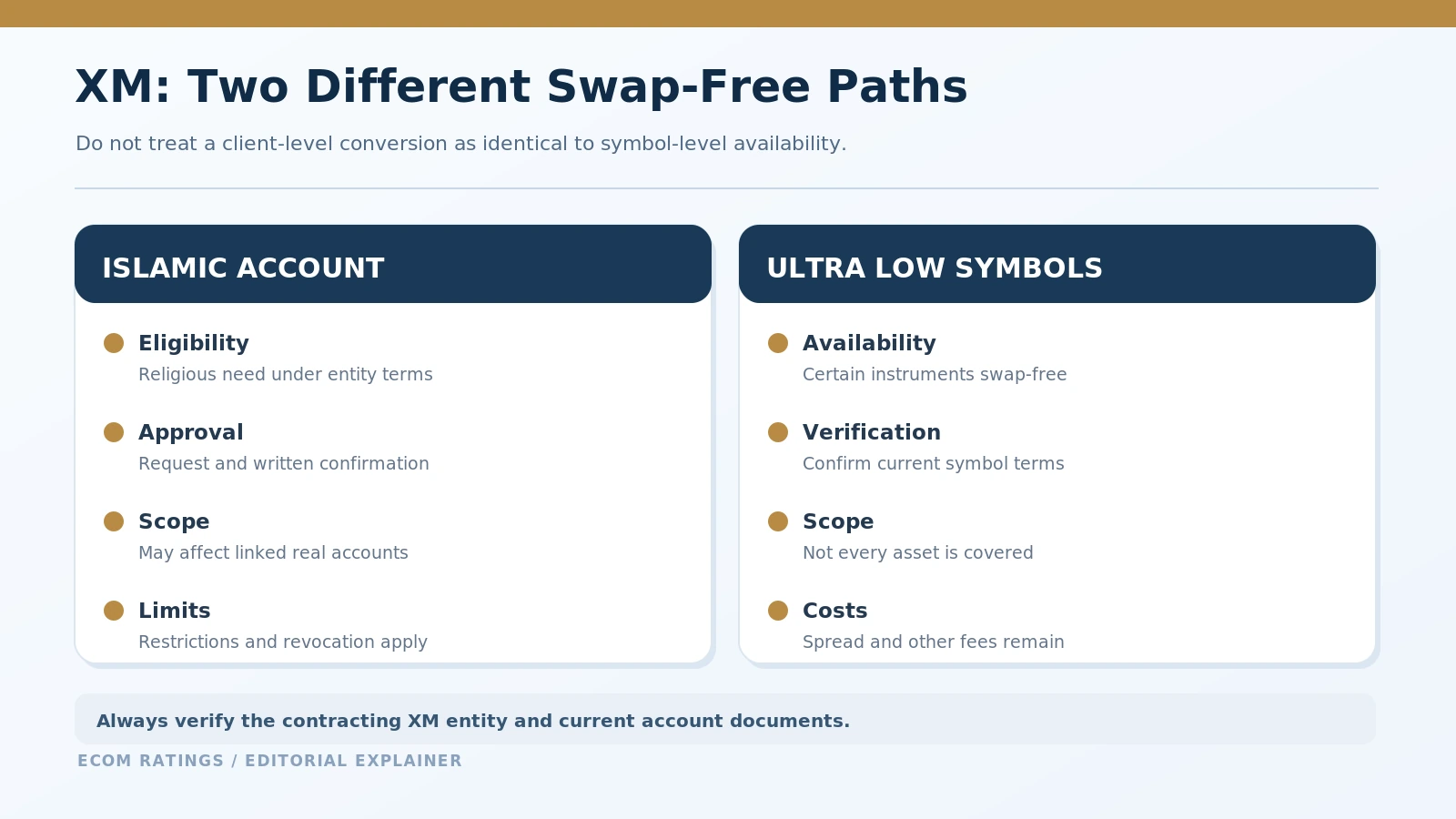
“Swap-free” sounds like a simple promise: hold a leveraged trade overnight without paying the usual rollover financing charge. In practice, XM uses the term in more than one context, and traders should not treat every swap-free label as interchangeable. Some XM materials describe Islamic accounts requiring an eligibility request tied to religious beliefs. Other current XM help materials say that an Ultra Low account permits swap-free trading in certain instruments. Those are different routes, with potentially different qualification and product rules.
This guide explains how to read the distinction, which documents to check, what remains part of trading cost even when a swap is absent, and why the contracting XM entity matters. It does not assume that every account, country, instrument or holding period enjoys identical treatment. In leveraged trading, the most expensive misunderstanding is often not the quoted spread; it is the feature you thought applied to a position but did not.
Begin with the exact meaning of swap-free
A swap or rollover charge normally arises when a leveraged position stays open beyond a broker’s daily financing cutoff. For currency pairs, the economic basis often involves the interest-rate differential between the currencies and a broker markup. Other asset classes have their own financing conventions. The exact amount can depend on direction, instrument, trade size, valuation method and timing.
A swap-free treatment removes that specified rollover debit or credit for an eligible position under the relevant terms. It does not automatically remove the spread, an execution commission, slippage, currency conversion or any other charge that might apply. A trader should therefore look at the full cost stack rather than assuming the absence of one line item means the trade is free to carry indefinitely.
This is also why the phrase requires context. A formal Islamic account arrangement is a client-level status that can alter the treatment of accounts held by an eligible person. Swap-free availability on an instrument within a particular account type is a product-level characteristic. The two may overlap in effect for a specific trade, but they should not be conflated when evaluating eligibility or planning a trading strategy.
Islamic account eligibility is a contractual question
XM Global’s published client agreement includes a section on Islamic or swap-free accounts. In that wording, swap-free accounts are available to clients who cannot use swaps because of their religious beliefs. The company reserves the right to request justification or evidence of need and may decline a request. The terms also say that conversion is performed after submission and assessment of the request, with confirmation provided to the client.
The practical implication is that a trader should never assume eligibility merely because a third-party review mentions “XM Islamic accounts.” The proper route is to find the account’s contracting entity, read its current Islamic-account terms and ask what documentation is required. That is especially important if a trader has multiple real accounts or is switching from a conventional account with existing open positions.
The XM Global terms also indicate that the request may affect all the client’s other real trading accounts with that company. This is a significant operational condition. A trader should clarify whether the conversion applies across the whole relationship and how existing open trades are handled, rather than expecting a single isolated toggle for only one chosen strategy. Keep the written approval and effective date with the account records.
A different case: Ultra Low and selected swap-free symbols
XM’s public Help Center also states that an Ultra Low account allows certain instruments to be traded swap-free. That statement is narrower than a universal promise that an entire account has no rollover charges under every circumstance. The words certain instruments matter. Product eligibility can be symbol-specific and may change with the relevant account conditions.
For a trader choosing between account types, the correct process is to confirm the exact symbol and current specification rather than extrapolating from a marketing overview. If EUR/USD is covered, that tells you nothing definitive about a different cross-currency pair, a commodity CFD or an index contract. If the account shows swap-free treatment today, do not assume the feature must apply permanently without checking the contract and symbol specification.
This is also where regional differences can enter. The XM brand operates through multiple legal entities, and the client documentation accepted during onboarding is the governing relationship. A current help article can be useful orientation, but it is not a substitute for the conditions attached to your actual account, jurisdiction and instrument. The correct question is always “Does this status apply to my account and this symbol?”
Entity and classification checks before opening a trade
A broker group may present one global brand while clients contract with different companies. This matters for swap-free status because account eligibility, legal definitions, approval procedures and remedies are governed by the documents supplied by the entity that actually opens the account. XM Global Limited’s agreement provides specific Islamic-account clauses, but a trader under another entity should consult that entity’s current version instead of relying on a document copied from a different region.
Save the entity name from the account-opening agreement and compare it with the customer-support domain, footer and legal-document area. If those references do not align, ask for written clarification before making assumptions about financing treatment. The most reliable evidence is an approval email or account-level confirmation that identifies the relevant status and effective date, paired with the document version applicable on that date.
It is not enough to ask support “Do you offer swap-free?” A better request names the entity, account type and planned instruments. For example: “Please confirm whether this account is eligible for Islamic conversion, whether the change affects all linked accounts, and which current symbols carry swap-free status on an Ultra Low account.” A specific request encourages a specific answer and produces a more useful paper trail.
Spreads remain real costs
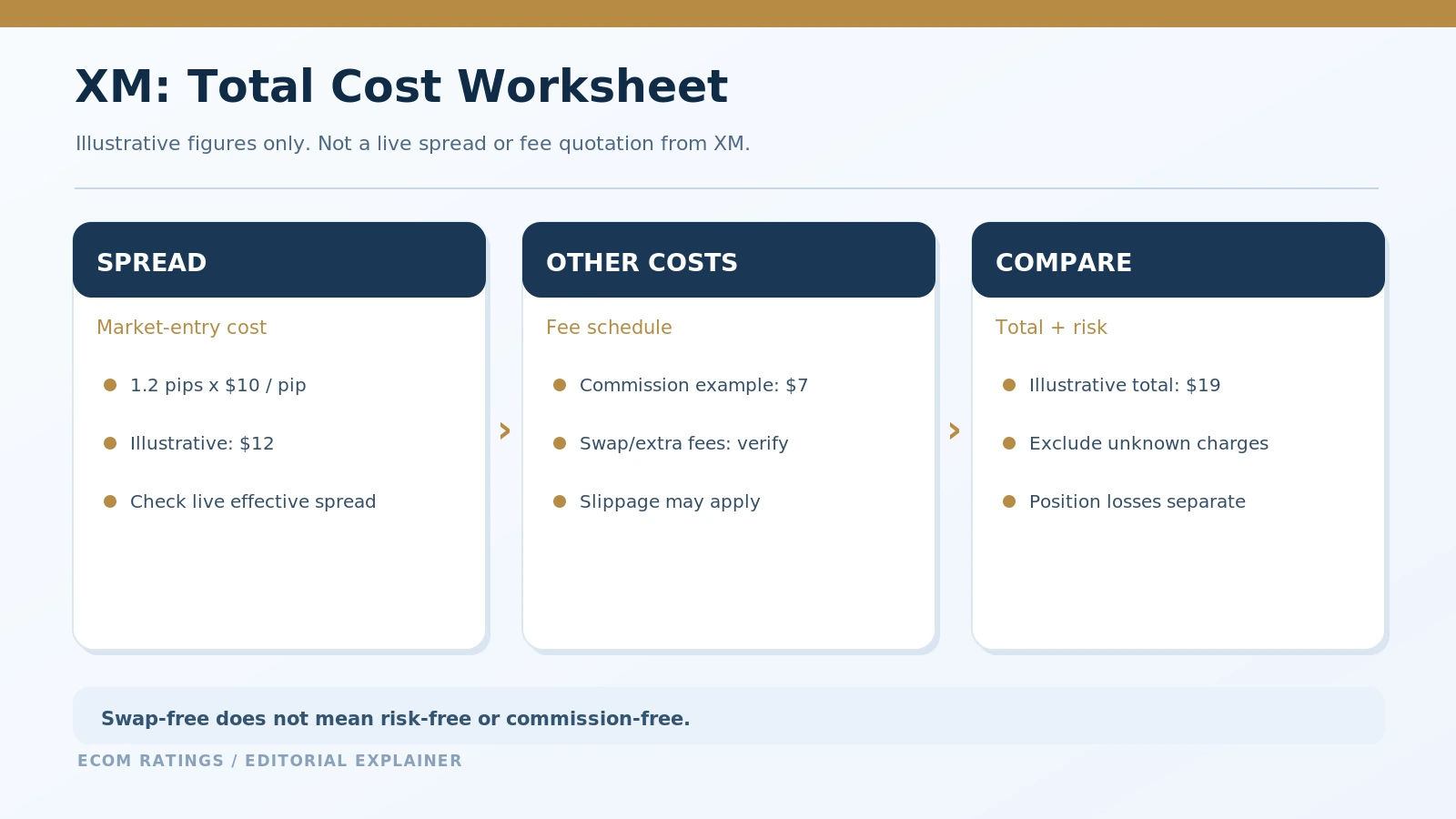
The spread is the difference between the bid and ask quotes. A position normally begins with an implicit spread cost even if no swap is charged later. The amount depends on the instrument, spread at entry, trade size and currency conversion. For an illustrative one-lot EUR/USD transaction with a pip value of approximately $10, a spread of 1.2 pips represents about $12 of initial trading cost. This is a hypothetical calculation, not a live XM quote or promise of a particular spread.
If the same hypothetical account also charged a commission of $7 per round trip, the combined spread-and-commission cost would be roughly $19, before slippage, any financing or conversion effects. The arithmetic is straightforward: $12 plus $7. What matters is not those fictional prices but the structure of the calculation. A swap-free trade could still cost $19 to enter and exit under that example.
Traders who compare accounts only on the word “swap-free” can miss this trade-off. A no-swap condition might be attractive for longer holding periods, but a different spread or commission schedule can change the economics of frequent trading. The right comparison holds the instrument, position size, execution assumptions and holding period constant across the alternatives.
Why overnight holding costs need a written check
XM’s public materials describe conventional swaps and how the rates are derived. They also describe swap-free availability under certain circumstances. They do not justify a blanket statement that every eligible trader will face exactly zero financing-related cost on every asset for unlimited time. The fact that a trade is swap-free under one published category does not answer whether separate administrative charges, instrument-specific terms or policy changes could apply elsewhere.
This is where precise wording prevents false expectations. Do not tell a reader that XM necessarily imposes a fixed replacement fee after a certain number of days unless that fee can be verified in the current document governing the relevant account. Equally, do not promise that there can never be any other carrying cost simply because the standard swap field shows zero. The responsible position is to inspect the live symbol specification and request a current written fee schedule when the terms are unclear.
For traders who hold positions through weekends, holidays or contract rollovers, this check is especially important. Financing cutoffs and symbol schedules can behave differently from ordinary weekday sessions. The absence of a swap charge in one day of account history is useful evidence for that day, but it is not contractual proof that every future day is covered.
Swap credit is not a risk-free revenue source
Islamic-account terms published for XM Global explicitly say that clients may not use swap-free treatment as a way to profit from swaps. This distinction matters because a trader might try to combine accounts, instruments or position directions solely to exploit differences in financing or cash-back treatment. The agreement addresses abuse, manipulation, arbitrage and related conduct, and the company reserves significant enforcement powers if it determines that those terms have been breached.
The practical lesson is not that ordinary long-term holding is prohibited. It is that the swap-free feature should be used for its intended purpose, in accordance with the approved account terms, rather than as a mechanism for extracting financing advantages unrelated to the underlying trading strategy. Traders who use hedges or carry-oriented strategies should clarify their approach before relying on the status.
These clauses also underscore why an account label is not a permanent entitlement. XM Global’s terms say swap-free status can be revoked. They describe potential recovery of charges and other remedies in cases of abuse. That means traders need to monitor both current conditions and account communications. A strategy whose profitability depends entirely on an unchanged swap-free privilege carries a contractual risk as well as market risk.
The difference between no swap and no risk
Rollover is only one source of trading cost and risk. Even with no conventional swap charge, a leveraged position is exposed to market movement, gaps, spreads widening during news, execution differences and margin requirements. A trade that remains open for weeks can incur a large market loss while showing little or no swap cost. Removing a financing charge does not change the direction of the underlying market.
This matters in educational comparisons because the word “free” can dominate a beginner’s attention. A swap-free condition is genuinely useful when it matches the trader’s needs, but it should sit alongside a discussion of leverage, margin close-out and volatility. If the position is oversized, avoiding a small overnight fee will not compensate for a sharp adverse price move.
A responsible cost worksheet therefore includes both direct expenses and exposure assumptions. The direct expenses are spread, commission, any verified financing-related or administrative charges and currency conversion. The exposure measures include leverage, notional position size, available margin and possible adverse movement. These two categories answer different questions, and neither should be dropped from the decision.
A worked comparison of two hypothetical trades
Consider two hypothetical accounts trading the same pair with the same notional position size. Account A has a one-pip effective spread and a conventional overnight charge of $4 per night. Account B is eligible for swap-free treatment, but its effective spread is 1.8 pips. Assume a one-lot EUR/USD equivalent with a $10 pip value and no other commissions. These numbers are illustrative, not published XM rates.
For a same-day trade, Account A’s spread cost is about $10, while Account B’s is about $18. In this simplified model, A is cheaper by $8. If the trade stays open for five nights, Account A’s approximate combined cost becomes $10 plus five times $4, or $30. Account B’s simplified spread cost remains $18 if no additional carrying charge applies to that instrument and period. Under those assumptions B becomes cheaper. Change the holding duration, spread or any extra verified fee, and the result changes.
The point of the example is not to recommend an account type. It is to show why a trader must compare the whole holding period, not a single feature label. A swap-free condition is economically meaningful, but only when paired with the real spread, commissions and contract terms for the exact instrument being traded.
What to verify in the trading terminal and statements
Before relying on the feature, inspect the exact instrument specification in the trading terminal. Record the account type, symbol, quoted spread, commission schedule and displayed swap values where shown. Then compare those observations with the relevant legal documents and support confirmation. A screenshot can capture the terminal state, while the agreement explains the conditions under which that state applies.
After a small, controlled position remains open through the relevant financing cutoff, review the account statement for any swap debit, credit, commission or other adjustment. That observation is useful for verifying the actual account behavior. It is not a substitute for the contract, and a single overnight observation should not be generalized to all symbols or future dates.
If the statement includes an unfamiliar charge, ask the broker to identify the exact fee category and the contractual clause supporting it. Keep the symbol, trade identifier, opening and closing times and account type in the inquiry. Avoid concluding automatically that every non-spread cost is a swap; a charge may have a different basis, and the explanation should be checked against the governing fee schedule.
A careful account-selection checklist
A trader evaluating XM swap-free access should answer five questions before proceeding. Which entity is opening the account? Which account type is proposed? Which symbols qualify? What approval or eligibility requirements apply? What other trading costs remain? A sixth question is useful for longer-term plans: how can the conditions change, and how will the customer be informed?
For Islamic conversion, retain the request and approval confirmation. For an Ultra Low instrument-specific arrangement, retain the current product specification. In both cases, save a current statement showing how charges were actually applied. The resulting file is small but powerful: entity, agreement, status, product terms and actual transaction evidence.
If a salesperson or internet review promises universal swap-free status without qualifying it, ask for the official terms. Generic comparisons often ignore the distinction between client-level eligibility and symbol-level treatment. In a real account, that distinction determines whether the promise survives the first overnight position outside the commonly discussed pairs.
Final assessment
XM offers recognizable pathways for traders concerned about swap charges, but eligibility and cost treatment require careful reading. The formal Islamic-account arrangement described in XM Global’s agreement is linked to religious need, review and approval, and potential restrictions on account use. Separately, XM’s Help Center states that certain instruments on its Ultra Low account can be traded swap-free. Neither statement supports a universal claim that all traders can hold all assets indefinitely without any other costs.
A strong decision starts with the contracting entity and ends with the full cost worksheet. Confirm the exact account status, symbol eligibility, spread, commissions, any additional verified holding charges and the rules against abuse. Keep the written evidence. Swap-free trading can be useful, but its value is best understood as one component of a carefully documented trading setup, not as a substitute for risk management or a guarantee of low total cost.
For additional context, see the XM company review on Ecom Ratings.
Primary sources and methodology
- XM: Swap calculations and Ultra Low account
- XM Global: Client Agreement, Section 73
- XM Global: Islamic Account Use Agreement