
WIX / SUBSCRIPTION OPERATIONS · ECOM RATINGS
Wix Subscription Products: How Failed Renewals Affect Customer Access
Editorial research · Primary sources reviewed November 4, 2026
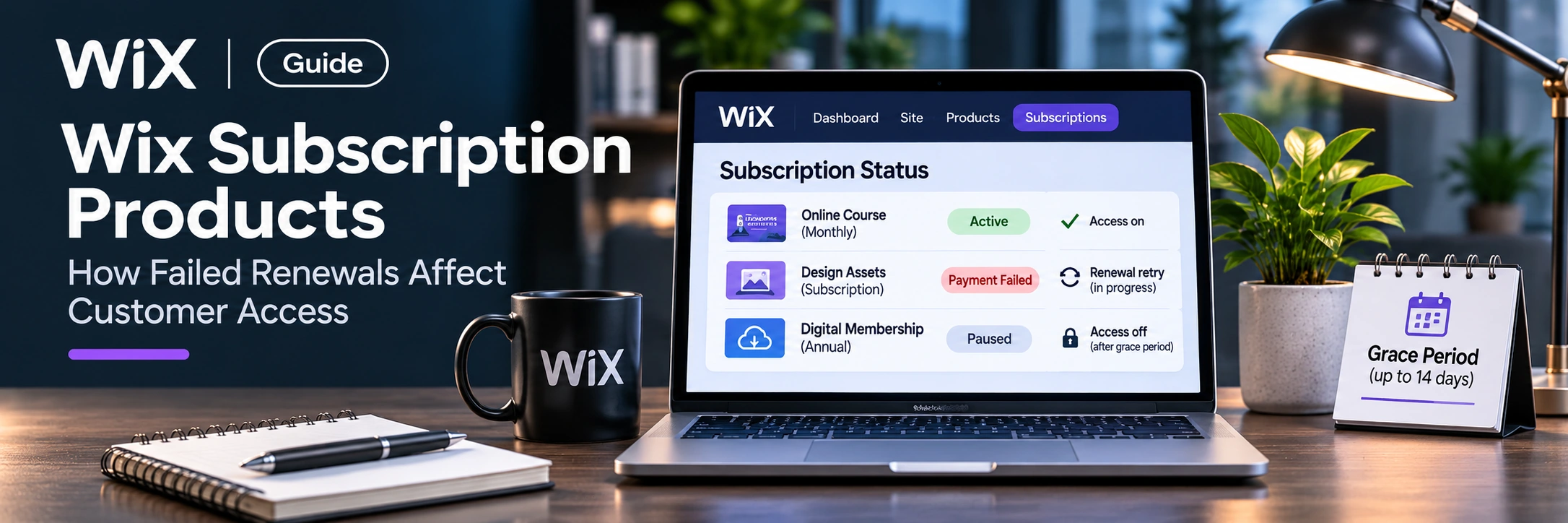
A subscription business can lose a paying customer without anyone actively choosing to cancel. A card expires, the issuing bank declines a renewal, or the customer replaces a payment method and forgets to update the site. What happens next is a product-access question as much as a billing question. For Wix merchants, the answer depends on the kind of subscription, whether a grace period has been enabled, and which status the subscription displays at that moment.
This guide focuses on subscriptions sold to customers through Wix Pricing Plans and Wix Stores, not the Wix Premium or Studio subscription that a site owner pays Wix for. The distinction is essential: advice for renewing a site owner’s domain does not explain whether a member can watch paid videos, use a booking benefit, or receive a subscription product. The goal here is to create an auditable recovery process rather than guess from a payment-declined email.
Identify which Wix subscription controls the benefit
Wix offers several recurring-payment workflows. Pricing Plans can be used for membership benefits, gated content and ongoing services. Wix Stores can sell recurring physical-product subscriptions. Wix Bookings and other supported subscription types have their own fulfillment logic, while the centralized subscription settings influence failed-renewal handling. The technical product matters because an access benefit is not always the same as an order shipment. A plan can grant permission to view a page; a store subscription may trigger a new recurring order.
Before investigating a failed payment, write down the product name, subscription type, payment provider and customer-facing benefit. Is the benefit a members-only page, online class, recurring appointment, digital download, physical delivery, or a combination? This list prevents the merchant from assuming that a restored billing record automatically fixes every downstream benefit. It also tells support which system to check after the financial status changes.
Wix’s public guidance says that recurring Pricing Plans and online Stores subscriptions support configurable grace periods. The help materials also name recurring invoices, Events memberships and Bookings monthly subscriptions among supported types. That does not mean every benefit works identically. Treat the subscription record as the payment truth, then confirm what the attached service does with that status.
What happens when a recurring payment fails
Without a grace period, Wix’s Pricing Plans guidance says a failed recurring payment can cancel the customer’s plan. A canceled plan is not usable by the customer. That is why a merchant should not promise that access will last until the next invoice simply because the customer paid successfully last month. The immediate status of the subscription, rather than the merchant’s recollection of the intended renewal date, determines the next check.
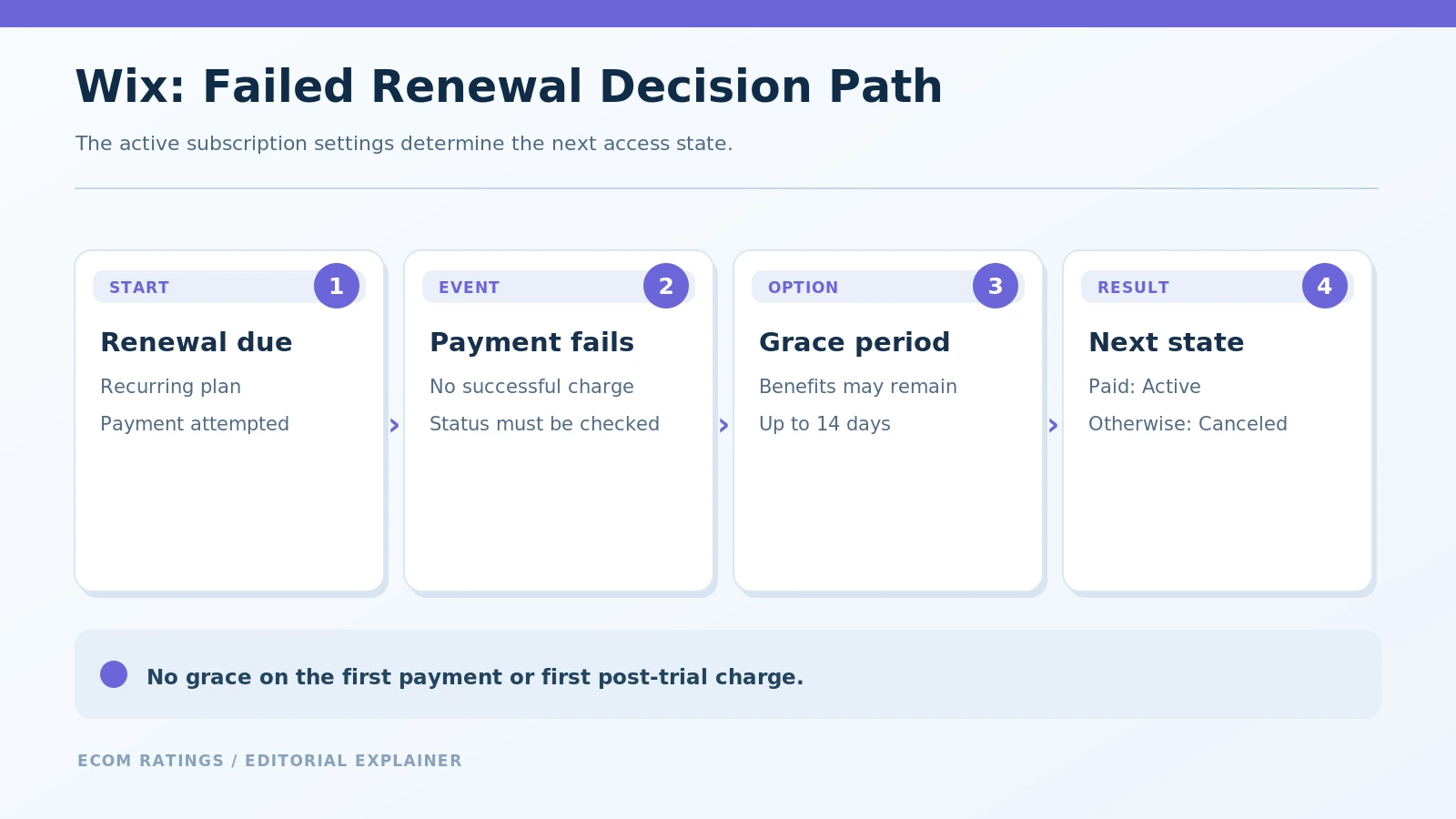
With a configured grace period, the path is different. A failed renewal can move the subscription into Grace Period instead of immediately ending it. Wix says the customer continues receiving the subscription benefits during that window, unless the business intentionally suspends the subscription. If payment is successfully collected, the status returns to active. If the period expires without successful payment, the subscription cancels automatically.
The grace period therefore acts as a customer-retention buffer. It is not free permanent access, and it is not proof that the card was charged. It simply creates a documented interval in which the customer can correct the payment problem while the membership remains available. A merchant who wants consistent recovery outcomes needs to configure the feature before a wave of failed renewals occurs.
The 14-day limit and shorter billing cycles
Wix currently documents a maximum grace period of 14 days, subject to the important rule that it may not be longer than one subscription cycle. This prevents a weekly subscription from turning into a two-week period of uncollected service. A merchant offering weekly and monthly products under the same settings needs to understand that the effective recovery window can differ across products even when a single global setting is used.
Consider a business with a seven-day subscription and a monthly subscription. It chooses a ten-day grace setting. The weekly plan cannot receive ten days, because that would exceed its billing cycle; its effective grace period is capped at the cycle length. The monthly plan can generally use the ten-day setting. This is a worked illustration of the documented rule, not a claim that every account sees an identical countdown screen.
The business should also check whether the subscription is in its first payment cycle. Wix specifically says the grace-period feature does not apply to the first subscription payment, including the initial payment that follows a free trial. This single exception changes how a merchant should design onboarding and trial-to-paid messages. Do not tell a customer that every failed payment automatically receives a grace window.
Retry attempts are useful but not universal
Wix provides a recurring-retry option within supported grace periods, but its documentation notes that this feature is still being rolled out and may not be available to every account. Where enabled, it attempts to collect payment using the existing method every 24 hours during the grace interval. The actual number of possible attempts depends on the duration and whether the method is eligible for retry. A card reported lost or stolen is an example where automatic retries may not be appropriate or possible.
A good operations manual should describe automatic retry as one recovery path, not as guaranteed background collection. If the retry setting is unavailable, disabled, or ineffective, the customer still needs a clear path to submit payment manually. Wix’s recovery emails can point members to My Subscriptions within the Members Area, where they can select Submit Payment and choose or enter a payment method. The precise screen may evolve, so this article treats the official current help page as the source of interface detail.
Monitor successful and unsuccessful recoveries separately. A business that counts every grace-period subscription as retained will overstate collections. The correct distinction is between a temporary access extension and a payment actually recovered. A simple report can show renewal attempts, failed renewals, customers entering grace, payments recovered, subscriptions canceled and any benefits that required manual restoration.
When the customer retains access
The clearest scenario is an active subscription: the customer has the benefits associated with their plan. The second scenario is a subscription in an unsuspended grace period: Wix says the benefits continue while payment is being resolved. These two conditions can look similar from the customer’s perspective, but they are financially different. One represents an active paid cycle; the other is a temporary recovery arrangement.
A third state is Pending Cancellation. Wix explains that plans with this status can remain usable until the paid period ends and then become canceled. This is especially important because customer-requested cancellation is not the same as a failed renewal. One may permit access until an already-paid endpoint; the other may require recovery within a grace interval or result in cancellation. Mixing the two creates incorrect support responses.
A fourth state is Suspended. Wix says a merchant can suspend a subscription during its grace period if it does not want benefits to continue. That option is commercially significant: a business selling costly live services may prefer to pause access rather than deliver multiple unpaid sessions. But suspension changes the customer experience, so it should be explained clearly and checked against the merchant’s published membership terms.
A sample customer-access timeline
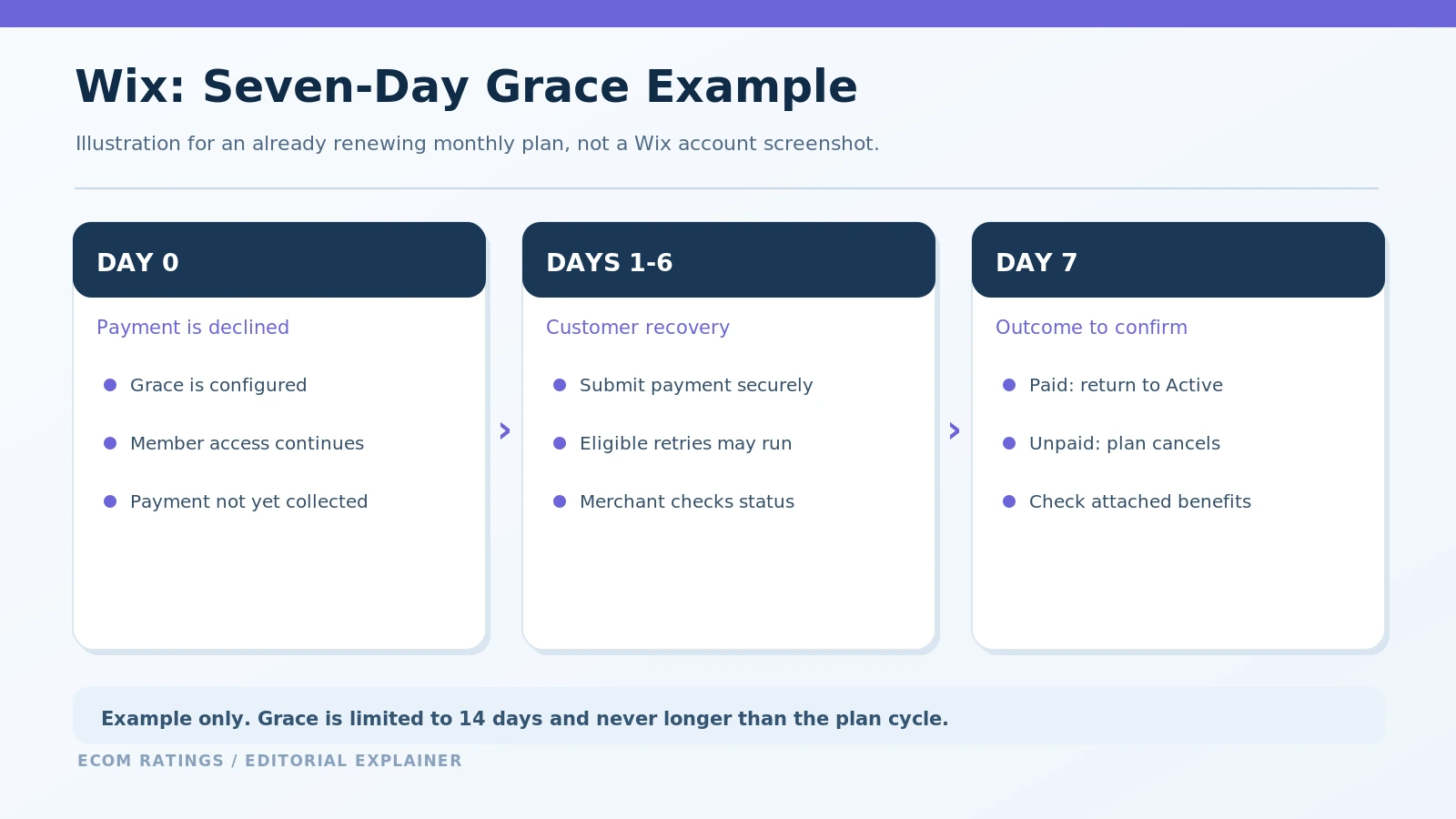
Imagine a monthly membership with a renewal scheduled for November 10 and a seven-day grace period already configured. The card is declined on November 10. If Wix places the plan into grace, the member retains the applicable access unless the subscription is suspended. The customer receives a payment-recovery message if the relevant automation is enabled. The merchant should see a grace-period status rather than treating the payment as collected.
Suppose the customer updates the card on November 13 and the payment succeeds. The subscription returns to active and the business should check that the associated membership benefits remain accessible. No second purchase is needed solely because a renewal failed if the subscription is recovered through the supported flow. The important evidence is the actual successful payment and status change, not merely the customer’s assertion that they entered a new card.
Now imagine the customer does nothing and the grace period expires. Wix says the subscription cancels automatically. In that scenario the business should stop presenting the customer as an active subscriber and should explain whether the customer needs to purchase a new plan. This timeline is illustrative; payment-provider behavior, notification delivery and specific benefit logic must be checked in the merchant’s real account.
Recovery by customer versus recovery by the merchant
The cleanest recovery usually begins with the customer using their own secure payment flow. Wix’s guidance routes customers through the Members Area and My Subscriptions so they can submit payment with an existing or new method. That reduces the need to exchange sensitive financial information with the business. Merchants should avoid requesting complete card numbers, CVVs or bank-login information by ordinary email or chat.
Wix also documents merchant-side options in the Subscriptions dashboard. Depending on the situation, the merchant may collect an authorized payment or manually mark an offline payment as paid. Those actions are powerful, but they must be backed by actual money received. Marking a subscription as paid without a corresponding transaction can create accounting discrepancies and may unintentionally restore access to a service that has not been funded.
A documented recovery log should capture the subscription identifier, original failed date, recovery method, financial confirmation and final status. If the customer pays in person, the merchant can record the receipt and match it to the restored subscription. If a card payment succeeds online, reconcile the processor record to the Wix subscription before closing the issue. Avoid using a dashboard status as the only evidence of settlement.
What merchants should test before launching recurring plans
A practical prelaunch test should cover three scenarios rather than just one successful purchase. First, confirm that an active member can reach the promised gated content or service. Second, simulate or examine a failed recurring renewal in a controlled test environment and verify how the configured grace period affects access. Third, verify the end state when payment is recovered or the grace period expires. These tests should not create unnecessary live charges to customers.
Also test the content of the recovery message. It should name the subscription, explain why payment is needed and direct the customer to the approved account area. It should not say that the plan has already canceled if it is in grace, or that a charge was successfully collected before the processor confirms it. The difference sounds small, but it directly influences customer trust and support workload.
Finally, test the first payment after a free trial separately. Because that initial payment does not receive the same grace handling, the trial-conversion message must set the right expectation. If you use a seven-day trial, consider reminding customers to verify their payment method before conversion. That reduces the risk of a new subscriber losing access before experiencing the value of the first paid cycle.
Common mistakes in access reporting
One mistake is to treat a failed payment notification as proof that the subscription has been canceled. With an active grace period, the customer may still be entitled to benefits. Another is to assume that customer access means a payment was collected. Grace-period members can use services while payment is unresolved. An accurate dashboard should not collapse these two conditions into the same revenue number.
A third mistake is confusing Wix customer subscriptions with the merchant’s Wix site plan or domain renewal. A site owner’s failed premium renewal may affect the website’s availability, but it is a different contract and workflow from a member’s payment for a course or product subscription. If support searches the wrong billing area, it can give a technically correct answer to the wrong question.
A fourth mistake is failing to document manual exceptions. If staff suspend access, extend a plan, manually mark a payment as received or restore a subscription, the business should record why. Otherwise customer-service decisions become inconsistent, and finance may be unable to reconcile what was promised with what was paid.
A weekly retention and reconciliation checklist
Each week, export or review subscriptions in grace, canceled plans following failed payments, and successful recoveries. Match recovered subscriptions to payments actually received. Confirm that benefits stopped for canceled or expired plans and remain available where the plan is legitimately active. For suspended plans, check that support communications match the deliberate decision to pause access.
Review the performance of your customer reminders as a separate metric. A reminder can be delivered but ignored, opened but not acted upon, or followed by a failed retry. The business should count successful payment recovery rather than treating email opens as wins. A simple cohort comparison of subscribers entering grace and subscribers returning to active can reveal how much revenue was saved by the recovery configuration.
Make the customer-facing policy explicit: whether a grace period is offered, whether access continues during that period, how payment can be resubmitted and what happens when the window ends. The documentation should never promise more than the current Wix account configuration supports. With that clarity, failed renewals become a manageable operations workflow rather than a confusing access dispute.
Why the customer experience deserves its own audit
A billing recovery flow can be financially correct and still feel broken to a customer. Suppose a subscriber is told that payment failed but receives no clear explanation of whether access remains active. They may avoid booking a service they are still entitled to use, or repeatedly try to pay because the first retry has not yet posted. Neither outcome is desirable. The merchant should therefore audit the words shown to customers as carefully as the underlying subscription status.
A useful customer-facing status message distinguishes three facts: the most recent charge was unsuccessful, access is currently active or paused according to the configured policy, and a specific action may restore normal billing. It should point to the official payment-update route without asking the customer to send card details by email. If access has already ended, the business should say so rather than promising invisible grace.
This communication audit can be paired with a small support checklist. When a member writes in, staff should check the current plan status, whether a grace period applies and whether the product-specific benefit remains attached. Only then should they decide whether to send a payment link, correct an account association or escalate a technical access issue. Clear status language is one of the simplest ways to protect renewal revenue without frustrating loyal customers.
Final assessment
Wix provides useful tools for managing failed subscription renewals, particularly configurable grace periods, supported payment retries and customer self-service recovery. But the merchant has to distinguish the payment state from the access state. A failed renewal does not always mean immediate loss of benefits, and continued access does not prove payment succeeded. The active settings and subscription status decide what happens next.
The strongest implementation is to choose a grace policy deliberately, test customer access for each subscription type, keep payment recovery evidence and communicate the boundary clearly. Remember the exceptions: grace periods do not apply to initial subscription payments or the first payment after a trial, and automatic retries may not be available to every account. The result is a more predictable experience for customers and cleaner records for finance.
For additional context, see the Wix company review on Ecom Ratings.
Primary sources and methodology
- Wix: Setting up a grace period
- Wix: Canceling client plans
- Wix: About recurring plans
- Wix: Managing product subscriptions
- Wix: Customer subscription statuses