
SELLVIA MALL / MEMBERSHIP ACCESS · ECOM RATINGS
Sellvia Mall Purchase-Only Products: Why Some Items Are Excluded From Infinity Pass
Independent editorial guide · Primary sources reviewed November 2026
Why the distinction matters
Sellvia Mall is designed to feel simple: browse the catalog, use the Infinity Pass for the included collection and keep the products you download. That simplicity is part of the appeal. Confusion arises only when shoppers assume that every item in the marketplace must be covered by the membership. The official terms show that this is not how the service is structured.
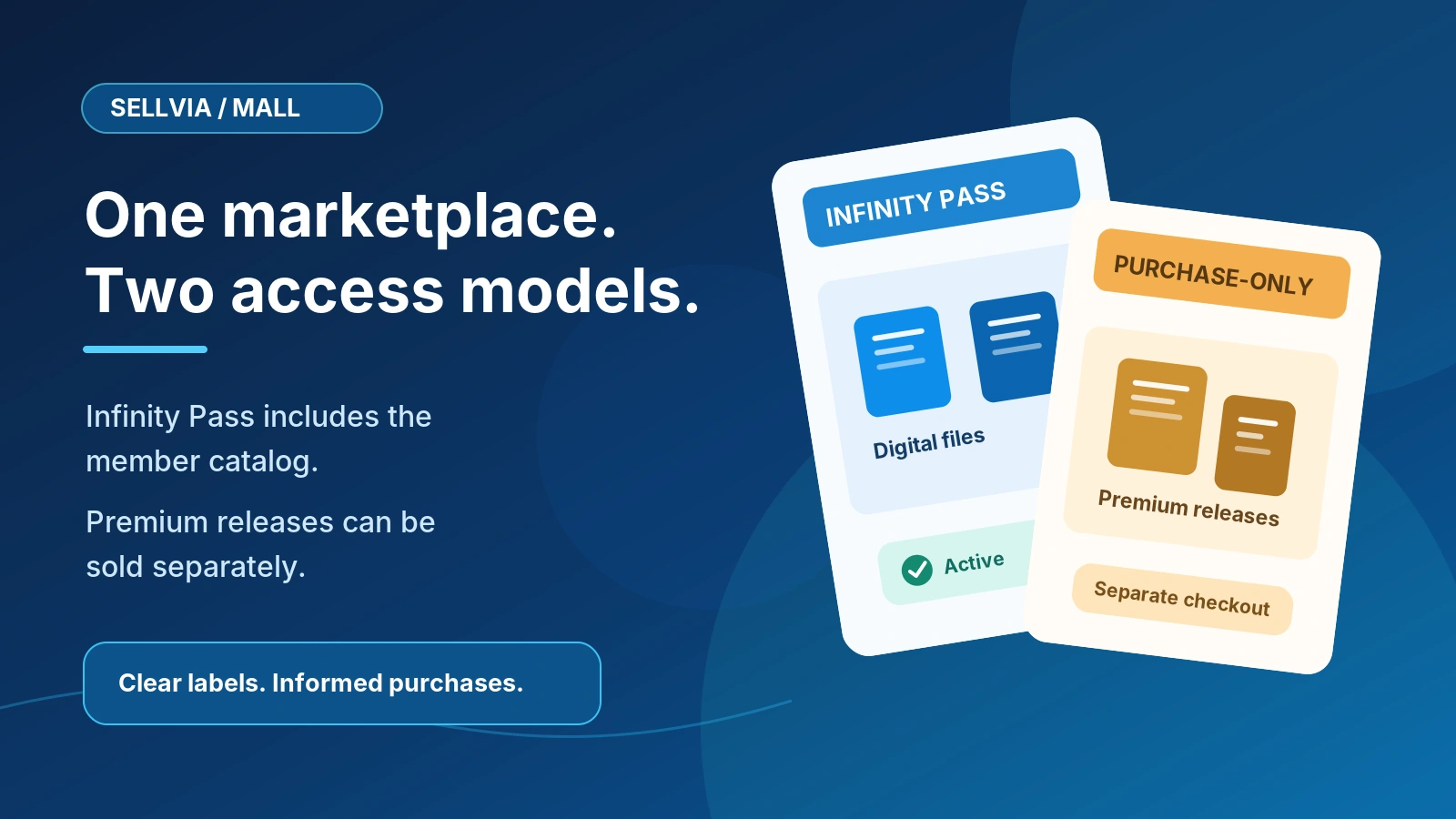
Sellvia Mall clearly separates two access models. The first is the Infinity Pass, a recurring membership that covers the included catalog while the pass is active. The second is a category of purchase-only products that are sold separately, even to active members. Once you see that separation in the official terms, the logic of the storefront becomes much easier to understand.
This is actually a healthy marketplace design rather than a contradiction. It lets the service provide an included member catalog while still reserving room for premium systems, larger releases and other offers that do not fit neatly inside an all-you-can-download membership.
What the official terms say about Infinity Pass
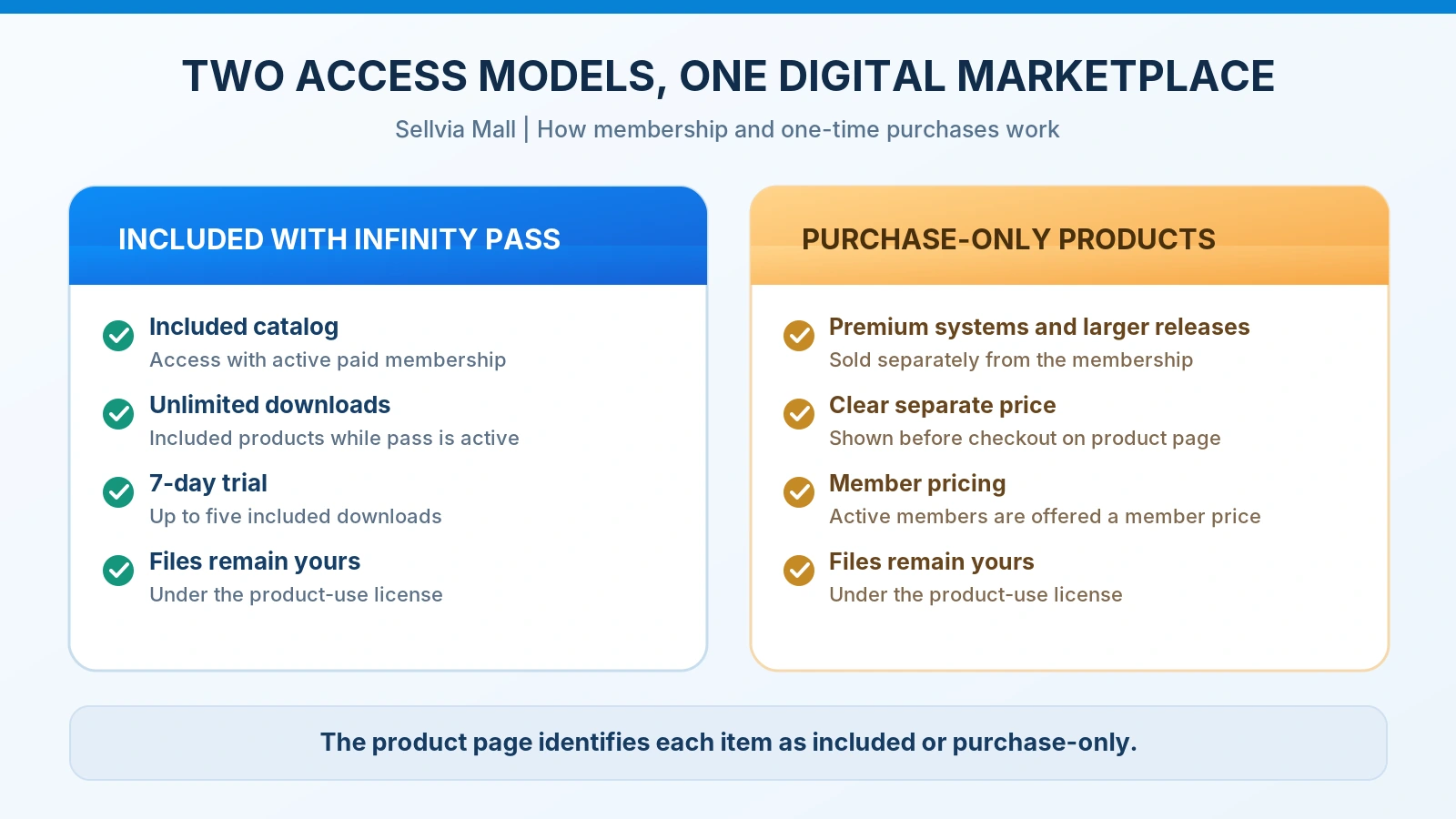
The Sellvia Mall terms describe the Infinity Pass as a monthly membership. During the trial, users can browse the full catalog and download up to five included products at no charge, while purchase-only items are explicitly excluded. Once the paid membership starts, active members can download unlimited products from the included catalog. The same section also says that new products may be added over time for active members.
That wording does two important things. First, it confirms the positive value of the pass: access to a broad included catalog with no meter on included downloads during an active paid period. Second, it draws a bright line around what the pass is not promising. It is not described as universal ownership of every product listed on the site. The included catalog is one category, not the whole marketplace.
For members, that is actually a useful level of clarity. You do not need to guess whether the pass is supposed to cover everything. The contract tells you that it covers the included catalog, and that purchase-only products sit outside both the free trial and the membership bundle.
What the terms say about purchase-only products
The purchase-only section is equally direct. Sellvia Mall says that certain digital products – such as premium systems or larger releases – are available for individual purchase only and are not included in the Infinity Pass or the free trial. The same section adds that active members may receive a member price on those items and that the product page shows whether a product is included or purchase-only.
That structure answers the core user question better than speculation does. Some products are excluded from the pass because they belong to a different commercial category. They are treated as discrete premium purchases rather than as part of the ongoing included library. The terms do not hide this. They make it visible in the product-level presentation and repeat it in the membership section.
The positive implication is that members still receive context and value. If a premium release is offered at a member price, the pass can still improve the economics even though the item itself is sold separately. The membership and the purchase-only category therefore work together rather than canceling each other out.
Why a marketplace would separate some items
From a product-strategy perspective, the separation makes sense. A subscription works best when there is a stable included catalog that people can explore freely. But some digital products have a different cost or value profile. A large toolkit, a premium operating system, or a specialized packaged release may justify a different pricing model because it carries more development effort, higher perceived value or a more targeted use case.
If everything were forced into the subscription, the service would lose flexibility. Either the pass price would have to rise dramatically, or the platform would have to avoid offering higher-value premium releases altogether. By keeping some items in a purchase-only tier, Sellvia Mall can preserve a reasonably broad included library while still listing specialized products that deserve individual pricing.
This is why the purchase-only label should not be read as a loophole. It is better understood as a product-class signal. The label tells the shopper that this item belongs to a premium or separately sold category, and that its economics are different from ordinary included downloads.
How to tell what is included before you buy
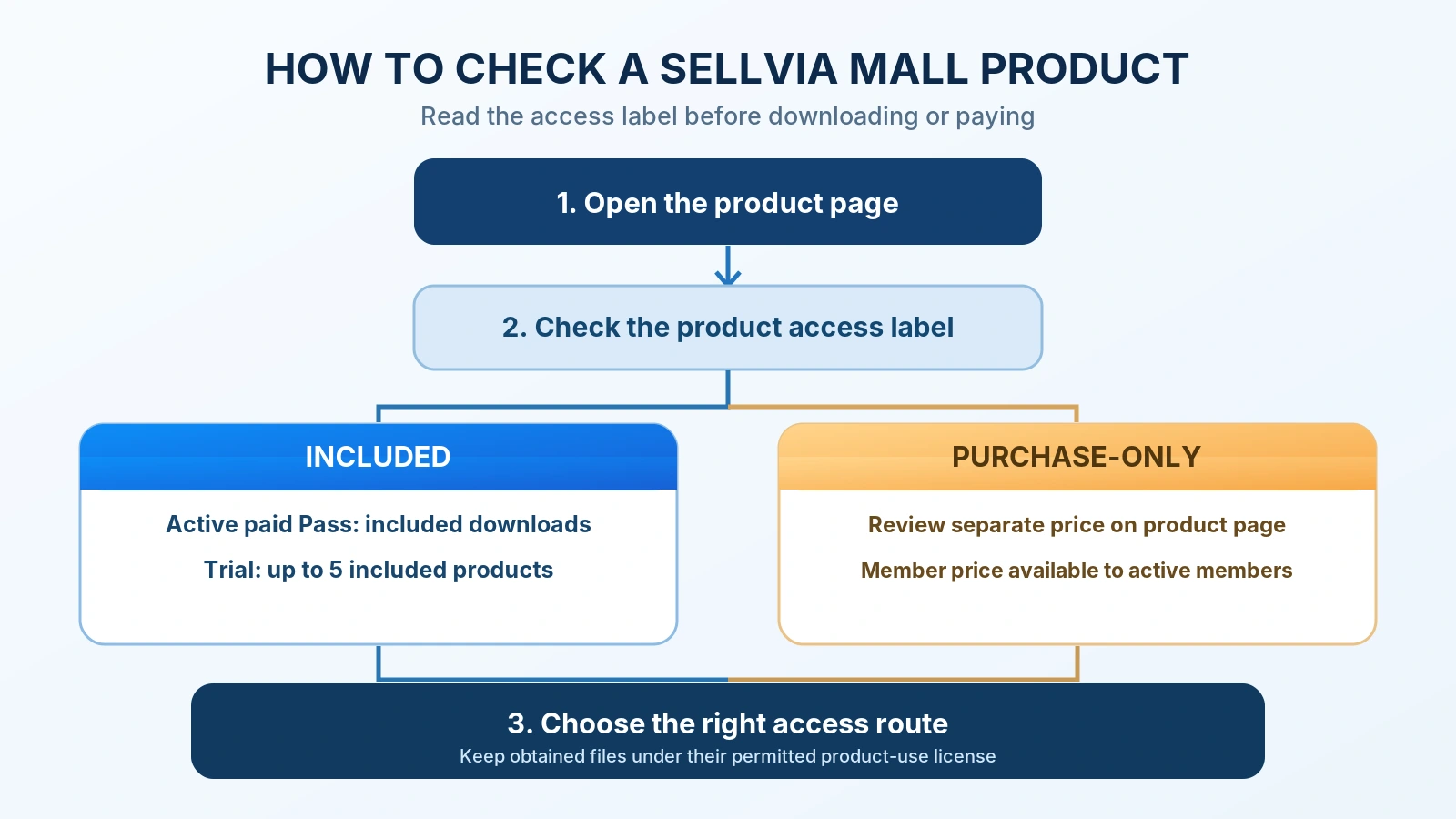
The most practical protection for users is that the storefront itself is supposed to show the product’s status on the product page. That means a careful buyer should never rely only on the existence of the item in the catalog. The question is not ‘Can I see it?’ but ‘How is it labeled?’ If the product is marked as included, an active pass should cover it. If it is marked as purchase-only, the buyer should expect a separate checkout flow and a visible price.
This makes disciplined browsing worthwhile. When you open a listing, confirm three things: whether the item is included or purchase-only, what price is displayed, and whether any member pricing is being offered. Those three checks answer almost every access question before frustration begins.
The official terms also help frame expectations during the free trial. Seeing a product while browsing the full catalog does not mean it can be downloaded free. The trial explicitly excludes purchase-only products. So the correct reading of the catalog is ‘browse everything, but download only what the access rules permit.’
What members still gain when an item is sold separately
A separate price does not automatically mean the membership lost its value. The Infinity Pass still gives access to the included library, and the terms say that active members may receive a member price on purchase-only items. For shoppers who use the included catalog regularly, that can still be a strong combined offer: wide included access for routine downloads and discounted separate pricing for occasional premium acquisitions.
The license logic is also favorable once the purchase is made. Sellvia Mall says that anything you download is yours to keep under the product license, including after the Infinity Pass ends. That means a separately purchased product does not vanish when the recurring membership cycle ends. The buyer acquires continuing use rights under the license terms, which gives extra stability to a one-time premium purchase.
In other words, the marketplace is not telling members to rent everything forever. It is saying that the membership provides included access while active, and individual purchases remain with the customer after purchase. That combination is easier to budget and easier to explain to new users.
Common misunderstandings that create support friction
The first misunderstanding is thinking that ‘unlimited’ means unlimited across the entire site. In context, the terms describe unlimited downloads from the included catalog while the pass is active. The second misunderstanding is assuming that a visible product card must be covered because it appears alongside included items. Visibility is not the same thing as inclusion.
Another source of friction is overlooking the difference between ‘browse’ and ‘access’. During the trial, users can browse the full catalog but can only download up to five included products, and purchase-only products remain excluded. That is a generous evaluation flow, but it still requires shoppers to read the label on the actual product page.
A final misunderstanding is believing that separate pricing means the pass failed to deliver. That conclusion ignores the actual structure of the service. The pass delivers included-catalog access. A purchase-only product is simply outside that bundle, often because it belongs to a premium or larger-release category.
How to explain the model to customers or readers
If you are writing about Sellvia Mall, reviewing it or answering support questions, the easiest explanation is this: the marketplace has an included catalog and a premium à la carte layer. The Infinity Pass unlocks the included catalog. Some products are intentionally sold separately and are clearly labeled as purchase-only. Members may still receive a member price on those premium items.
That wording is honest and easy to remember. It also avoids promising something the terms do not say. Instead of claiming that the pass covers everything, it emphasizes what the pass really does well: broad included access, a free-trial evaluation path, and clear product-level labeling for exceptions.
From an editorial standpoint, that makes Sellvia Mall easier to recommend responsibly. The user is not trapped in hidden conditions if they read the label on the product page. The architecture is explicit: included products live under the subscription, premium items can sit outside it, and the service tells you which is which.
A buying strategy that makes sense for active members
For most members, the best strategy is to treat the pass as the base layer of value and purchase-only items as deliberate upgrades. Start by extracting value from the included library. Build a short list of the premium products that are clearly relevant to your workflow. Then compare the separate price, any member pricing and the expected usefulness of the item before checking out.
That approach prevents impulse frustration. If the product is mission-critical, the purchase-only price may be fully justified. If it is merely interesting, the included library may already provide enough value to postpone the separate purchase. The important point is that the choice becomes intentional rather than emotional.
Because purchased items remain yours to keep under the license, it can also make sense to reserve one-time purchases for the releases you expect to revisit long after a membership cycle ends. That is where the separate-purchase model can be quite efficient.
How trial users should read the catalog
The free-trial experience is one place where expectations need extra care. Sellvia Mall says trial users can browse the full catalog and download up to five included products. That combination is useful because it lets a new user see the full range of the service before the first paid charge. But it also means catalog visibility is broader than immediate trial access. A user can see premium listings that are intentionally outside the trial download allowance.
The practical rule for trial users is to slow down when a product looks especially premium or packaged as a larger release. Open the product page, look for the inclusion status and review the displayed price. If the item is purchase-only, treat the listing as part of the broader marketplace showcase rather than as one of the five included trial downloads. That reading aligns with the terms and prevents the feeling that something promised as “free” suddenly changed at checkout.
This is also why support and editorial content should explain the trial carefully. The trial is generous because it provides real access to included products and full browsing of the wider catalog. It is not meant to erase the separate premium layer. Once users understand that, the trial feels more transparent and easier to evaluate on its own merits.
Why a purchase-only label can be a positive signal
A purchase-only badge is not just a restriction. It can also be a useful signal that the product belongs to a more substantial release tier. In many digital marketplaces, premium items are easier to spot precisely because they are priced separately. The label tells the shopper that this is not ordinary catalog inventory but an item the platform considers distinct enough to price on its own.
For experienced buyers, that can actually improve trust. Instead of hiding premium items inside vague subscription language, the storefront marks them openly. The user can then compare the standalone value of the offer with the included value of the pass. This keeps the membership honest and keeps premium pricing visible rather than disguised.
It also creates a more useful expectation for support. When a shopper sees a separate price on a clearly marked premium product, the conversation changes from “Why isn’t this included?” to “Is this premium item worth buying in addition to my membership?” That is a healthier and more informed decision point.
How members can avoid friction at checkout
Most checkout frustration disappears when members use the product page as the source of truth. Before clicking through, confirm whether the item is included, whether a separate price is shown and whether a member discount is visible. If all three signals are clear, there is much less room for misunderstanding later.
This small habit is worth repeating because Sellvia Mall operates as a marketplace, not just a single flat subscription wall. Marketplace logic rewards users who read labels closely. In return, it gives them broader browsing and more flexibility in how they combine subscription value with one-time purchases.
Final assessment
Some Sellvia Mall items are excluded from Infinity Pass because the service intentionally separates the included subscription catalog from a premium purchase-only category. The official terms describe this clearly. Included products belong to the membership bundle. Purchase-only products, such as premium systems or larger releases, are sold separately and are not part of the pass or trial download allowance.
Seen in that light, the structure is not a flaw. It is a workable marketplace design that gives members both broad catalog access and a clear path to acquire higher-value releases when needed. The service also adds useful protections: the product page is supposed to show whether the item is included or purchase-only, member pricing may apply, and purchased products remain yours to keep under the license.
For shoppers, the simplest rule is to trust the product page label and price rather than assumptions. Read the status, confirm whether your pass covers the item, and use separate purchases intentionally for the premium releases that matter most. For a broader overview, see the Sellvia Mall review on Ecom Ratings.