
TRADING / EXECUTION & COSTS · ECOM RATINGS
NAGA Copy Trading Risk: Position Sizing, Slippage and Fees Explained
Independent editorial guide · Primary sources reviewed November 4, 2026

NAGA Autocopy can reproduce eligible positions opened by another trader without requiring the follower to enter each order manually. That convenience is real, but it is not the same as receiving an identical percentage return. The follower has a separate account, chooses an allocation method, pays applicable trading and copy charges, and can encounter funding or instrument-size constraints. Understanding those differences is essential before copying a leaderboard profile.
This guide takes a trade-by-trade approach. It separates NAGA’s publicly described Fixed Amount and Relative to Leader options, explains how execution and missed orders affect outcomes, and shows how to calculate fees without assuming that one historical schedule applies to every legal entity. All calculations below are illustrative, not actual NAGA trades or a live price quotation.
The central question: why a copied result can diverge
A lead trader’s reported performance describes trades in that trader’s account. A follower experiences the same strategy through a different financial and operational pathway. The follower may invest a smaller amount, begin copying after older positions were opened, or stop following before a trade closes. Each of those choices changes exposure. If an order is not copied because the account lacks available funds or the minimum trade size cannot be met, the set of positions differs immediately.
NAGA’s official Autocopy materials describe automated replication of eligible orders and say missed trades can appear in an Autocopy timeline. The site also promotes a price-matching algorithm, but that claim should not be read as a promise that every follower’s net return equals the leader’s. Net performance also reflects allocation, contract specifications, overnight financing, conversion costs and copy fees. A useful audit therefore compares positions and cash flows, rather than comparing two headline return percentages.
The most informative unit of analysis is one copied order: the leader’s instrument and direction, the follower’s chosen amount, both timestamps, the resulting exposure, close-out value and every deduction. Once those fields are reconciled, the overall divergence usually becomes much easier to explain. Without that evidence, claims about “slippage” or “the algorithm” are only guesses.
Fixed Amount versus Relative to Leader
NAGA documents two allocation choices. Fixed Amount assigns the follower’s selected value to every eligible copied trade regardless of how large the leader’s position is. The official example describes setting $100 and allocating $100 to each copied trade. Relative to Leader applies a chosen percentage to the size of the leader’s trade: a 50% setting applied to 100 shares produces an illustrative 50-share copy, subject to instrument minimums and account constraints.
Those controls solve different problems. Fixed Amount creates predictable nominal allocations per trade, but the resulting portfolio can become concentrated if the leader opens many positions at the same time. Relative to Leader aims to preserve proportional exposure to the leader’s position sizes, but that exposure may be unsuitable for a smaller account. If the lead trader commits a large fraction of their capital to a single position, copying half that position is not automatically a conservative decision.
Neither setting constitutes a loss limit. A fixed $100 exposure is not the same as a maximum $100 loss across all leveraged products, and the financial meaning of the setting depends on the instrument and how NAGA applies the order. The follower should verify instrument quantity, contract size, margin and stop-loss behavior in the actual ticket before assuming that a nominal allocation tells the whole risk story.
| Question | Fixed Amount | Relative to Leader |
|---|---|---|
| What determines copied size? | Selected amount for each eligible trade | Selected proportion of leader’s trade size |
| What varies if the leader changes size? | Follower allocation may remain fixed | Follower allocation generally changes |
| Main audit issue | Concentration across many simultaneous trades | Oversized proportional exposure or minimum-size constraints |
| What must be checked? | Actual units, margin, number of open trades | Ratio, actual units, rounding and skipped trades |
A worked position-sizing example
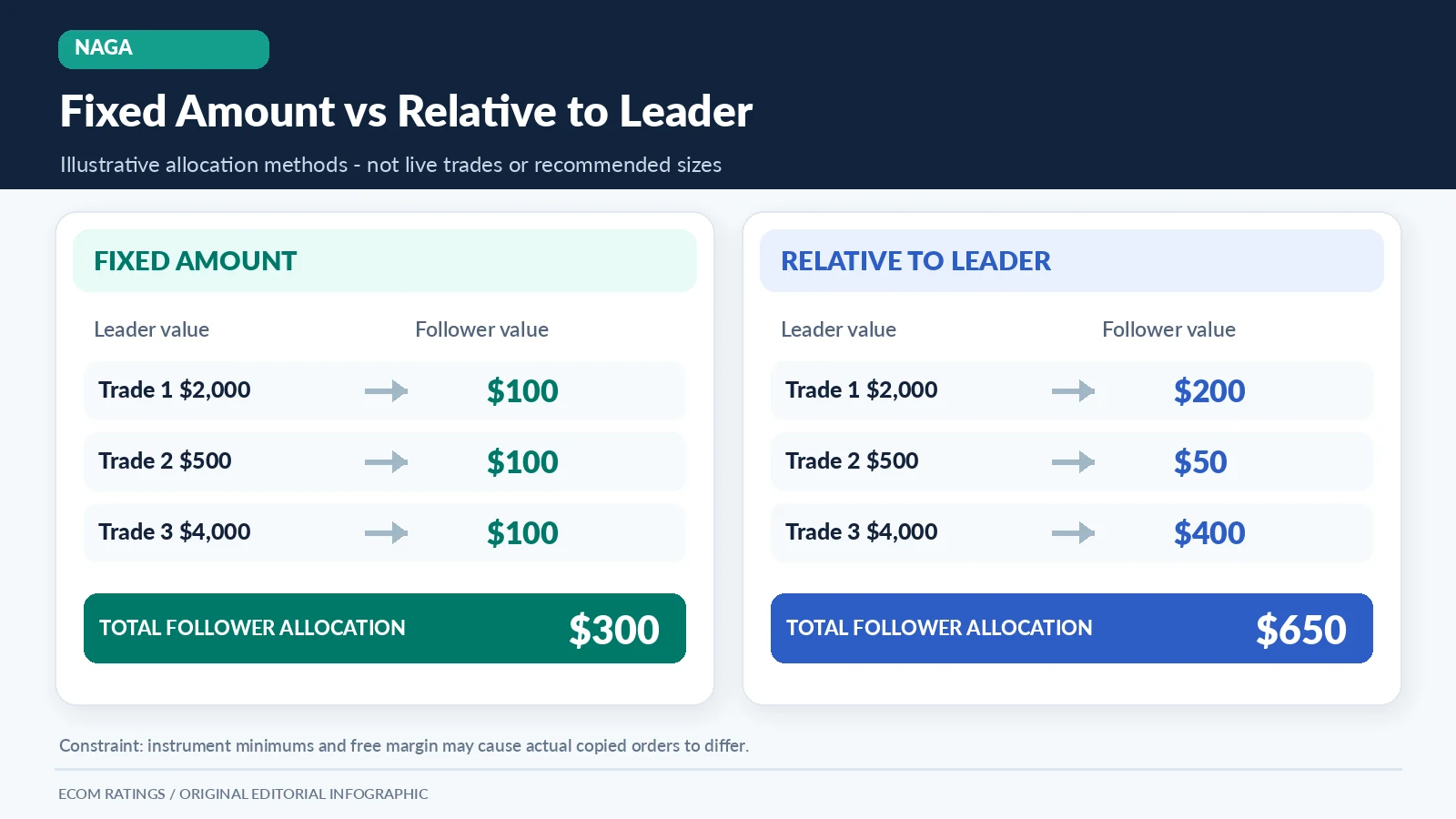
Consider a leader who opens three positions with reference values of $2,000, $500 and $4,000. A follower chooses $100 Fixed Amount. Ignoring minimum-size restrictions for illustration, the follower has $100 in each of the three copies, or $300 total nominal allocated value. The leader’s three position values total $6,500 and are not equally weighted; the follower’s are. That is a meaningful portfolio difference even if all three instruments later move by exactly the same percentages.
Now assume the follower instead chooses 10% Relative to Leader. The illustrative position values become $200, $50 and $400, totaling $650. Compared with Fixed Amount, that preserves the leader’s weighting but increases the follower’s exposure to the largest trade. If the second instrument has a minimum allowed order value above $50, the order may not open at all. NAGA warns that minimum instrument sizes and insufficient funds can cause skipped trades.
The arithmetic is simple: copied exposure = leader exposure × chosen ratio, subject to platform constraints. What matters is the next question: exposure relative to the follower’s account equity. A $650 allocation may be manageable for one account but too large for another, particularly where leverage, correlated instruments or open losses affect usable margin. Always compare copied notional and required margin to the follower’s available balance and stated risk budget.
Execution price, latency and slippage are not the same concept
NAGA publicly advertises a price-matching algorithm intended to give copied trades the lead trader’s execution price. That is a platform claim worth understanding, and it can reduce one traditional problem in copy trading. Nevertheless, an analyst should separate the advertised price-matching feature from a blanket guarantee about every possible order, instrument, account and market condition. Current legal documents and the actual trade log remain the appropriate sources for a specific account.
Slippage means that an order is filled at a different price from an expected or requested price. It may arise during volatile trading, market gaps, low liquidity or execution delays. A lead trader’s position may already be open before a follower starts copying, and an older open position copied later cannot recreate the historical entry date. NAGA’s client-agreement disclosures specifically caution that manually changing or closing copied trades can create materially different outcomes and that current open positions may be entered at available prices.
When results diverge, first establish whether both accounts actually held the same trade during the same interval. Check instrument, side, execution time, execution price, price unit and closing price. Then calculate the difference attributable to price or quantity. Only after doing that should the analyst label a mismatch as execution-related. A profit discrepancy may arise even with matched entry prices because the accounts have different trade sizes or different fees.
The real effect of minimum sizes and missed copies
Minimum position sizes are easy to overlook because they are a technical constraint rather than a market forecast. A leader may open a position that scales down to a quantity below the follower’s instrument minimum. In that situation, NAGA says the system may skip the position, and a missed-trade record can appear in the timeline. A follower with a small account may consequently replicate only the larger positions of a strategy, which changes its balance and risk profile.
Funding constraints create a second type of omission. Two traders may follow the same leader and choose the same ratio yet receive different actual portfolios if one has more free margin. Positions already open, deposits still settling, or floating losses all affect available capital. The follower should therefore evaluate the portfolio as a collection of simultaneous obligations, not as isolated trades. The third copied order may be impossible even if the first two were accepted.
A practical audit starts with the complete lead-trader transaction list, then marks which trades appeared in the follower’s account. Classify every missing order separately: insufficient funds, minimum size, copying not active at that moment, unsupported conditions, or unknown cause. This classification matters because each cause suggests a different operational decision. Increasing copy size blindly might solve a minimum-size issue while creating unacceptable exposure elsewhere.
Copy fees: why a single quoted percentage can mislead
NAGA fee documents deserve unusually careful handling. Publicly available 2024 NAGA Capital Ltd materials describe a fixed €0.99 charge on a closed copied position and an additional 5% component on qualifying profit above a stated threshold. A February 2025 NAGA Markets Europe Ltd policy also describes €0.99 but lists tiered variable percentages for different profitable ranges, including a higher percentage on larger profits. These are documented examples from different entities and dates, not a verified universal tariff for every account in November 2026.
The distinction is material. Copy-trading fees are not necessarily identical to spreads, commissions or swap charges that arise from the underlying instrument. A follower could face spread cost when entering and exiting, overnight financing if the position is held, currency conversion when the account’s base currency differs, and a copy-specific charge when the position closes. A seemingly small fixed charge matters proportionally more on a small copied trade than on a much larger position.
Before estimating returns, obtain the live schedule for the exact contracting entity, account type and instrument. Do not take the rate from an old PDF merely because it appears under the NAGA brand. Record the document title and date next to the calculation. If the official dashboard shows a charge breakdown different from a document found online, ask support for the governing schedule rather than choosing the lower-looking figure.
Illustrative fee arithmetic for a profitable trade
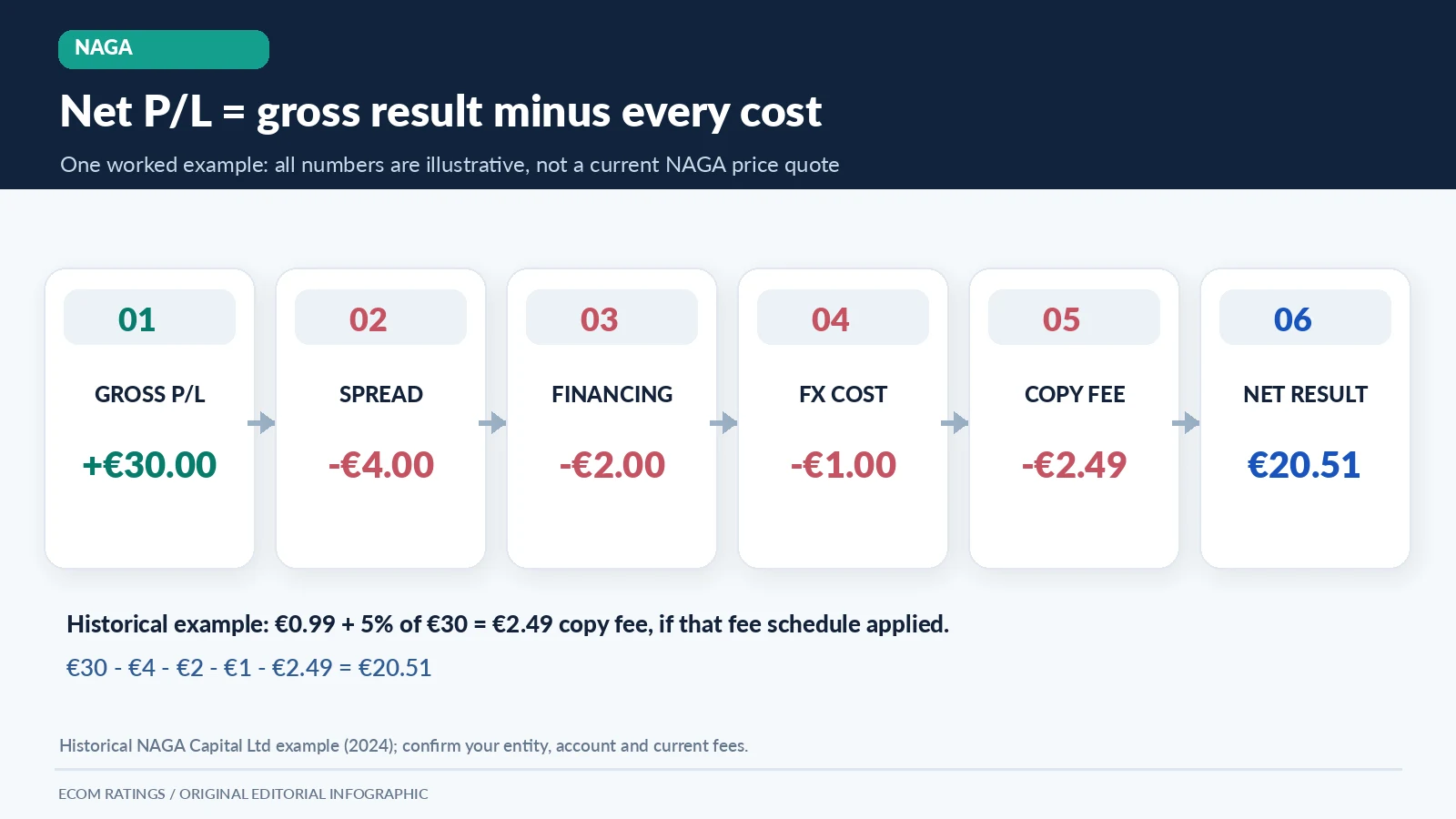
Suppose a copied trade produces €30 gross trading profit before all explicit copy charges and other costs. If the applicable schedule were the illustrative NAGA Capital Ltd historical formula of €0.99 fixed plus 5% of eligible profit, the copy-specific charge would be €0.99 + €1.50 = €2.49. The remainder would be €27.51 before any separate trading costs, swap or conversion. This is a demonstration of arithmetic, not a quote of current charges.
If the trade instead loses €3 before copy fees, and a €0.99 fixed fee applies to the closed copy, the follower’s illustrative result becomes -€3.99, again before other costs. A losing trade is not necessarily free of copy charges. A series of many modest profitable or losing trades can accumulate fixed deductions, so the number of closed copied positions matters alongside the win rate.
Do not extrapolate either calculation to all NAGA entities. The European historical policy contains a different tiered variable structure, which can change the outcome. Even the word “profit” needs definition: is the percentage computed on the amount shown before a given fee, or on another reference amount? Use the precise definition in the applicable schedule. When a result depends on an unknown fee base, mark it not verified instead of inventing an exact net return.
Spread, swap, currency conversion and withdrawal costs
An accurate copy-trading ledger distinguishes at least four layers. The spread represents the bid-ask difference or its economic effect on entry and exit. A commission may apply depending on the instrument or account. Swap or overnight financing can affect a position held across rollover. Currency conversion can change the base-currency result when a trade or its costs are denominated differently. These are trading expenses, not the same item as an Autocopy-specific fee.
Consider a follower whose gross trade outcome is €30. If illustrative trading costs were €4 spread effect, €2 financing and €1 conversion, and the copy-specific amount were €2.49 under the earlier illustrative formula, the follower’s simplified net would be €20.51. Those amounts are invented only to show how a ledger is assembled: €30 – €4 – €2 – €1 – €2.49. They do not imply a particular current NAGA spread or swap schedule.
Withdrawal costs matter when comparing realized cash performance across a longer period, although they are not part of a single trade’s market P/L. Official NAGA fee schedules have historically mentioned tier-dependent withdrawal charges. An honest comparison reports per-trade net outcome separately from account-level transfers or withdrawal expenses, so the latter are not accidentally used to explain a difference in trade execution.
Managing the copied portfolio instead of only the leader
Follower risk control should start with a cap on total exposure. If three copied traders all focus on technology stocks, adding all three may increase concentration rather than produce meaningful diversification. If they all run correlated high-leverage positions, simultaneous losses can overwhelm a follower even though no single copied trade looks excessive. A prudent dashboard tracks open trades, concentration by asset, gross notional exposure, margin and floating drawdown across every leader.
NAGA’s interface allows followers to customize stop-loss and take-profit parameters and to pause or adjust copying. Those controls are useful, but changing the exit logic makes the follower’s strategy less comparable with the leader’s. A follower might close early at a loss while the lead trader later recovers, or take a small profit before the leader holds for a larger gain. That outcome is neither an error nor necessarily slippage; it is the consequence of a different trade-management rule.
Before copying, write down a personal maximum portfolio drawdown and acceptable capital-at-risk. Determine how many simultaneous positions could be opened under the selected sizing method. Review the leader’s actual history and drawdowns, not only their recent return or rank. Copy trading is speculative and past performance does not demonstrate the safety of future trades. A controlled allocation is more important than a charismatic leaderboard profile.
A seven-field reconciliation worksheet
For each copied trade, maintain a record with trade identifier, instrument/direction, leader size, follower size, open/close prices and times, gross P/L, and all fee lines. That is more than seven individual spreadsheet columns, but the seven information groups make a practical audit template. Add a status field for missed trades, because omitted positions can explain performance differences that are invisible in a worksheet of completed orders alone.
Run the worksheet over a short representative period. Start with the same date range and base currency for the leader and follower. Check whether the follower began copying at the same moment; if not, exclude or separately label positions opened earlier. Next, compare position weights. Then reconcile execution, charges and any independent follower intervention. Only once those steps are complete should you compare aggregate percentage returns.
An audit that identifies no discrepancy is still valuable: it verifies what the platform did for the tested trades. But it cannot prove future execution quality or eliminate market risk. Keep copies of relevant schedules, timestamps and transaction exports. These records are useful if a calculation changes, a trading fee is questioned, or a provider updates its policies later.
Practical decision: is Autocopy suitable for your account?
NAGA Autocopy offers clear convenience: selection of a lead trader, flexible sizing modes, automated trade copying and options to adjust risk controls. For a user who understands the underlying markets, it can reduce manual trade entry while providing a transparent way to follow another strategy. The main mistake is to mistake automated replication for identical economics or guaranteed performance.
A careful follower evaluates the exact account entity, verifies current fee documents, chooses a sizing method that fits their capital, and monitors skipped trades and net outcomes. NAGA itself cautions that copying may produce losses and that insufficient funds can prevent replication. The useful result is not a promise that copy trading eliminates risk; it is a repeatable framework for measuring the risks and costs that remain even when the copying mechanism works as designed.
For a broader provider profile, see our NAGA review on Ecom Ratings.
Primary sources and verification
- NAGA official Autocopy explanation
- NAGA Academy: Copy Trading
- NAGA Capital Ltd cost and charges policy, September 2024
- NAGA Markets Europe Ltd costs and charges policy, February 2025
- NAGA Capital Ltd client agreement, August 2024