
EDITORIAL RESEARCH / DIGITAL PRODUCT QUALITY · ECOM RATINGS
Ecomzy AI Product Builder Quality Audit: Facts, Formatting and Marketing Claims
Independent editorial research · Source check: November 2, 2026
Ecomzy is designed around a practical proposition: a solopreneur starts with a functioning digital-product store, a catalog to work with, and an integrated promotion ecosystem rather than assembling every component separately. That head start creates an opportunity to focus on the work that differentiates a credible offer: clear explanations, accurate product information, polished presentation, and advertising claims that match what buyers actually receive. A disciplined AI-assisted content audit helps make those strengths visible.
This guide uses the phrase 'AI Product Builder' as a description of an AI-assisted product-content creation and review workflow. The public Ecomzy pages checked for this article describe ready-made stores, AI-powered digital products, and AI influencers; they do not conclusively document a separate dashboard tool with the exact official name 'AI Product Builder.' Do not mistake this editorial workflow for a verified product feature or an exact screenshot of an Ecomzy admin panel. The recommendations below can be applied to drafts prepared by a merchant, a content team, or an AI assistant supporting an Ecomzy storefront.
Why a ready-made digital catalog is a useful starting point
A blank storefront creates several kinds of work at once. The owner needs a site, a catalog taxonomy, product descriptions, imagery, checkout structure, and a marketing plan before a shopper has anything useful to see. Ecomzy's public materials describe a turnkey digital store with 50 products across ten categories and integrated promotion options. That structure gives an owner examples to learn from immediately and a more concrete starting point for content review than an empty editor.
The most productive way to use that advantage is to separate underlying product facts from the wording that presents them. A prepared product may already have a purpose, category, access method, and price. Those should be verified rather than invented. Marketing copy can then explain who benefits, what task the product helps with, how delivery works, and which expectations are realistic. This kind of editing amplifies existing value; it does not require exaggerated income claims or complicated technical changes.
A good product-content audit therefore asks a favorable question: how can a well-organized starting catalog become easier to understand, discover, and trust? The answer is not simply 'generate more words.' It is to make every customer-facing statement more precise while preserving the convenience of the established store structure.
Define the source of truth before using an AI draft
An AI draft is often fast, but it is only as reliable as the information provided to it. Start each content project with a compact factual brief. Include the official product name, intended audience, confirmed deliverables, file or access format, any stated limitations, current product-page price, and the approved description of what the service does. Treat those facts as locked fields; the writing process may clarify them but must not silently replace them.
This matters especially for digital tools that address work, money, learning, or other consequential decisions. If a product provides a template, checklist, or educational explanation, its sales page should not describe it as a guaranteed professional service. If a tool suggests possible billing questions, the copy should not promise that a hospital will reverse a bill. If a career-oriented resource helps write better application material, the page should not imply that employment is assured. Accurate boundaries make marketing more persuasive to the right audience.
The five-pass quality audit
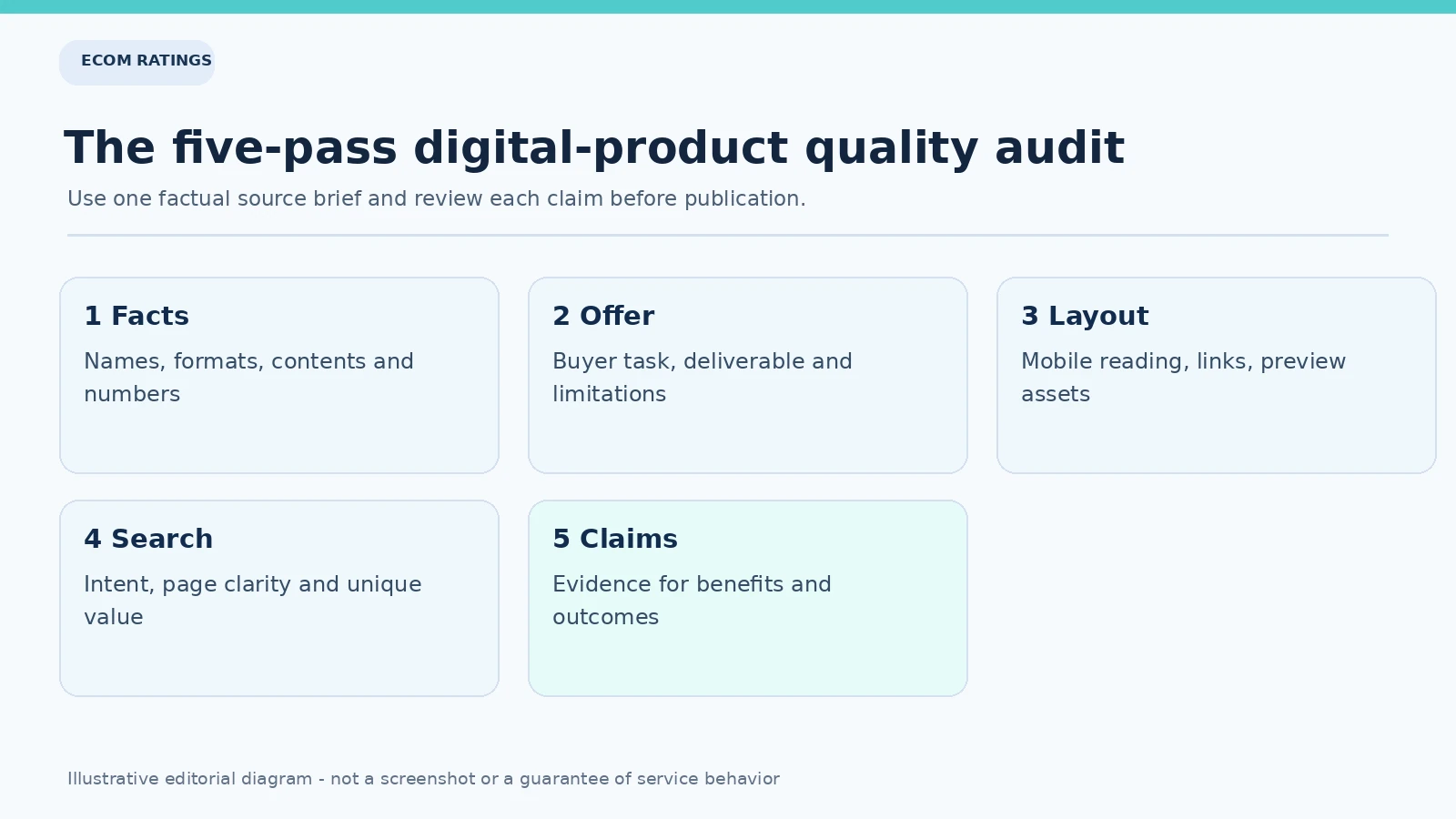
A useful review process separates content into five passes: factual accuracy, offer completeness, structure and formatting, search clarity, and claims compliance. Each pass answers a different question. Is the description correct? Can a buyer tell what is included? Can a mobile reader scan it easily? Does it match the search intent? Can every claim be defended with evidence?
Trying to do all five at once usually leads to superficial editing. A product title can be catchy but inaccurate. A page can be factual but difficult to scan. A beautifully formatted description can still hide an unsupported promise. Separate passes reveal those issues early, before they become customer-service problems or misleading campaign messages.
The output should be a short review record with pass or revise decisions, not just a subjective overall score. A content reviewer should be able to point to the sentence being corrected, the reason, and the approved replacement. Repeatable checks make the process scalable across a catalog and easy to hand to a second editor.
Pass one: verify features, formats and access claims
Start with observable product details. If the product page says the customer receives a file, confirm the correct format and method of access. If the purchase grants access to an interactive tool, avoid describing it as a downloadable PDF unless that is actually true. For a bundle, list what is included and make sure each included item has a matching source record. A buyer should not have to infer whether a preview image is a bonus, a template, or the entire product.
Next, check every numeric claim. Quantities, page counts, version dates, pricing, and time estimates are all facts. They should be verified against the current catalog rather than copied from a draft that may have been written months earlier. If a product includes ten worksheets, do not casually say 'dozens.' If an instruction takes an estimated fifteen minutes, label that as an estimate instead of a universal promise.
The same principle applies to technical compatibility. Do not say that a resource works with all devices, platforms, or file viewers without checking. A positive product description can still make sensible boundaries clear: the format provided, the tools needed to use it, and whether buyers receive updates. Accurate compatibility information is part of good marketing because it reduces unnecessary pre-purchase hesitation.
Pass two: describe the offer from the customer's perspective
The best product pages organize information around a practical outcome the buyer can understand, not around vague praise. Begin with the task: what problem is this product intended to make easier? Then name the output: what does the buyer receive or create? Finish with the usage context: when might someone benefit, and what effort or judgment will still be required? This three-part structure keeps the copy concrete.
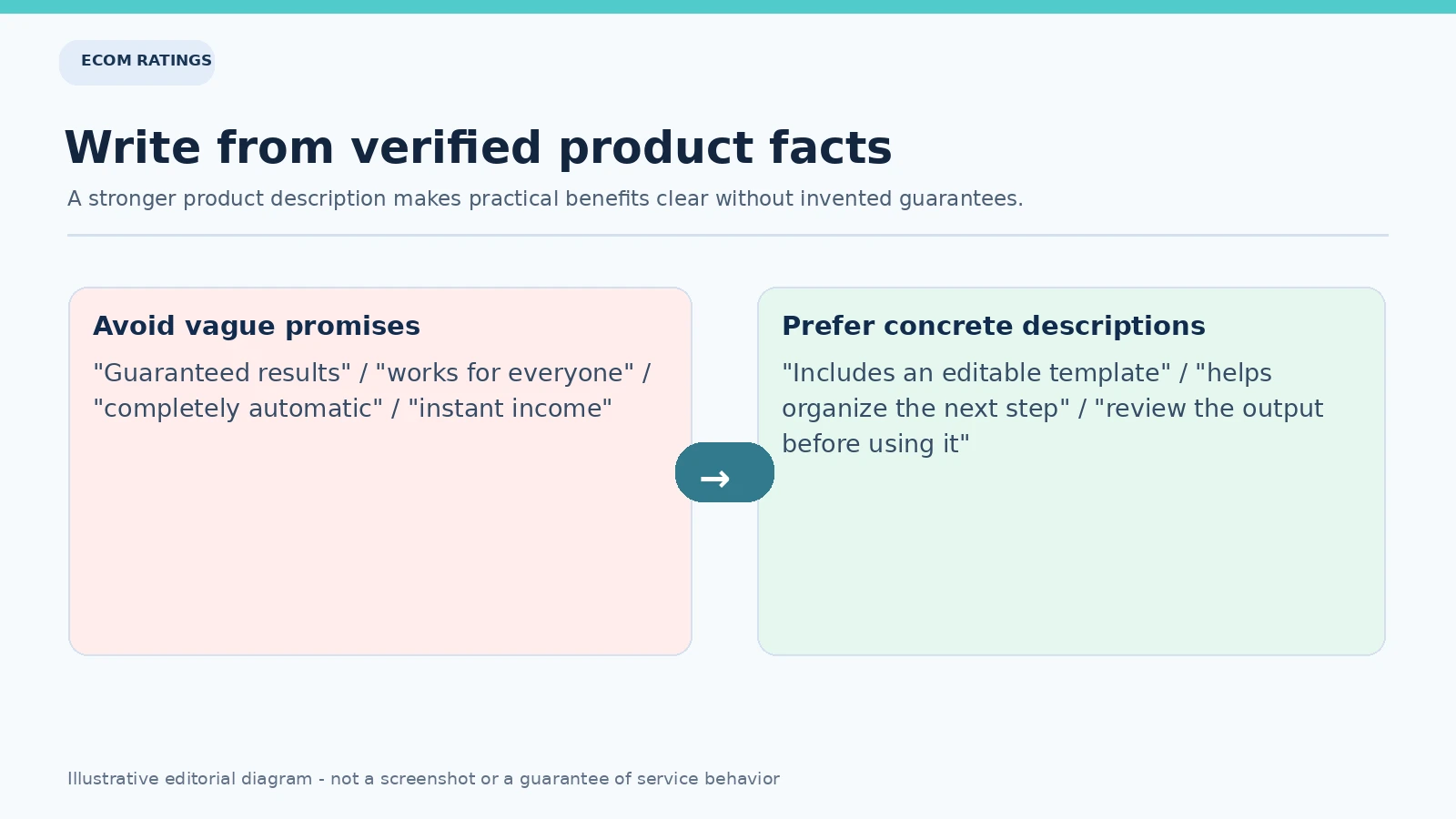
Consider a generic digital planning tool. Weak copy might call it a revolutionary AI solution that changes everything. A stronger description says that it helps organize a decision into a checklist, draft plan, or editable template that the buyer can review. The second description is less dramatic but easier to trust because its promise can be matched to the deliverable.
A useful audit also checks whether the copy answers ordinary questions. Does the customer need to provide input? Is there a downloadable result? Can the result be edited? What happens if it contains an error? Which elements are educational rather than professional advice? The answers should be drawn from the verified product documentation, not assumptions about how generative tools usually behave.
Pass three: formatting that works on mobile
A catalog can contain excellent material and still underperform if descriptions are presented as dense text. Ecomzy's public site emphasizes a mobile-optimized storefront; the content should support that experience. Use one clear main heading, short descriptive subheadings, concise paragraphs, and compact bullet groups where they genuinely help scanning. Avoid an endless sequence of one-sentence hype lines that feels like a template.
The top of the page should quickly tell the reader what the item is, what problem it addresses, and what they receive. Detailed explanations can sit lower down, where readers with more questions can find them. Important limitations should not be buried at the bottom in tiny type. On a phone, a well-placed factual clarification can increase confidence more than decorative animation or extra slogans.
Formatting review should include the actual publishing surface, not only the draft text. Check line breaks, link destinations, heading hierarchy, button labels, and contrast in both desktop and mobile views. If an AI assistant created formatted text, manually inspect where emphasis and lists landed after pasting into the editor. The safest final check is a real preview, not a screenshot of the writing tool.
Pass four: search relevance without keyword stuffing
Search-oriented copy begins with intent. A reader looking for a resume template, a study planner, or a budgeting worksheet wants a useful explanation, not a repeated brand name inserted into every paragraph. Pick a primary question that matches the product and answer it naturally in the title, introduction, and supporting content. Use related phrases when they clarify meaning, not to increase repetition.
A product page should distinguish itself from a category page. The category page helps visitors choose among related solutions. The product page explains one specific offer in enough detail to support a purchase decision. If both pages repeat the same generic introduction, neither is working as hard as it could. Distinctive content may include a use case, a comparison of versions, a brief example, or a clear description of how the customer uses the output.
Metadata matters, but it should be written last. A good SEO title summarizes the page accurately. A meta description helps set expectations before the click. Neither should promise benefits unsupported by the product itself. Search performance also depends on technical and competitive factors outside the wording, so a clean rewrite should be measured as an improvement in clarity rather than marketed as a guaranteed ranking boost.
Pass five: test every marketing claim against evidence
This is where responsible AI-assisted content differs most sharply from unchecked automation. Highlight sentences containing words such as guaranteed, proven, instant, official, certified, best, risk-free, or unlimited. Ask whether the underlying source supports each claim. Often the sentence can be improved by replacing a certainty with a precise description: 'helps you prepare' instead of 'guarantees success,' or 'provides an example plan' instead of 'produces the perfect plan.'
Claims about financial savings, employment, business growth, medical outcomes, or legal decisions deserve especially careful review. They can be persuasive without exaggeration. An educational guide can help the user organize facts for a discussion with a professional. A business template can make planning more structured. An AI tool can generate a first draft for review. These are meaningful benefits that do not require pretending every user will achieve the same result.
The same standard applies to testimonials and numeric performance claims. Do not invent customer stories, reviews, conversion rates, or earnings. If a public statistic is used, record its source, date, and scope. Marketing copy stays strongest when it is grounded in the product's actual function and the buyer's realistic next step.
Before-and-after example: a digital planning resource
Imagine a merchant drafting a page for a digital business planning workbook. An unchecked AI description might promise to produce a profitable company in minutes, handle every decision automatically, and eliminate the need for expertise. That combination sounds exciting but is not credible or supportable from a generic workbook description. It creates the wrong expectations and makes later support harder.
A better version would explain that the resource helps the customer describe a business idea, list likely costs, organize questions about customers, and draft a basic action plan. If the product includes editable sections, that detail can be featured. If it is educational, say so. If the customer must enter their own figures, explain that clearly. The revised version remains positive because the practical benefit is more understandable.
The difference is not a weaker brand voice. It is better alignment between promise and deliverable. A user who sees the real workflow is better equipped to decide whether the product fits. That is a quality improvement worth making across every catalog, whether copy originated with a person or an AI assistant.
Review images, covers and downloadable files together
A product page's visual layer is part of its claim. A cover that depicts an elaborate dashboard, a certification, or a finished financial result can mislead even if the written copy is careful. Use graphics that show the nature of the product without fabricating capabilities. If you demonstrate a sample worksheet or example output, label it as an example rather than as evidence that a particular customer obtained a result.
Review the image title, alt text, visible labels, and any product mockup. Misspelled text, cut-off tables, or tiny captions can undermine an otherwise credible page. Cropped mobile thumbnails should still make sense without the whole design visible. A hero image can be polished and professional without forcing every factual claim into the artwork.
Where a digital asset has multiple formats, test the actual deliverables too. Open files in common viewers, inspect fonts and spacing, confirm that links work, and make sure the preview matches what the buyer receives. This is especially important when AI-generated drafts are exported to PDF, spreadsheets, or document templates, where layout errors can appear after conversion.
Build a lightweight editorial approval system
A small store does not need an elaborate publishing committee. It needs a repeatable checklist and an owner for each decision. For every product-content update, record the source brief, draft version, reviewer, open issues, and approval date. Mark whether facts, marketing claims, links, mobile formatting, and preview assets were checked. That record makes future updates easier because the team can see which assumptions were verified last time.
Assign different review priorities according to risk. A creative journaling template may need a simple accuracy and accessibility check. A tool discussing medical bills or financial decisions should receive additional attention to qualifications, disclaimers, and the difference between educational guidance and regulated advice. This does not mean those products are less useful. It means their usefulness depends on readers understanding their appropriate role.
For products already under active promotion, consult Ecomzy's current service terms before modifying titles, descriptions or pricing. The published Promotion Service terms restrict changes to actively promoted listings. A content-quality program should therefore coordinate with the platform's supported workflow rather than changing live promotional assets without permission. This protects the coherence of campaign presentation and avoids avoidable account or operational conflicts.
Measuring whether the audit improved the store
There are several useful measures, and they do not all need to be sales metrics. Start with defect reduction: fewer broken links, fewer unsupported claims, fewer confusing product descriptions, and fewer mismatches between preview and delivered content. Track which questions customer support receives before and after a rewrite. If buyers consistently ask what is included, the page probably needs clearer explanation.
Next look at engagement indicators available to the merchant, such as relevant page visits, clicks to product details, and customer movement through the checkout journey. These indicators should be interpreted carefully. A change in traffic source, promotional campaign, or season can alter performance independently of a product-content audit. Do not declare that a rewrite caused higher revenue unless the measurement actually isolates that effect.
A practical one-week review schedule
Day one: inventory the pages that need attention and collect their current product facts. Day two: check access and deliverable statements. Day three: review product positioning and search intent. Day four: edit formatting and mobile presentation. Day five: check claims and example images. Day six: preview the revised pages and confirm with the relevant team that changes do not conflict with active promotion. Day seven: publish approved edits and log any remaining items for the next cycle.
This schedule is a planning model, not a claim that Ecomzy automatically runs such a workflow or that every storefront gives the owner identical editing permissions. Its value is in allocating limited editorial time across distinct tasks. If some product fields are centrally managed, the review can document suggested improvements for the responsible team rather than editing prohibited fields directly.
For store owners who start with a ready-made digital catalog, the process is especially practical: the focus can move from creating every asset to strengthening the accuracy and clarity of the assets that already exist. It is a constructive, achievable next step after launch.
Bottom line
Ecomzy's main editorial advantage is a ready-made foundation: a digital-product storefront and a structured catalog that give owners something concrete to evaluate and present. AI-assisted writing can help prepare clearer descriptions, examples, and supporting content, but the strongest results come from a human-controlled process that checks facts, formatting and marketing claims before anything reaches customers.
The five-pass audit keeps the process focused. Verify the actual offer, explain it from the buyer's perspective, format it for mobile, match the search intent, and remove unsupported promises. That approach supports a credible, useful, and increasingly polished Ecomzy presence without inventing product capabilities or treating AI-generated text as self-verifying.
Primary sources and verification
- Ecomzy official platform overview
- Ecomzy Terms of Service
- Ecomzy Fulfillment Policy
- Google Search Central SEO guide
Related editorial research: Ecom Ratings Ecomzy review.
Editorial disclosure: Source documentation and worked examples are distinguished throughout. Policies, API features, regulatory records, legal agreements and insurance evidence can change. This article is informational research, not legal, financial or investment advice, and it does not claim testing of a private account or unverified Ecomzy interface.