
DIGITAL SELLING / SOFTWARE LICENSING · ECOM RATINGS
Lemon Squeezy License Keys After Refunds: Revocation and Access Control
Independent editorial research · Source check: November 2, 2026
A refund can reverse the payment for a software purchase, but the software does not necessarily stop working at the same instant. That gap is the most important operational issue for developers who use Lemon Squeezy license keys. The platform can notify an application about order refunds and provides several license-management tools. The developer must still define what an external application should do with those signals, especially when an installed copy has already been activated or can run offline.
The objective of this guide is to create an auditable access-control design, not to imply that every refund automatically disables a key. It distinguishes purchase records, license status, activated device instances, local entitlements, and the webhook events that connect them. The worked scenarios are illustrative; any actual refund decision should also follow the seller's published policy and applicable consumer law.
What Lemon Squeezy actually controls
Lemon Squeezy can generate a unique license key when a customer buys a product or variant with license keys enabled. A key can have an activation limit and, for eligible non-subscription purchases, a configured lifetime. Subscription-linked licenses follow the subscription lifecycle. In the dashboard, sellers can view keys, modify activation limits and expiration dates, disable keys, and regenerate them. Those are useful controls because a merchant does not have to build a license database from scratch before launching a digital product.
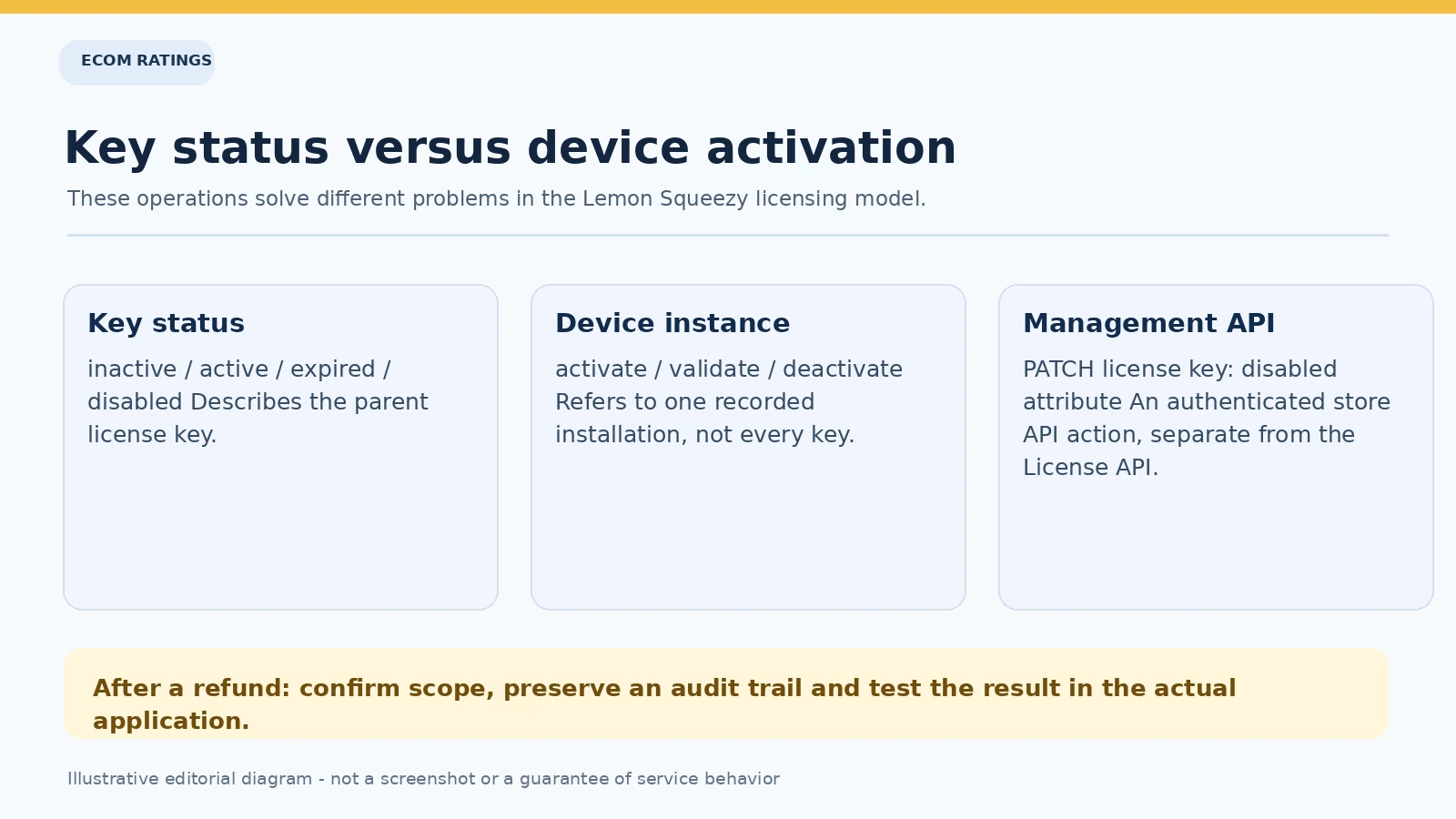
The License API is a different interface from the authenticated store-management API. The former accepts activate, validate, and deactivate requests, using the license key and, for some operations, a device-specific instance identifier. The latter offers license-key records with attributes such as disabled and expires_at. A developer reading the tutorial's statement that a key cannot be disabled through the License API might incorrectly conclude that programmatic disabling is impossible everywhere. The correct distinction is interface scope: the separate License API has no general disable operation, while the authenticated store API documents an update endpoint with a disabled attribute.
A further distinction matters for refunds: the order record describes payment history; the key record describes license status; the application decides whether that status is sufficient to permit current use. A refund notification is not itself proof that every instance, device, cache, download, or SaaS user session has already been cut off. Merchants need to map these layers before writing a revocation policy.
The refund event is a trigger, not a complete policy
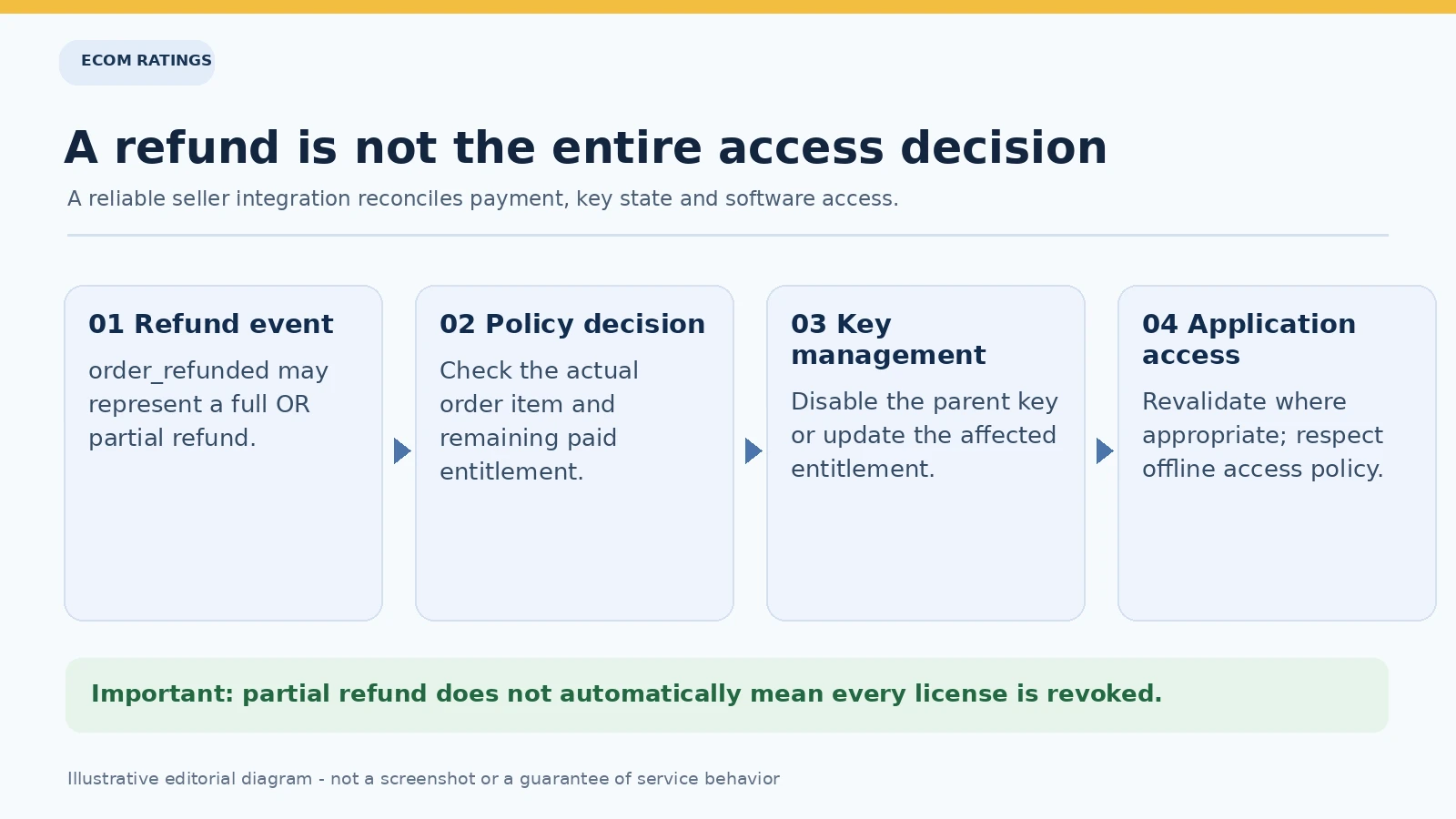
The official webhook event list includes order_refunded, which is sent for a full or partial refund on an order. It also includes license_key_updated, subscription_updated, and subscription_expired. These events are useful but represent different facts. A refund may be partial and may cover only one item of a larger order. A subscription's cancellation may allow access through the remaining paid period, whereas expiration normally marks the end of that lifecycle. A license update conveys a key-record change, not necessarily why it happened.
A reliable integration starts by treating each event as evidence to examine rather than a command to blindly delete access. On an order_refunded event, read the order identifier, the refunded status or amounts available in the payload, and the related purchased items. Match them to the exact internal entitlement. If a multi-item purchase contains two separate products, a partial refund should not indiscriminately disable access to both. Likewise, if a customer has another valid purchase of the same software, the local account may remain entitled despite one refunded transaction.
The decision must be written as a policy table in plain language. For example, a complete refund of a perpetual license may lead to disabling that particular key. A partial refund of a support add-on may leave the original app license intact. A fraud-related refund might require faster action than a goodwill credit. None of these choices should be represented as automatic Lemon Squeezy behavior unless the specific integration actually implements them.
License state versus device activation
Lemon Squeezy lists four key statuses: inactive, active, expired, and disabled. Inactive means the key is valid but has no activations. Active means one or more recorded activations exist. Expired refers to the configured term ending or a subscription-linked license reaching expiration. Disabled means the key has been disabled through seller controls. These statuses are more useful than a simple true-or-false field because they preserve why a license might fail validation.
An activation produces a license-key instance and an instance ID. The developer should store that ID against the installation or account session that initiated the activation. Deactivating an instance removes that particular recorded activation and decreases usage; it does not necessarily disable the parent key. A seller who wants to prevent all future use after a full refund therefore needs to disable the key or enforce another entitlement decision in the software, not merely deactivate one old laptop and assume the entire purchase is revoked.
Conversely, a legitimate customer might replace a broken computer, accidentally use all available activations, and request help. Instance deactivation is valuable for that support case precisely because it does not destroy the underlying purchase. A properly designed product should expose meaningful error messages: activation limit reached, key expired, key disabled, invalid instance, or wrong product. A single generic 'license invalid' message produces support tickets and encourages users to treat a routine device change as a disputed refund.
Build the entitlement record before automating revocation
The most dependable design gives every purchase a durable internal identifier. Store the Lemon Squeezy order ID, order item ID, store ID, product or variant ID, license key ID, customer identity, entitlement type, and current application access state. If your application has accounts, keep a separate mapping from purchased entitlement to user account rather than relying solely on email strings. Email addresses change, and a buyer may have used a different address at checkout than in the app.
This record enables an important safety check during activation. Lemon Squeezy recommends verifying that the store, product, and variant identifiers returned by the API are the expected ones. Otherwise, a key for one product might be accepted by a different product in the seller's catalog. Where appropriate, the purchase email can also be checked against the app's user identity, but it should not be the only account-recovery mechanism. Avoid storing raw license keys in logs or customer support tickets when a reference or masked value is sufficient.
When a refund arrives, locate the correct entitlement, record the event, and apply the policy through an idempotent worker. 'Idempotent' means that repeated delivery of the same event will not repeatedly deactivate unrelated accounts or produce contradictory state. This matters because webhooks are asynchronous and retries are a normal part of delivery. The worker should be able to reconcile its decision against the source API before taking an irreversible step.
A worked example: one paid app on two computers
Imagine a $49 desktop software license that allows two activations. The customer activates it on a laptop and a desktop, producing two instance IDs. Both devices successfully validate their instances when the app starts. Later the buyer receives a complete refund. The webhook reaches the seller's application, which marks the purchase as under refund review, checks the source order, and decides that a full refund ends the paid right to use this license.
At that point there are three possible technical responses. Disabling the parent key blocks fresh validation and future activations. Deactivating each known instance cleans up the device ledger, but is not sufficient alone if the underlying key remains valid. Updating a local entitlement table prevents the seller's own cloud API from serving gated features, even if the client has not yet phoned home. For a robust implementation the seller should coordinate all relevant controls rather than choosing just one and expecting every other layer to follow automatically.
What happens to the copy of the software that runs without internet? The answer is determined by the app architecture. If the desktop binary never revalidates after activation, remote disabling may not revoke use immediately. A reasonable offline-license design defines a bounded revalidation interval, stores a last-verified timestamp, and explains to users what happens when they are traveling or temporarily disconnected. That is a product policy decision, not a magic property of a payment webhook.
A second example: partial refund on a bundle
Suppose a buyer purchases a $60 app license and a $20 onboarding service in one order, then receives a $20 partial refund because the onboarding was unavailable. An unguarded 'refund equals revoke' rule would disable the $60 app even though the core software was fully paid. That would be an operational error and a poor customer experience. The correct response is to inspect item-level intent and the seller's records before altering the license.
Not every webhook payload will contain every detail needed for this decision. A cautious integration fetches the related order and line items through the authenticated store API when there is ambiguity. It also distinguishes a partial financial credit from a canceled entitlement. If the refund is a price adjustment that leaves the software license paid for, the access decision may be no change. Record that outcome and why it was chosen.
The benefit of this approach extends beyond refunds. Support can answer questions from an auditable timeline: what was purchased, what was refunded, when the refund was processed, which key belonged to which item, and whether the app still had a valid entitlement. Clear records make disputes faster to resolve and reduce the risk of disabling a legitimate customer by mistake.
Webhooks, signatures, retries, and audit trails
Lemon Squeezy webhooks send signed POST requests to the endpoint the merchant configures. The integration should validate the signature against the signing secret, store the received payload, and only then acknowledge the event. A forged or incorrectly verified refund request should never cause a customer's account to be disabled. Secure webhook handling is an access-control requirement, not merely an infrastructure nicety.
Documentation recommends responding with HTTP 200 after safely receiving an event. Non-200 responses can trigger retries, but the retry process has limits; the merchant can also review and resend events in the dashboard. A practical handler should persist the event quickly and perform more expensive entitlement checks in a separate queue. This avoids losing a refund because a slow database or API call caused the webhook endpoint to time out.
Maintain an audit trail that records source event ID or a stable deduplication key, the order and license references, previous entitlement state, chosen action, timestamp, and result. For manual overrides, record who approved the decision and why. The result should be reversible when a refund is canceled or an error is corrected. A design that simply deletes rows makes reconciliation and customer support unnecessarily difficult.
Choosing how frequently software validates a key
Not every license-backed product needs constant online validation. A browser-based app can usually check entitlements on authenticated API calls. A downloadable desktop product may need occasional validation with a reasonable offline grace period. A plugin running on a customer-controlled server may need to handle slow responses and network failures without taking the customer's business down because the licensing service is briefly unreachable.
The right frequency depends on how much misuse the product can tolerate and how damaging a false denial would be. An accounting tool used daily by a small business requires more graceful failure handling than a low-risk optional content library. Any grace period should be consistent and documented. Avoid a design where an unrelated Lemon Squeezy outage immediately locks out all paying customers.
For subscriptions, include the difference between cancellation and expiration. The webhook list documents subscription_cancelled and subscription_expired as distinct events. A canceled subscription may retain paid access through its remaining period. Turning off access at cancellation click-time instead of the effective end date is a common and preventable implementation mistake.
Dashboard actions versus API actions
The seller dashboard offers direct manual operations for managing a troubled license. This is useful when an urgent refund, abuse incident, or support request cannot wait for an automated reconciliation pipeline. The authenticated store API also documents updating a license-key record, including its disabled attribute. Meanwhile, the separate public-facing License API is designed around activation, validation, and instance deactivation rather than full key administration.
Use the correct tool for the correct level of control. A support agent who only needs to release a device activation should not disable an entire customer's key. An automated refund processor that must terminate a specific full-refund entitlement should not rely on a single instance deactivation. If the action is performed through the authenticated API, protect that API credential as a privileged secret; it must never be embedded into client-side software.
This separation also helps define roles. Customer support can request and approve a remedy, backend automation can apply validated entitlement changes, and engineering can inspect unusual cases without granting broad billing privileges to every employee. Least privilege and a reversible audit log reduce both security exposure and accidental lockouts.
An implementation checklist for launch day
Before release, create test orders for a one-time product and a subscription product. Activate a key on one device, then on a second device if allowed. Check validation with and without an instance ID. Deactivate one instance and verify that the other still works. Disable the key through the correct management surface and confirm that new validations fail while the app shows a meaningful message. Restore the key and check whether legitimate access returns as intended.
Next test a full refund, a partial refund of a mixed order, a canceled subscription that remains paid until period end, and a subscription that has actually expired. Verify how the application reacts to duplicate webhooks, temporarily unavailable APIs, bad signatures, and delayed messages. The acceptance criteria should include customer-facing messages and support visibility, not just successful HTTP responses.
Lastly, document the refund-to-access policy on the website. Customers should know whether a refund ends future updates, cloud services, local application access, or all three. A transparent policy reduces confusion because many digital products combine downloadable bits with ongoing service. Lemon Squeezy gives developers the building blocks; the seller remains responsible for designing the experience that connects financial events to access.
What sellers should preserve as evidence
A well-run licensing system keeps a minimal but useful record of purchase, entitlement, activation and decision history. Preserve the order identifier and relevant line items, refund amount and timing, licensing status, activation records, and the notice shown to the customer when access changed. Make sure support can connect those records without exposing raw card numbers or sensitive personal data. If users can recover their account or replace devices, those actions should also be reflected in the audit history.
It is usually better to store an entitlement history than merely the current state. A customer who was disabled, reinstated after a support decision, and later upgraded should not look identical to a customer whose license never changed. That sequence matters for debugging and for explaining why one installation has a different local token than another. Retention should still be limited to what is necessary for tax, support, fraud prevention and legal requirements.
Also test the process from the customer's perspective. Does the application explain why a refunded key stopped validating? Can a legitimate purchaser reach support with an order reference? Does an accidental duplicate refund trigger a rapid correction path? These are not secondary details. They are how payment-provider features become a reliable software business rather than a collection of disconnected APIs.
Bottom line
Lemon Squeezy offers practical licensing infrastructure: generated keys, activation instances, status-aware validation, webhook notifications, dashboard controls, and management APIs. But no single refund event can replace an explicit entitlement policy. A seller needs to determine which product was refunded, whether the refund was partial, what local software access exists, and whether the license should be disabled, an instance removed, or a subscription allowed to run until its paid end date.
The robust pattern is straightforward: verify the event, reconcile the affected order, record a decision, apply the change through the correct license-management interface, and test what the application actually does afterward. Done carefully, this preserves legitimate access while making refund-related revocation consistent, auditable, and understandable.
Primary sources and verification
Related editorial research: Lemon Squeezy refunds and chargebacks.
Editorial disclosure: Source documentation and worked examples are distinguished throughout. Policies, API features, regulatory records, legal agreements and insurance evidence can change. This article is informational research, not legal, financial or investment advice, and it does not claim testing of a private account or unverified Ecomzy interface.