
DIGITAL COMMERCE / LICENSING AND RIGHTS · ECOM RATINGS
A buyer-focused rights audit: how reading a product differs from copying, sharing, adapting, and reselling its files.
Editorial research · Sources checked October 26, 2026 · Documentation-based guide

Key point: Selling a digital guide through a Sellvia store does not automatically transfer copyright or grant the buyer the right to resell that file. Sellvia’s publicly available terms say it holds the rights or licenses to the digital materials in its catalog. The scope of an end buyer’s permission must be determined from the applicable product terms and buyer-facing license, not guessed from the fact that a purchase was completed.
A buyer may assume a purchased PDF can be forwarded to a colleague; another may want to adapt a template for a client. Someone else may want to resell an eBook. Those are different rights questions, not one blanket permission.
Sellvia operates a subscription-based SaaS storefront model with a catalog of digital products, including educational guides, courses, and templates. Store operators obtain access to a hosted selling environment and licensed catalog for the applicable subscription period; Sellvia’s terms make clear that the platform’s intellectual property is not simply transferred to subscribers. The fact that an operator can list and sell a catalog item through the authorized store does not mean that the operator owns the original files or can grant unlimited rights to downstream buyers.
This guide addresses end-buyer permissions without assuming every digital item has the same license.
The three layers of rights in a Sellvia digital sale
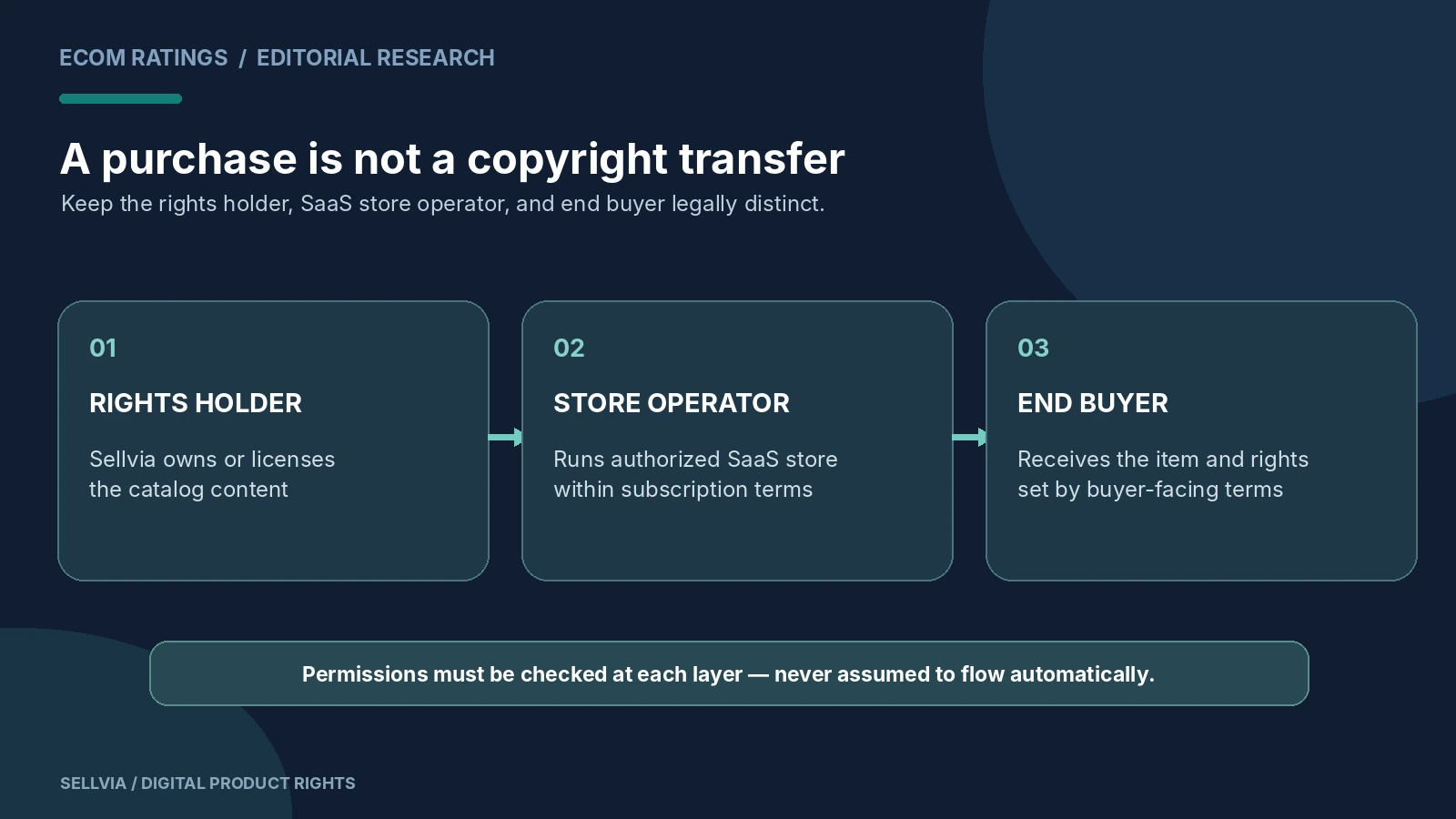
To understand who may do what, keep three layers separate. First, the originator or rights holder controls the underlying digital material. Second, the store operator receives whatever permission the platform gives them to present and sell catalog items under the SaaS arrangement. Third, the end buyer receives the rights stated in the relevant sales terms and product license. A permission at one layer cannot be assumed to be unlimited at the next layer.
For example, permission to promote a licensed eBook through a hosted store is a commercial permission held by the store operator. It does not establish that a person who buys that eBook is entitled to reproduce it for resale. Equally, a buyer may be allowed to read and apply the information in an eBook without gaining copyright in the text itself. These are routine distinctions in digital content licensing, but they are often omitted from simplified product descriptions.
Sellvia’s Terms of Use, in the section on digital products, describe guides, eBooks, courses, and similar informational materials and state that the materials are created by the Sellvia team and that Sellvia holds exclusive rights and/or licenses. The terms do not amount to an all-purpose downstream resale license for every buyer of every catalog item. Before making a specific promise about a particular item, a store operator should check the buyer-facing documents and any item-specific license information available at checkout or delivery.
What purchasing a digital product ordinarily provides
At the minimum, a successful digital sale is supposed to deliver the purchased item or authorized access to it according to its product description. That may mean a downloadable file, a set of resources, or access to a digital course. It is a practical right to receive and use what was advertised, subject to the actual contractual terms and consumer law where applicable. It is not, by itself, a legal assignment of intellectual property.
The distinction is easiest to see with a research guide. The reader pays for advice and can study it, make personal notes, and use the underlying ideas in their own decisions. Copyright protects the original expression of the guide, not every generic business principle discussed inside it. Copying entire chapters into a paid guide of your own is different from learning a concept and applying it. Which forms of copying or adaptation are contractually permitted depends on the license and applicable law.
A downloadable template raises another question. A buyer may reasonably expect to enter their own information into a worksheet to accomplish the task for which it was sold. But permission to complete a template is not the same as permission to upload the blank master template into a competing catalog. A business should describe intended usage specifically rather than borrow blanket legal wording from unrelated marketplaces.
What Sellvia publicly confirms—and what still needs checking
There are two reliable starting points for this topic. Sellvia’s current Terms of Use identify the digital product categories and state its rights position. Sellvia’s official educational material about selling digital products tells sellers to be clear about what buyers receive and whether sharing or resale is permitted. Taken together, those sources support a practical conclusion: do not advertise redistribution or resale rights unless they are expressly supported by the product’s governing license.
They do not establish a universal list of permissions that automatically applies to every eBook, guide, course, or template sold through every hosted storefront. If the buyer-facing page lacks a clear statement on commercial adaptation or redistribution, the safe editorial answer is “verify before doing it”—not “all commercial reuse is forbidden” and not “commercial resale is included.” The applicable product license, store terms, checkout disclosures, and consumer rights must all be considered.
This article addresses Sellvia storefront digital catalog sales; terms belonging to other services are not interchangeable.
A practical permissions matrix for common buyer actions
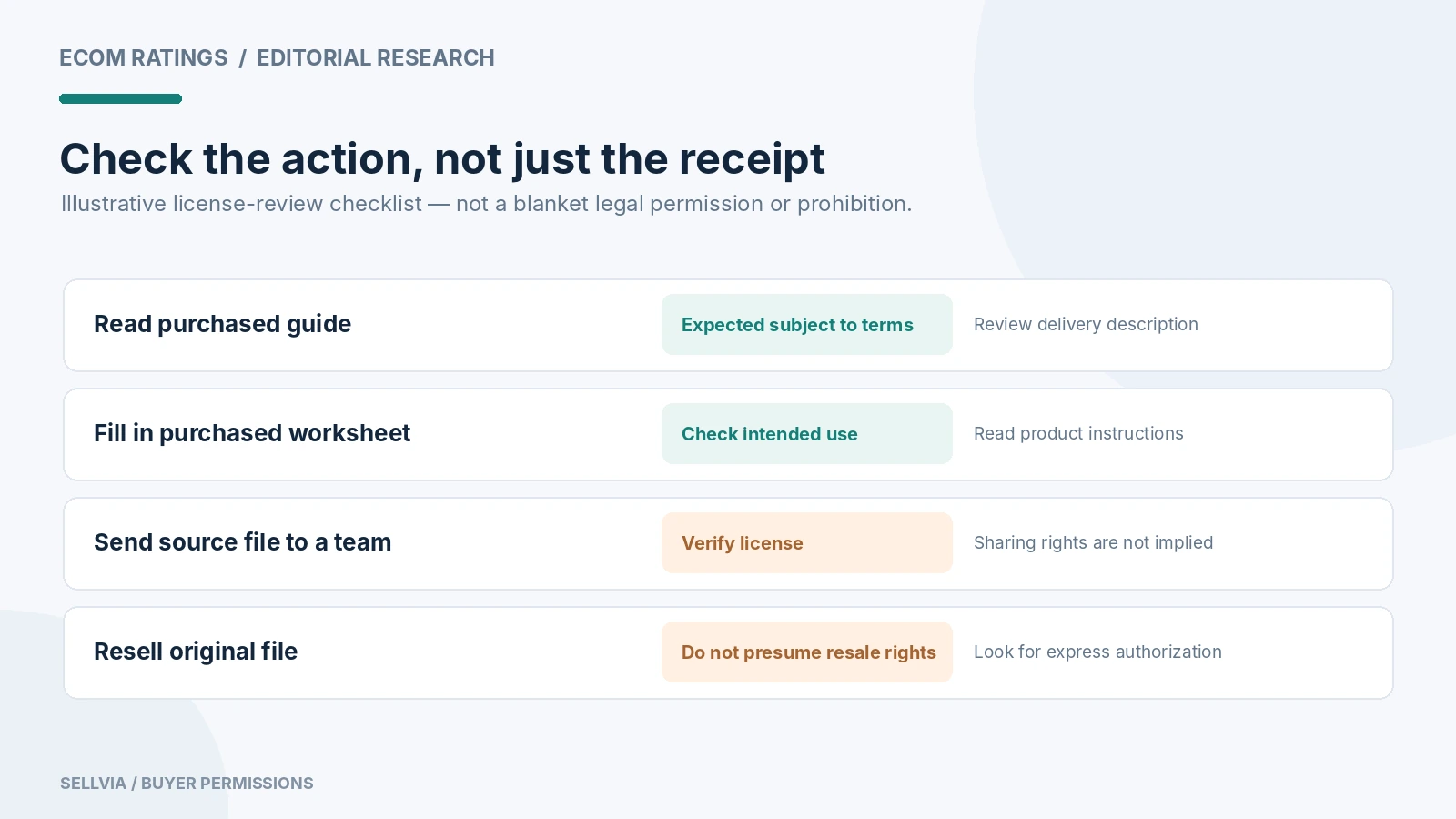
The table below is not a statement of universal Sellvia entitlements. It is a risk-based decision aid: an action can be treated as reasonably expected, requires product-specific verification, or should not be promised without express permission.
| Buyer action | How to approach it | Evidence to check |
|---|---|---|
| Read a purchased guide | Core use normally expected from the sale | Product description and delivery terms |
| Download the purchased item | Confirm whether download is the delivery method | Checkout and account access instructions |
| Print a personal working copy | Check the item license where printing matters | Product-specific permissions |
| Enter personal or business data into a worksheet | Often essential to using the product, but scope varies | The worksheet’s instructions and license |
| Send the original file to coworkers or clients | Do not assume redistribution rights | Explicit sharing or seat terms |
| Publish chapters or lesson files online | Requires rights analysis and often permission | Copyright and redistribution language |
| Repackage a guide into a paid digital product | Do not claim the right without explicit authorization | Resale or derivative-work license |
| Sell an unmodified copy of the original file | Do not treat purchase as a resale license | Express resale rights, if any |
| Create original work after learning from a course | Distinguish ideas learned from copying protected expression | Contractual restrictions and general copyright principles |
The central rule is to describe a right at the level actually documented. “Customers can download the PDF” is different from “customers can resell the PDF.” A store should not slide from one claim to the other simply because both involve a downloadable file.
A worked scenario: the buyer wants to share a template
Imagine a buyer purchases a project-planning template. A colleague asks for the blank template file so the whole team can use it. There are at least three possible rights structures. In one, the license is personal to one purchaser. In another, the item comes with a defined team license. In a third, the seller explicitly permits wider internal distribution. Without checking the license, it is impossible to know which case applies to the specific product.
The store operator should therefore avoid answering “yes” based on what seems convenient. Instead, point the buyer to the product terms or request clarification from the rights holder if the terms are silent. A well-designed product page can prevent the question by stating whether a purchase is for one person, one team, or another defined scope. This is a better customer experience than allowing an ambiguous expectation to harden into a refund dispute later.
If the buyer merely needs to share the result of their work—a completed planning document based on the template—that may be a different issue from redistributing the reusable blank master. The distinction between output and underlying content is useful, but again the specific license determines whether that distinction is enough for permission. Do not invent a broad output license where none is documented.
A second scenario: can a buyer resell the eBook?
This is where plain-language answers matter. Buying a digital guide is not automatically buying its copyright, just as purchasing access to a course does not automatically grant the right to sell recordings of its lessons. A buyer interested in reselling an eBook needs a license that specifically allows the desired distribution and covers relevant restrictions such as attribution, modification, sublicensing, geographic scope, and duration.
If the product terms do not grant those rights, the store should not market the guide as a resale asset. If the rights are available under a special agreement, the store should be able to identify that agreement and its conditions. This is especially important for educational products because someone may be attracted by the subject matter and wrongly infer that the material can be republished as their own instructional package.
Sellvia’s official content guidance warns against selling digital materials that the seller did not create or lacks permission to resell, and encourages clear product descriptions. For an end buyer, the practical takeaway is similar but narrower: a copy received after checkout is not proof of resale authorization. Ask to see the permission, then read what it actually allows.
Commercial use is not the same as redistribution
A product can be useful in a business without being available for commercial republication. A consultant can read a management guide and implement its ideas for a client. A freelancer can follow a workflow explained in a tutorial. A team leader can use a checklist to improve internal processes. None of those examples necessarily involves distributing copies of the purchased work. By contrast, uploading the original checklist for download by customers directly implicates the rights to reproduce and distribute the protected work.
That difference matters because search queries like “can I use Sellvia digital products commercially?” are too broad. Commercial use could mean learning a technique while running a business, filling in a worksheet for a project, displaying a portion of a template, or selling the file itself. Each question requires different license language. A useful FAQ should ask the buyer to describe the intended action, not merely the commercial context.
When reviewing an item’s permission, look for terms such as personal use, internal business use, single user, multi-user, redistribution, derivative works, sublicensing, resale, attribution, or transfer. The absence of one particular label does not always resolve the legal issue. It is a sign that further review may be necessary before promising downstream rights.
What store operators should publish on product pages
A product page should explain exactly what the customer receives, how they access it, and what uses are supported by the governing rights. Keep the delivery statement factual: number and type of downloadable resources, whether the item is a file or course access, and whether updates are included. Separately, provide a concise licensing line or link to the applicable terms. Do not bury a commercially important restriction in a general policy if customers are likely to misunderstand the product.
A strong internal listing checklist includes these questions: Have we identified the rights holder? Is this item part of the authorized Sellvia catalog? Does the official license cover the intended buyer-facing offer? Are sharing and redistribution terms disclosed? Are we implying that the buyer owns the underlying work? Does the copy claim that users can resell, rebrand, or transfer the asset without evidence? Is the delivery method explained? Are support and refund processes clear?
Avoid claims such as “Own this toolkit” if they could falsely suggest transfer of copyright. Link to the exact use and sharing terms instead.
The difference between the SaaS subscriber and the end buyer
Sellvia offers a hosted store and catalog access for a subscription period. In its terms, important intellectual property remains with the platform, and store-related licenses are limited rather than outright transfers of all assets. For a seller, this matters because an authorized storefront does not automatically become a repository of independently owned source materials. Access to products can depend on the continuing platform arrangement.
For the end buyer, the key issue is different: what was actually purchased through the store, which delivery and use terms apply, and what happens when access changes. The seller should not conflate its own limited subscription rights with the buyer’s entitlement to receive an item already purchased. If the store later closes, the treatment of an existing buyer’s access depends on the applicable contract and delivery mechanism; one should not promise indefinite hosted access unless it is part of the documented offer.
Store owners should keep product identifiers, purchase confirmations, delivery records, and copies or references to the applicable license version. This record supports honest buyer communication if someone later asks whether a file may be redistributed or whether the purchased access is still available.
Rights questions that often become chargebacks
Many licensing disputes begin as ordinary customer-service problems. The buyer expected an editable source file but received a PDF. They thought the purchase included access for an entire team. They believed the template came with resale rights. Or the product page used “lifetime” casually without identifying what that meant. These disputes may arise even if the file was delivered correctly.
A business can reduce them by matching four things: the sales page, the checkout disclosure, the delivery interface, and the product license. If one says “personal use” and another says “resell unlimited copies,” that contradiction must be corrected before promoting the item. Keep an evidence trail of the buyer-facing text in effect at purchase, but handle personal data responsibly and avoid storing sensitive details beyond what is needed.
A buyer who raises a licensing question should receive a concrete explanation, with a citation to the relevant term. Vague assurances about owning the product rarely solve the problem. If the policy is silent, the honest answer is to verify rather than invent permission or threaten the buyer with an unsupported prohibition.
A buyer checklist before sharing or repurposing content
1. Identify the exact item. A title alone may not distinguish versions or bundles. Save the purchase receipt and product identifier.
2. Read the licensing text. Search for ownership, permitted use, copying, modifications, transfer, distribution, and resale. If the link is unclear, request the relevant terms.
3. Define the proposed action. “I want to use this at work” is too vague; “I want to email the original worksheet to 12 coworkers” gives the rights holder something specific to evaluate.
4. Separate the original from your output. Using the ideas in an instructional guide is different from copying its text or distributing its source files. Decide which situation applies.
5. Ask about additional seats or licenses. If broader sharing is needed, a properly authorized license is better than relying on assumption.
6. Retain the answer. Save any written clarification that specifically identifies the product and intended use. Avoid making decisions based on an unrelated help page about a different product.
7. Recheck before resale. If your plan changes from internal use to commercial distribution, reassess the permission. A license for personal or internal work is not automatically a reseller agreement.
Editorial limits: what this article does not claim
The current public sources reviewed do not provide a universal, item-by-item license matrix for every digital product sold through every Sellvia customer storefront. Consequently, this guide does not claim that every buyer can print, share, rebrand, sublicense, or resell all purchased files, nor does it claim that every such act is invariably forbidden. It explains the verification method and distinguishes documented platform ownership from product-specific rights.
Overclaiming buyer rights can create disputes even when the underlying catalog is legitimate.
Bottom line
Sellvia’s digital catalog makes it possible to run a store offering guides and other informational products within a SaaS model. But the existence of a storefront and a completed purchase does not erase the difference between receiving content and owning its copyright. Sellvia’s terms establish a rights framework at the platform level. A buyer’s freedom to share, adapt, or resell a specific product must be supported by the relevant license and buyer-facing terms.
For broader commercial context, see Sellvia Pricing Rules: What Happens Before and After You Pay and Sellvia vs Gumroad. This guide addresses only the legal and practical use of purchased digital materials, not platform pricing or its overall value.
Primary sources and methodology
- Sellvia: Terms of Use, digital products and intellectual property
- Sellvia: Selling digital products and describing buyer permissions
Editorial method: This article separates statements explicitly supported by Sellvia’s published documents from general rights-analysis principles and clearly labeled illustrative scenarios. It is informational, not legal advice or an item-specific license interpretation. Sources reviewed October 26, 2026.